WHAT WE LEARNED
We learned so much through the findings from the analysis of the APS Standardized Intake Decision Tool, especially regarding APS outcomes for people who are vulnerable and reported as abused, neglected, or financially exploited. Thank you to the many APS professionals who participated in the study through focus groups, supervisor interviews, or serving on the MACSSA Stakeholder group. As the individuals leading the use of the intake tool to conduct screening on APS for vulnerable adults suspected of experiencing maltreatment, your participation was critical. The consultants relied on your input and feedback throughout the study to vet the hypothesis, review data to inform data and systems analysis, and provide feedback on the preliminary recommendations.
The findings and recommendations resulting from this study provide an important map for how to improve service outcomes for people in Minnesota. The recommendations identify how we can make improvements to consistency and service response so APS screening service decisions can be understood by reporters, our communities, and the people referred to APS by the Minnesota Adult Abuse Reporting Center (MAARC) as suspected of experiencing abuse, neglect, or financial exploitation.
The most significant take away from the evaluation and recommendations is that the use of discretionary overrides based on local prioritization guidelines is the basis of inequity and inconsistency in outcomes for people who are vulnerable and reported as suspected of experiencing maltreatment.
Immediate improvements to equity and consistency in outcomes for vulnerable adults in the APS system can be made by following the SDM® tool guidance when making intake screening decisions.
The cause of MN’s high screen out rate was identified not as too many maltreatment reports of poor quality or too many reports being received for people that didn’t meet APS policy criteria, but instead that many people meeting policy criteria to screen-in for APS are being screened out through a discretionary override based on county prioritization guidelines. People who meet criteria for APS under the VAA are not accepted for APS due to a decision based in the county’s Prioritization guidelines, not state policy. The MN APS SDM Tool Evaluation Final Report found that people who otherwise met policy criteria as a vulnerable adult who may have been maltreated and were screened in for APS using the SDM® Intake Tool, were ultimately screened out by APS using a local discretionary override. The study also found that discretionary overrides were used more often for Minnesotans who are Black and for Minnesotan’s who have chemical dependency based disability. The evaluation found that APS following the intake tool guidance, and not applying a discretionary override to the original screening decision, would result in a similar screening rate in Minnesota (59%) as the rest of the nation (62%) instead of the 24% APS final client acceptance screen-in rate.
Kathy Greenlee, Senior Director, representing ADvancing States as a partner to Guidehouse in this project (Kathy is former U.S. Assistant Secretary for Aging, former Kansas Secretary of Aging, National Council on Aging Board of Directors) addressed concerns regarding the types of calls APS receives in Minnesota and who is reporting to APS:
"The types of calls that are coming in to APS in Minnesota are the types of calls that are coming in to APS everywhere. [. . .] I think that there is a unique issue that has surfaced with regard to the use of the override and how cases are being worked at intake, not just pure intake."
-Kathy Greenlee
The study did not identify that there are too many reports for people that don’t qualify for APS in Minnesota. The number of reports meeting policy criteria in Minnesota aligns with national reporting data. Data analysis shows Minnesota does not have a need for public awareness to decrease “inappropriate reports.” We have a need to increase the capacity of our APS programs to offer services for the people reported.

NEXT STEPS
We recognize the evaluation of Minnesota’s APS standardized intake decision tool for validity in screening decisions has raised concerns throughout APS of what these findings mean for vulnerable adults referred to our APS system as suspected of experiencing abuse, neglect, or financial exploitation.
DHS is evaluating the study recommendations regarding statewide consistency, equity, and person-centered outcomes for vulnerable adults. We also encourage all stakeholders, including counties responsible for APS, to take time to analyze the meaning of these findings for impacts on vulnerable adults as well as the APS system. As part of our evaluation of the findings, DHS is looking at our technical assistance, training, and policy guidance as well as resource needs for planning to enhance the state’s APS system at the state and local levels.
DHS is working with MACSSA and other stakeholders and policy makers to establish an agreed upon vision for APS’s role in the state’s social services continuum and establish goals for person-centered outcomes consistent with guidance from the Administration for Community Living (ACL) – including time frames for screening decisions, equity, and state wide consistency – and will work with partners to evaluate APS’s resource needs in order to improve service outcomes for vulnerable adults consistent with the state’s vision for the vulnerable adult protection system.
It is easy to imagine your deep desires for justice, dignity, and healing for all vulnerable people were activated through the findings and recommendations from this project. Racial inequities, disparities for people who are challenged with chemical dependency, and inconsistencies in outcomes for people who are vulnerable are not issues for just a few counties - they are statewide issues and require a statewide response.
We all know that serving more people reported/referred for APS requires resources. We need to work together to identify desired outcomes and the resources needed to support those outcomes. Your advocacy is important.
From the Adult Protection Unit at DHS, thank you to all of you who work to prevent maltreatment, improve safety, and respect people’s rights by offering services, engaging, and supporting people who are vulnerable as well as their families and communities. There is a lot for us to work on together and each of us is the right person to do it.
|
MACSSA and DHS are establishing two working groups to strengthen the state’s system for supporting vulnerable adults reported as abused, neglected, or exploited and referred to adult protective services (APS). The first group, APS Visioning Team, will start meeting in November and is intended to be short term, meeting approximately 8 times over 4-5 months. The second group, MACSSA/DHS Working Group, is a longer-term joint entity with shared commitment to develop and monitor outcomes from the policy, system, resources, and to identify changes necessary to create meaningful and mutually supported change throughout the state's APS system.
The Visioning Team will be facilitated by Stacy Sjogren, Senior Consultant, Management Analysis and Development (MAD/MMB), and will serve as a primary stakeholder for development of a mission, vision, and performance outcomes for vulnerable adults served by APS. The vision will be grounded in values identified by community and institutional stakeholders in the Vulnerable Adult Act Redesign and outcomes will be informed by the ACL Voluntary Consensus Guidelines and recommendations from the APS Standardized Intake Tool Evaluation.
The Visioning Group will also serve as a stakeholder for the strategic operational plan DHS is required to submit to the Administration for Community Living (ACL) by January 31,2021 under the American Rescue Plan Act (ARPA) formula grant funds for adult protective services (APS). APS Operational Plans - including a vision, mission, and values - are being developed and submitted to ACL by every US state and territory. The vision for vulnerable adults will guide agreed upon outcomes and ARPA resources.
The charter developed by the APS Visioning Team will define the MACSSA/DHS Working Group’s vision, mission, values, and performance outcomes; all of which are focused on improving statewide consistency and equity in person-centered outcomes for vulnerable adults served through the state’s APS programs. The MACSSA/DHS Working Group is intended to strengthen the partnership between DHS, in the agency’s duty to supervise the adult protection system, and counties, in their duty to administer adult protective services programs.
APS Visioning Team:
- Amber Webb, Program Manager, Adult Protective Services, Hennepin County
- Barb Dietz, Director, Brown County Human Services
- Berit Spors, Health and Human Services Director, McLeod County
- David Vukelich, Adult Protection Supervisor, St. Louis County
- Mary McGurran, Adult Protection Supervisor, Aging and Adult Services, DHS
- Melissa Vongsy, Human Services Program Consultant, Adult Protection, DHS
- Rachel Shands, Manager, Home and Community Based Services, DHS Aging and Adult Services (delegate for Kari Benson, Director, DHS Aging and Adults Services, Executive Director Minnesota Board on Aging)
- Sarah Jones, Support Planning Supervisor (delegate for Natasha Merz, Director, DHS Disability Services Division)
Data help policy makers and the public understand the nature and scope of an issue. In the case of adult protection, data provide a basis to understand if vulnerable adults are treated fairly and justly in our state. Data can impact program evaluation, benchmarks for quality and performance outcomes, budget planning and resource allocation, and inform evidenced based prevention and remediation/service response for vulnerable adults who have been maltreated.
“Without data, you're just another person with an opinion."
― W. Edwards Deming
The Vulnerable Adult Protection Dashboard provides annual state and county data on the number of reports, allegations, and investigation determinations. The dashboard explains what happens after reports of suspected maltreatment of a vulnerable adult are made to the Minnesota Adult Abuse Reporting Center (MAARC).
The image below shows slide 12, "Screening Decision Analysis," from the November 4, 2021 presentation hosted by MEJC titled, "Evaluation of Adult Protective Services Standardized Intake Assessment Tool - Findings and Recommendations."
The left side of the slides shows screening decision data totals when using the APS Standardized Intake Assessment Tool; the right side of the slide shows screening decision data totals after discretionary overrides are applied.
59% of initial APS reports are screened in using the APS Standardized Intake Assessment Tool; and, 24% of initial APS reports are ultimately screened in for APS service assessment and investigation after discretionary overrides are applied.
As stated in the bottom box on the slide, Minnesota screens out 75.8 percent of initial APS reports, while the national average is 37.7% screen out rate based on the National Adult Maltreatment Reporting System 2019 Report.
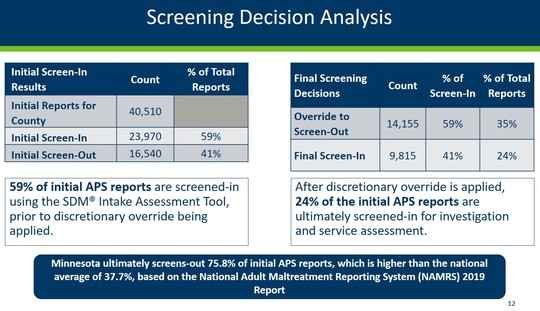 Kathy Greenlee, Senior Director, representing ADvancing States as a partner to Guidehouse in this project (Kathy is former U.S. Assistant Secretary for Aging, former Kansas Secretary of Aging, National Council on Aging Board of Directors) characterized the information on the slide as follows:
"The left side is not alarming, and the right side is alarming, because of what you have in the bottom box. [. . .] Minnesota starts close to the (national numbers), and it’s really [. . .] about what happens at the county level, which I view as being process that results in bad outcomes. But Minnesota doesn’t get everything wrong, we start out here really pretty close to what the national averages are showing us. It’s a process that happens, calls come in in every state and calls are screened out and you are just like everybody else. You’re in that pack. What we do next is talk about the impact once you take this to the county level and what we are hoping to do in the future to figure that out in a different way."
-Kathy Greenlee
APS Foundations
APS Foundations provides a basic introduction to the adult protection system in Minnesota. APS Foundations focuses on fundamental elements of Minnesota's adult protection system such as statutes and definitions, Minnesota Adult Abuse Reporting Center (MAARC), Lead Investigative Agencies (LIAs) and jurisdiction, the Adult Protection service cycle and time frames from intake to case closure, and much more.
APS Foundations is intended for new adult protection workers and supervisors, or adult protection workers and supervisors seeking a refresher. APS Foundations supports equity and consistency in service response and outcomes that safeguard and promote dignity for vulnerable adults, regardless of their location in Minnesota, and addresses core competency training recommendations in the ACL Voluntary Consensus Guidelines for State APS Systems.
APS Foundations is offered online and consists of four 2 hour sessions over four consecutive weeks (8 hours total). Attendees will need to complete all four sessions to receive a certificate of completion. APS Foundations dates are set up to precede SSIS Worker Training dates as much as possible. Therefore, APS workers have the option to attend policy (Foundations) and systems (SSIS) trainings sequentially.
Upcoming APS Foundations Cohorts (registration is for all four dates of a cohort):
- Jan 18 and 25, Feb 1 and 8, 2022 (Tues) 10:00 a.m. to 12:00 p.m. | Click Here to Register
- Mar 10, 17, 24, and 31, 2022 (Thurs) 10:00 a.m. to 12:00 p.m. | Click Here to Register
- May 12, 19, 26, and Jun 2, 2022 (Thurs) 10:00 a.m. to 12:00 p.m. | Click Here to Register
Please contact us at dhs.adultprotection@state.mn.us if you have any questions.
SSIS Adult Protection Worker Training
The SSIS Adult Protection Worker course is a technical training designed to provide an overview of data entry as related to Adult Protective Services (APS) into SSIS. The training is offered in two half-day virtual classes and is designed for new adult protection workers, SSIS Mentors, and those seeking a refresher. More information can be found on the SSIS Adult Protection Worker Training website.
Upcoming SSIS Adult Protection Worker Training:
- Jan 10 and 13, 2022 (Mon and Thurs) 9:00 a.m. to 12:30 p.m.
- Feb 14 and 17, 2022 (Mon and Thurs) 9:00 a.m. to 12:30 p.m.
- Apr 11 and 14, 2022 (Mon and Thurs) 9:00 a.m. to 12:30 p.m.
- Jun 6 and 9, 2022 (Mon and Thurs) 9:00 a.m. to 12:30 p.m.
Please visit the SSIS Adult Protection Worker Training website for registration instructions, additional resources, and more detailed information about the course.
SSIS Essentials eLearning
SSIS Essentials is a collection of six eLearning courses designed to provide caseworkers with an introduction to basic navigation and functionality of core SSIS functions. SSIS Essentials eLearning is offered through TrainLink. New workers are encouraged (not required) to take the online SSIS Essentials eLearning courses prior to taking SSIS Adult Protection Worker training.
Please visit the SSIS Essentials eLearning website for registration and TrainLink instructions, technical requirements, and more detailed information about each of the six SSIS Essentials courses.

APS Technical Assistance and Resource Center (TARC)
APS TARC provides a variety of no-cost educational opportunities for APS professionals including webinars, briefs, and toolkits that align with APS Core Competencies in national standards. APS TARC offerings address a wide variety of topics including APS supervision, frauds and scams, interviews with experts, APS investigation, impacts of COVID-19 on APS, and much much more. Keep up to date with APS TARC offerings by joining their mailing list.
|
Additional Practice Resources
Find information on adult protection policy, procedure, resources, and training information for mandated reporters and APS on the DHS Adult Protection: Policies and Procedures web page. Specific training resources for APS workers are included under the "Adult protection worker resources and training" drop down. These resources support APS workers meeting education requirements under 626.557 Subd. 9e.
Our goal for the DHS Adult Protection Newsletter is to share knowledge specific to adult protection work in Minnesota, answer common questions regarding adult protection work in Minnesota, and provide awareness of DHS Adult Protection training opportunities. Please contact us with any questions or concerns at dhs.adultprotection@state.mn.us or (651) 431-2609
For more information about DHS Adult Protection, please visit us online DHS AP: Program Overview

|