|
Thank you to all who attended the October 20th webinar for APS professionals presented by Guidehouse, Inc., on behalf of MN DHS, regarding the findings and recommendations to improve statewide consistency, equity, and outcomes for vulnerable adults from the "Evaluation Report of Adult Protective Services Standardized Intake Decision Tool."
If you were unable to participate on October 20th, we are offering the presentation again! MN DHS Adult Protection Unit has partnered with the Minnesota Elder Justice Center (MEJC) to present the webinar again for the general public from 1:00 pm - 2:30 pm on November 4th, 2021.
 |
|
Findings and Recommendations to Improve Statewide Consistency, Equity, and Outcomes for Vulnerable Adults (90 Minutes)
November 4, 2021
1:00 pm - 2:30 pm
Cost: Free
Click here to register
|
The National Adult Maltreatment Reporting System (NAMRS) recently released the 2020 Adult Maltreatment Report.
The annual Adult Maltreatment Report provides an overview of adult maltreatment as reported to APS programs. The goal of NAMRS is to collect consistent and accurate national data on investigations and services from APS programs to better understand adult maltreatment in the U.S. as investigated by APS. All states participate in NAMRS.
NAMRS is a comprehensive, national reporting system for state APS programs, funded by the Administration for Community Living (ACL). NAMRS is one of many activities undertaken by ACL to build public and professional understanding about adult maltreatment and strengthen the social supports needed to prevent it.
|

APS Technical Assistance Resource Center (TARC) recently released a brief titled, "COVID-19 Fraud and Scams: What APS Needs to Know." APS TARC briefs offer a synopsis of information on specific topics and include links for additional information. "COVID-19 Fraud and Scams: What APS Needs to Know" includes background on how scammers appeal to vulnerable populations, including four signs that it is a scam, common types of fraud and scam associated with the COVID-19 pandemic, and resources for more information.
The APS TARC serves as a focal point for the Administration for Community Living's (ACL's) overall approach to leading the development of comprehensive APS systems. Keep up to date with APS TARC offerings by joining their mailing list.
|
Data help policy makers and the public understand the nature and scope of an issue. In the case of adult protection, data provide a basis to understand if vulnerable adults are treated fairly and justly in our state. Data can impact program evaluation, benchmarks for quality and performance outcomes, budget planning and resource allocation, and inform evidenced based prevention and remediation/service response for vulnerable adults who have been maltreated.
“Without data, you're just another person with an opinion."
― W. Edwards Deming
The Vulnerable Adult Protection Dashboard provides annual state and county data on the number of reports, allegations, and investigation determinations. The dashboard explains what happens after reports of suspected maltreatment of a vulnerable adult are made to the Minnesota Adult Abuse Reporting Center (MAARC).
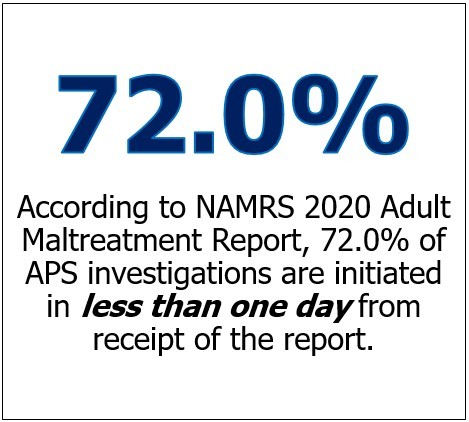
The image below shows that according to the federal Administration for Community Living (ACL) National Adult Maltreatment Reporting System (NAMRS) 2020 Adult Maltreatment Report, 72.0% of APS investigations in the United States are initiated in less than one day from receipt of the report. For comparison to the national data, Minnesota requires intake decisions be made within 5 days. NAMRS defines Investigation Initiation as the length of time from receipt of the report until the start of the investigation.
NAMRS 2020 Adult Maltreatment Data Report, page 15, Exhibit 2.8: Time to Initiation

DHS Adult Protection Resource Specialists (APRS) support adult protective services (APS) workers and supervisors with policy clarification and case consultation regarding intake, assessment, service intervention, and investigative outcomes for the safety and dignity of vulnerable adults reported as having experienced maltreatment. Connect with your APRS today at dhs.adultprotection@state.mn.us or (651) 431-2609.
APRS Quick Tip - Documenting Interventions at Close
APS engages the vulnerable adult and their supports in assessment and safety planning, and carries that person centered engagement through to service interventions. Closing the assessment with the person as "safe" or "conditionally safe" usually requires implementation of interventions, either by the worker themselves to help the person and their supports identify and plan to prevent maltreatment, or through referrals for interventions outside of APS.
Interventions are entered in the AMR on the last tab in the Assessment Workgroup. Interventions and referrals offered/provided to stop, reduce, or prevent maltreatment are identified here.
Engagement can include identifying the person’s preferences, providing options for service interventions, and exploring barriers to successfully implement interventions including past trauma and the need for cultural/racial appropriate service interventions.
And as always, you can call your APRS to consult if you have any questions!
|
APS Technical Assistance and Resource Center (TARC)
APS TARC, funded by the Administration for Community Living (ACL), provides a variety of no-cost educational opportunities for APS professionals including webinars, briefs, and toolkits that align with APS Core Competencies in national standards. APS TARC offerings address a wide variety of topics including APS supervision, frauds and scams, interviews with experts, APS investigation, impacts of COVID-19 on APS, and much much more.
The APS TARC serves as a focal point for the ACL's overall approach to leading the development of comprehensive APS systems. Keep up to date with APS TARC offerings by joining their mailing list.
APS Foundations
APS Foundations provides a basic introduction to the adult protection system in Minnesota. APS Foundations focuses on fundamental elements of Minnesota's adult protection system such as statutes and definitions, Minnesota Adult Abuse Reporting Center (MAARC), Lead Investigative Agencies (LIAs) and jurisdiction, the Adult Protection service cycle and time frames from intake to case closure, and much more.
APS Foundations is intended for new adult protection workers and supervisors, or adult protection workers and supervisors seeking a refresher. APS Foundations supports equity and consistency in service response and outcomes that safeguard and promote dignity for vulnerable adults, regardless of their location in Minnesota, and addresses core competency training recommendations in the ACL Voluntary Consensus Guidelines for State APS Systems.
APS Foundations is offered online and consists of four 2 hour sessions over four consecutive weeks (8 hours total). Attendees will need to complete all four sessions to receive a certificate of completion. APS Foundations dates are set up to precede SSIS Worker Training dates as much as possible. Therefore, APS workers have the option to attend policy (Foundations) and systems (SSIS) trainings sequentially.
Upcoming APS Foundations Cohorts (registration is for all four dates of a cohort):
- Nov 9, 16, 23, and 30, 2021 (Tues) 10:00 a.m. to 12:00 p.m. | Click Here to Register
- Jan 18 and 25, Feb 1 and 8, 2022 (Tues) 10:00 a.m. to 12:00 p.m. | Click Here to Register
- Mar 10, 17, 24, and 31, 2022 (Thurs) 10:00 a.m. to 12:00 p.m. | Click Here to Register
- May 12, 19, 26, and Jun 2, 2022 (Thurs) 10:00 a.m. to 12:00 p.m. | Click Here to Register
Please contact us at dhs.adultprotection@state.mn.us if you have any questions.
SSIS Adult Protection Worker Training
The SSIS Adult Protection Worker course is a technical training designed to provide an overview of data entry as related to Adult Protective Services (APS) into SSIS. The training is offered in two half-day virtual classes and is designed for new adult protection workers, SSIS Mentors, and those seeking a refresher. More information can be found on the SSIS Adult Protection Worker Training website.
Upcoming SSIS Adult Protection Worker Training:
- Oct 11 and 14, 2021 (Mon and Thurs) 9:00 a.m. to 12:30 p.m.
- Jan 10 and 13, 2022 (Mon and Thurs) 9:00 a.m. to 12:30 p.m.
- Feb 14 and 17, 2022 (Mon and Thurs) 9:00 a.m. to 12:30 p.m.
- Apr 11 and 14, 2022 (Mon and Thurs) 9:00 a.m. to 12:30 p.m.
- Jun 6 and 9, 2022 (Mon and Thurs) 9:00 a.m. to 12:30 p.m.
Please visit the SSIS Adult Protection Worker Training website for registration instructions, additional resources, and more detailed information about the course.
SSIS Essentials eLearning
SSIS Essentials is a collection of six eLearning courses designed to provide caseworkers with an introduction to basic navigation and functionality of core SSIS functions. SSIS Essentials eLearning is offered through TrainLink. New workers are encouraged (not required) to take the online SSIS Essentials eLearning courses prior to taking SSIS Adult Protection Worker training.
Please visit the SSIS Essentials eLearning website for registration and TrainLink instructions, technical requirements, and more detailed information about each of the six SSIS Essentials courses.
Additional Practice Resources
Find information on adult protection policy, procedure, resources, and training information for mandated reporters and APS on the DHS Adult Protection: Policies and Procedures web page. Specific training resources for APS workers are included under the "Adult protection worker resources and training" drop down. These resources support APS workers meeting education requirements under 626.557 Subd. 9e.
Our goal for the DHS Adult Protection Newsletter is to share knowledge specific to adult protection work in Minnesota, answer common questions regarding adult protection work in Minnesota, and provide awareness of DHS Adult Protection training opportunities. Please contact us with any questions or concerns at dhs.adultprotection@state.mn.us or (651) 431-2609
For more information about DHS Adult Protection, please visit us online DHS AP: Program Overview

|