-- Nick Vega Puente, DHS
Problem gambling negatively affects individuals, families, and communities in Minnesota.
The behavior patterns associated with problem gambling compromise relationships, education and vocational opportunities, personal and financial well-being, substance use, emotional stability, physical health, and housing.
The Behavioral Health Division at DHS administers a program that funds awareness and education campaigns and a statewide helpline. It also funds residential and non-residential treatment for problem gambling, professional training opportunities and research designed to address the needs of those experiencing problem gambling.
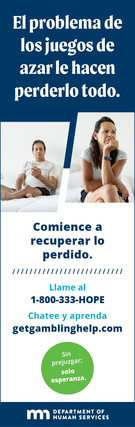
With Problem Gambling Awareness Month just around the corner, in March, we are highlighting a new statewide awareness initiative – the Problem Gambling Culturally Specific Awareness Initiative.
Through this initiative, we are getting the word out about the harmful effects of problem gambling in ways that are most understandable to and likely to be well received by the different communities that live in Minnesota.
Many of our culturally specific communities, which include our racial and ethnic communities, have been marginalized far too long and forgotten when it comes to health and equity, despite our efforts to reach all Minnesota communities. As a result, state data related to behavioral health continue to show disparities among these populations and don’t seem to be getting any better today as this relates to the COVID-19 pandemic. While data is limited on the prevalence of problem gambling among culturally specific communities, Minnesota did complete a health and wellness survey regarding problem gambling in 2020.
The Problem Gambling Culturally Specific Awareness Initiative has allowed DHS/BHD the opportunity to partner with community- and culturally-based organizations to help us reach their respective communities – because a one-size-fits-all approach to reaching all communities is not an effective strategy. We know from other behavioral health initiatives that positive outcomes are more likely, when we educate, engage and empower communities to drive toward their own destiny. We also know that the more buy-in that is established and the more relationships and collaborations are established, the more likely partnerships will be sustained over time, long after a grant expires. In short, capacity is about sharing and growing knowledge and hope for health and wellness in all communities.
Our partners in this initiative: Asian Media Access, Minneapolis; Progressive Individual Resources, St. Paul; Lao Assistance Center of Minnesota, Minneapolis; Neighborhood Youth Academy, Minneapolis; and Russell Herder, Minneapolis.
Nick Vega Puente is manager of the Promotion, Prevention and Infrastructure Development Unit, Behavioral Health Division, Minnesota Department of Human Services.
|