|
Please to continue to use sub-service code 87- COVID-19 Related during the COVID-19 peacetime emergency period for targeted case management and waivered services.
DHS Bulletin 20-56-10 LTSS policy amendments related to COVID-19 peacetime emergency was issued September 14th, 2020 and defines policies related to the administration and management of Long-Term Services and Supports (LTSS) that have been amended temporarily for the duration of the COVID-19 peacetime emergency.
- Allow LTSS assessments and reassessments to be conducted remotely (this was also communicated in the March 23, 2020, eList: COVID-19 emergency protocol updates for the DHS disability Services and Aging and Adult Services divisions)
- Allow case management visit requirements to be conducted remotely. (This also was communicated in the April 6, 2020, eList: COVID-19 emergency protocol for case management visits)
- Waive document and signature requirements
This will allow Minnesota’s lead agencies (counties and tribal nations) to continue providing essential programs and services to people who receive services safely and without undue delay during the COVID-19 pandemic.
An intermittent technical issue has been discovered that impacts approximately 6% of email notifications made by MAARC to law enforcement agencies, medical examiners and the Ombudsman for Mental Health and Developmental Disabilities (OMHDD). The date this issue initiated is unknown. This issue results in e-mail notifications to these agencies appearing as sent in the Social Services Information System (SSIS), but not transmitting out of the state system to complete notification to the recipient. The cause of the issue has not yet been able to be identified.
Daily technical audit is now being performed for emails notifications. Reports impacted by this issue are resent within 24 hours. Remediation for reports impacted by this issue August 1-September 17, 2020 has been completed with impacted reports resent. Efforts continue to identify and remediate notifications which failed prior to August 1, 2020
County APS initiating coordination with law enforcement, medical examiners and OMHDD in response to a MAARC report, when the MAARC report referral tab indicates notification to any of these agencies, mitigates risks to that agency’s investigation.
A new FASD screening requirement was approved in legislation this spring:
Subd. 7. Prenatal alcohol exposure screening. (a) The responsible social services agency shall coordinate a prenatal alcohol exposure screening for any child who enters foster care as soon as practicable but no later than 45 days after the removal of the child from the child's home, if the agency has determined that the child has not previously been screened or identified as prenatally exposed to alcohol.
This screening requirement applies for children who entered foster care on or after August 1, 2020. The FASD screening is not in SSIS and can be accessed through Proof Alliance, as well as all training related to this new requirement.
Initial information about the new requirement to complete a FASD screening for some children in out-of-home placement can be found in the Overview of 2020 child welfare legislation, DHS Bulletin #20-68-25. DHS will make more information available soon.
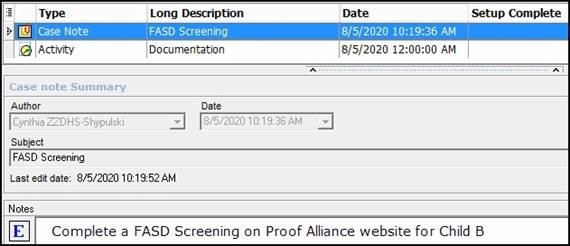
We recommend workers document the completion of FASD Screenings in a Case Note in SSIS Chronology. Enter “FASD Screening” as the Subject. Other relevant information should be entered in the Notes section.
Registration is open for September’s SSIS Coffee Talk Tuesday for Mentors. All SSIS mentors are welcome! Questions are appreciated in advance and should be directed to the SSIS Help Desk.
Date: Tuesday, Sept. 29 at 9 a.m.
Topic: MAPCY post permanency
Register in advance at: https://umn.zoom.us/webinar/register/WN_K6Udi38uQx6VvaEFZueWsA
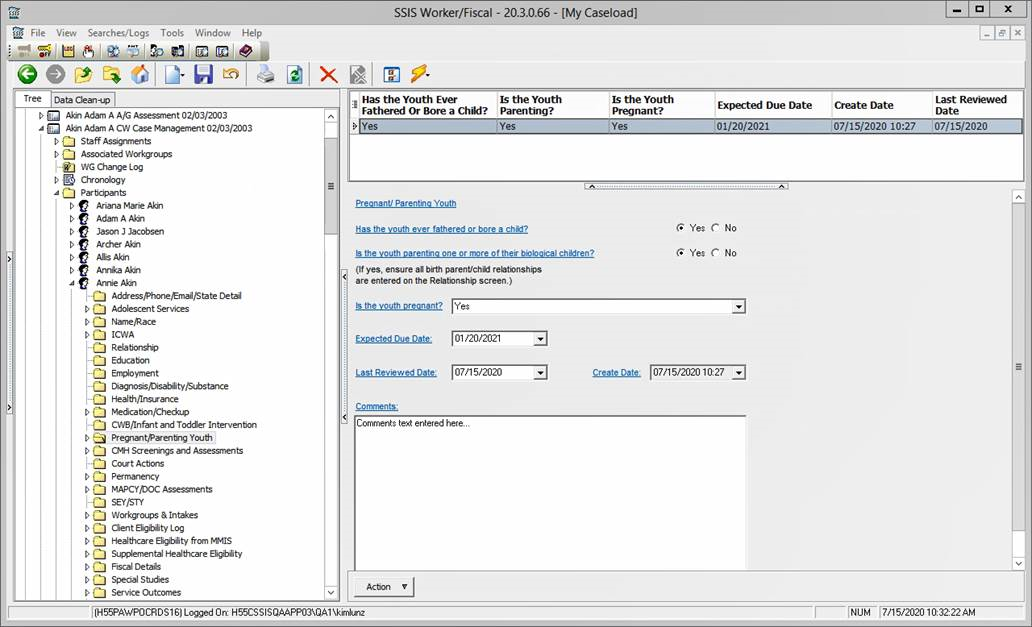
A new Pregnant and Parenting Youth (PPY) Screen was released in SSIS on Aug. 26. As of Sept. 1, this screen is required (OR must be completed) for all youth in care who are age 10 or older. See the screenshot below and the PPY Help Text job aide.
The SSIS claiming interface will be unavailable Oct. 1 and 2 for MN-ITS annual password updates, which will allow claiming interfaces to continue between SSIS and MMIS. The effect on agencies should be minimal. Normal operation of the claiming interface will resume Monday, Oct. 5. If issues arise after that time, contact the SSIS Help Desk.
Please note: This process only changes SSIS user accounts for county MN-ITS mailboxes. Agency users have their own user IDs and passwords to access their MN-ITS mailboxes that are not affected by the SSIS password change. Heide Moris, SSIS mentor coordinator, will send out a reminder prior to Oct. 1 and will give the all clear when the process is complete.
Several tutorials related to SSIS Admin have recently been updated. A new tutorial, How to Add, Edit, Delete Roles in SSIS is posted and ready for review on the SSIS Worker Documentation Page under Admin.
The Minnesota Child Welfare Training Academy (MNCWTA) is now accepting applicants for Research and Evaluation Supervisor and Curriculum Developer. Visit the MNCWTA website for more information about these positions along with application instructions.
The Family First and Prevention Services Act (FFPSA) requires that all staff working in a Title IV-E Group Children’s Residential Facility (CRF) receive fingerprint-based “Adam Walsh” background checks in order to meet Title IV-E child safety requirements.
To assist counties and initiative tribes with claiming Title IV-E reimbursements for these placements, we will periodically update the list of facilities that have met the background checks safety requirements.
Click here for an updated list of facilities in compliance
|