|
|
|
|
|
|
In this issue:
Juneteeth
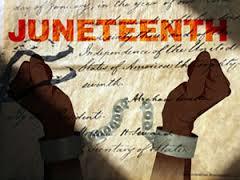
“The people of Texas are informed that, in accordance with a proclamation from the Executive of the United States, all slaves are free. This involves an absolute equality of personal rights and rights of property between former masters and slaves, and the connection heretofore existing between them becomes that between employer and hired labor. The freedmen are advised to remain quietly at their present homes and work for wages. They are informed that they will not be allowed to collect at military posts and that they will not be supported in idleness either there or elsewhere.” —General Orders, Number 3; Headquarters District of Texas, Galveston, June 19, 1865
When Maj. Gen. Gordon Granger issued the above order, he had no idea that, in establishing the Union Army’s authority over the people of Texas, he was also establishing the basis for a holiday, “Juneteenth” (“June” plus “nineteenth”), today the most popular annual celebration of emancipation from slavery in the United States. After all, by the time Granger assumed command of the Department of Texas, the Confederate capital in Richmond had fallen; the “Executive” to whom he referred, President Lincoln, was dead; and the 13th Amendment abolishing slavery was well on its way to ratification.
Read more information on Juneteeth online
|

LGBTQIA Pride Month
Lesbian, Gay, Bisexual, Transgender and Queer (LGBTQ) Pride Month is currently celebrated each year in the month of June to honor the 1969 Stonewall Uprising in Manhattan. The Stonewall Uprising was a tipping point for the Gay Liberation Movement in the United States. In the United States the last Sunday in June was initially celebrated as "Gay Pride Day," but the actual day was flexible. In major cities across the nation the "day" soon grew to encompass a month-long series of events. Today, celebrations include pride parades, picnics, parties, workshops, symposia and concerts, and LGBTQ Pride Month events attract millions of participants around the world.
Supreme Court Delivers Major Victory To LGBTQ Employees
On Monday, June 15, in a historic decision, the U.S. Supreme Court ruled Monday that the 1964 Civil Rights Act protects gay, lesbian, and transgender employees from discrimination based on sex. The ruling was 6-3, with Justice Neil Gorsuch, President Trump's first appointee to the court, writing the majority opinion.
Pride at DHS
June is the month when DHS’ LGBTQIA Employee Resource Group usually march in the Twin Cities Pride Parade and share information about the history of the community through information boards in the Elmer L. Andersen Human Services Building and 444 Lafayette. This year, instead, staff and members of the LGBTQIA ERG participated in several virtual events, including the 2020 Proud to Work Conference, https://www.mossier.org/proud-to-work/conference/ and the Twin Cities Pride Festival. The LGBTQIA ERG also shared links to online educational resources.
|

Caribbean Heritage Month
Caribbean Heritage Month commemoration was adopted by the U.S. House of Representatives in 2005 to recognize the significance of Caribbean people and their descendants in the history and culture of the United States. The resolution passed the Senate in February 2006 and President George H.W. Bush issued the proclamation in June 2006.
Since the declaration, the White House has issued an annual proclamation recognizing June as Caribbean-American Heritage Month. This year marks the 13th anniversary of June as National Caribbean American Heritage Month.
Read more information about Caribbean-American Heritage Month online
|

Governor Walz proclaims June as Refugee Recognition Month
Resettled refugees open new businesses, hold public office and add to the life of neighborhoods and communities. Their hard work and resilience set an example for all of Minnesota. Governor Tim Walz has proclaimed June as Refugee Recognition Month.
“People with refugee status have experienced extreme loss and had to start their lives and careers over again with little more than courage and determination,” the proclamation states. “These same individuals are now legislators, school board members, teachers, state workers, nurses, factory workers and business owners. Their tenacity strengthens the future of Minnesota.”
DHS celebrates the courage, resilience and entrepreneurship of refugees and recognizes their contributions to Minnesota. An Outstanding Refugee Awards ceremony typically occurs in June to honor residents who have had refugee status and are helping to make Minnesota a better place to live. This year, that ceremony has been rescheduled to September due to the COVID-19 pandemic.
The DHS Resettlement Programs Office supports the effective resettlement of refugees by providing the resources and stable foundation they need to rebuild their lives and contribute to the state’s communities.
In 2019, Minnesota welcomed 891 refugees from 13 countries. Through March 2020, Minnesota had welcomed 103 refugees from eight countries.
|
|
|
 'Just Mercy' is a movie based on the powerful and thought-provoking true story of young lawyer Bryan Stevenson and his history-making battle for justice.
After graduating from Harvard, Stevenson had his pick of lucrative jobs. Instead, he headed to Alabama to defend those wrongly condemned or who were not afforded proper representation. One of his first, and most incendiary, cases was that of Walter McMillian.
In 1987, McMillian was sentenced to die for the notorious murder of an 18-year-old girl, despite a preponderance of evidence proving his innocence and the fact that the main testimony against him came from a criminal with a motive to lie. In the years that followed, Stevenson became embroiled in a labyrinth of legal and political maneuverings. He also encountered overt and unabashed racism as he fought for McMillian, and others like him, with the odds — and the system — stacked against them.
The was screened Tuesday, June 30, from 1 to 3:30 p.m. via web-ex. A discussion followed after the viewing.

The Children and Family Services Administration hosted a virtual equity forum June 9. The forum focused on COVID-19's impact on the Black community and state agencies' efforts to advance equity amid this deadly pandemic
The forum was designed to better prepare government staff, as well as decision and policymakers, in deploying equity strategies to the work performed within the black community during the COVID-19 pandemic and beyond. The forum's panelists offered insight into responses and solutions for this community during the worldwide health emergency.
Children and Family Services Equity and Inclusion Director, Verona Mitchell moderated the forum and panelists included the following:
- Karen McKinney, Chief Equity Officer and Assistant Commissioner at DHS
- Devon Gilchrist, Supervisor of the Child Safety and Permanency Division’s African American Child Wellbeing Unit at DHS
- Zeke J. McKinney, Faculty Physician at HealthPartners Occupational and Environmental Medicine
- Betty Hiller, Health Equity Specialist at the Minnesota Department of Health’s Center for Health Equity
|
Systemic racism impacts many areas of our lives, including medical care. Studies show that black people have among the worst health outcomes in the country compared to other racial groups. Black people are more than twice as likely to die because of COVID-19 than white people are, according to data analysis by APM Research Lab.
Learn more in a June 9 MPR program about black trauma that featured Nathan Chomilo, Medicaid medical director at DHS, as a guest.

Employee Resource Groups are voluntary, employee-led groups, formed by traditionally underrepresented and marginalized groups. Members are employees linked by a common bond, such as a protected class status, along with their supporters, referred to as allies. They meet to support each other and advance the mission, vision and values of DHS. Listen directly to the stories of people involved with ERGs in this series of video
interviews hosted by Right Track Intern Toe Meh.
This week’s spotlight features an interview with Tikki Brown, director of Economic Opportunity and Nutrition Assistance in the Children and Family Services Administration, and sponsor of the Black Women’s ERG.
Links to the ERG videos can be found on the ERG webpage in InfoLink. See the ERG one-pager (PDF) and the ERG guidelines (PDF) for more information about each ERG or contact Wendy Plager, diversity and inclusion consultant, 651-431-3035.
|
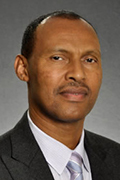 Name: Dagim Gemeda
Position: Resettlement Programs specialist
Location: Resettlement Programs Office, Economic Assistance and Employment Supports Division, Children and Family Services Administration, 444 Lafayette, fourth floor
Background: At the age of 30, Gemeda immigrated to the United States, seeking asylum from his homeland of Ethiopia. Before coming to DHS one-and-a-half years ago, he worked for Anoka County as a senior vocational counselor and at Lifetrack Resources as a refugee employment services program manager, supervisor and employment counselor. He has a bachelor’s degree in economics from the University of Asmara in Asmara, Eritrea.
Describe the work you do:
I am a member of a team responsible for policy development, program development and implementation of resettlement programs initiatives. I work on special projects, developing and implementing new programs. I also provide training and resources to service providers in Minnesota’s Resettlement Network to help them improve and strengthen the well-being of families granted humanitarian protection in Minnesota.
I also present, with the Resettlement Programs Office team, a weekly COVID-19 resources highlights call for service providers during the health crisis. This gives our service providers direct access to information on resources so they can empower clients with this information.
Describe current projects or accomplishments you’re most proud of:
The Resettlement Programs Office recently developed a new regional resettlement services network model. Four regional networks support whole families with coordinated services at hub locations in each region. They connect program participants to existing systems and resources to ensure service accessibility and integration. Minnesota’s Resettlement Network provides coordinated services to support family well-being in Minnesota, including help with finding jobs or legal assistance. I am very proud to our work on the implementation of this new service model.
When I’m not working I like to …
Walk with my family (my wife and three kids) and play basketball with my 13-year-old son. I also enjoy volunteering in the community.
|
|
|
The Asian Heritage Employee Resource Group (AH ERG) met for the first time via Webex and call-in on Thursday, June 25. The meeting focused on impacts of the COVID-19 pandemic and the death of George Floyd. All DHS employees were welcomed to attend.
In addition to learning more about the Asian Heritage ERG, participants had the opportunity to share stories and experiences, discuss ways to support each other during these very difficult times, and find avenues to connect with others across all racial and cultural backgrounds.
The AH ERG will serve as a platform to build, grow and strengthen engagement, communication and leadership for individuals of Asian heritage. In collaboration with their sponsor, Lauren Hunter, Director of Diversity Recruitment and Retention, the AH ERG will create opportunities to foster authentic leadership and build meaningful relationships internally and externally.
The kick-off event for the new Asian Heritage Employee Resource Group originally scheduled for Thursday, April 30, has been rescheduled for Thursday, Aug. 20. It will take place from 1:30 to 3:30 p.m. at the Elmer L. Andersen Human Services Building in Rooms 2370 and 2380.
For information on and how to join AH ERG, send an email to MN.aherg@state.mn.us
Clinical Program Therapist 1 – Behavior Analyst Program Assistant (Fergus Falls, MN) - 40681
The Community Behavioral Health Hospital (CBHH) in Fergus Falls, is seeking a passionate, person-centered individual to join the team as a behavior analyst program assistant. The behavior analyst program assistant assists unit staff of varying levels of expertise in implementing and sustaining support guidelines using evidence-based practices and works with the treatment team to provide quality medical and psychiatric care to patients as specified on individualized treatment plans, maintains a safe environment, and provides active treatment and social support to patients under the clinical supervision of a mental health professional. If you are interested, we want to hear from you!
Clinical Program Therapist 2 – Mental Health Practitioner (Wadena, MN) - 40683
Minnesota Specialty Health System (MSHS) in Wadena is seeking a talented, person-centered mental health practitioner to join our team in providing rehabilitation and supportive residential services for individuals with serious mental illness and possible co-occurring disorders. The mental health practitioner coordinates and assists with identifying clients goals in order to develop individual rehabilitation plans, collaborates with other treatment team members on client’s individualized treatment plans, facilitates evidence based treatment, and provides on-going technical direction for treatment service delivery, under the direction of the mental health professional. If you are interested, we want to hear from you!
Registered Nurse Department Manager (40195)
Applicants may be eligible for a hiring incentive of up to $2,500!
The Minnesota Department of Human Services (DHS) is seeking experienced nurses to provide leadership as a Registered Nurse Department Manager at the Anoka Metro Regional Treatment Center (AMRTC). AMRTC is an inpatient psychiatric hospital serving adults with mental illness in a large, campus-based setting. The population also includes individuals civilly committed for specialized care, such as competency for criminal court (Rule 20), emergency 48-hour bed holds, and co-occurring mental illness/chemical dependency. Located just 15 minutes north of the Twin Cities metro, this modern facility offers compassionate, person-centered care in a pleasant environment appreciated by patients and employees alike.
In the role of Registered Nurse Department Manager at AMRTC, you will direct, plan, coordinate and supervise activities associated with the treatment process and delivery of person-centered patient care, as well as staff development and environmental management. You will also establish, maintain and evaluate standards of care, plus share expertise through consultation. If you are interested, we want to hear from you!
|
|
|
|
|
|
|