October 2026
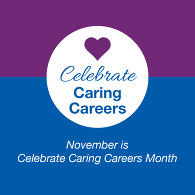
Celebrate Caring Careers Month this November
Minnesota’s inaugural Celebrate Caring Careers Month is coming up in November!
This month will celebrate the people who make a difference every day in the lives of older adults, people with disabilities and people with behavioral health care needs across Minnesota and raise awareness about the many employment opportunities in this field.
-
Do you have training programs that prepare people for work in aging services, disability services and behavioral health services in long-term care, home care and/or community settings?
-
Do you work with job seekers who may wish to consider working in a Caring Career?
-
Do you have success stories from people who have completed a training program and found work in a Caring Career? If so, please share them with Rita.Beatty@state.mn.us
There are thousands of job vacancies for these positions across Minnesota – let's help raise awareness about all the employment opportunities and career paths in Caring Careers!
|
 ACP Team News
The ACP team is offering Help Sessions from 9:00-10:00 a.m. every Wednesday (with some exceptions). Grant Coordinators will be available during this time for drop-in assistance. Please join the “ACP Connect & Collaborate - Happy Help Hour” using this WebEx link.
Tips/Tricks/Reminders
Although ACP programs are state-funded, ACP guidance related to all certificate/credential training, specifically CDL training, has aligned, and will continue to align, with federal guidance. In reference to Training and Employment Notice (TEN) 26-01, please follow the guidance below:
- Use assessments and other available information to determine whether the training is appropriate for the participant and whether they are positioned for success.
- Complete all required math and reading assessments before training begins.
- Consider whether the participant has the English-language skills necessary to successfully complete meet any required training, testing, licensure, and employment requirements. When appropriate, refer participants to ESL or remedial coursework.
- Ensure participants understand that many training materials and required tests are provided in English, and that required tests must be administered in English.
The goal is to ensure that participants enter training that is appropriate for their needs and provides a realistic opportunity for successful completion and employment.
RPR Reminders:
Before submitting your monthly Reimbursement Payment Request (RPR), remember to check that:
- Participants are enrolled in WF1 and have a signed and dated Employment Plan (EP) before participant-related costs are incurred.
- All required eligibility documentation is collected and uploaded to WF1.
- Receipt of Support Services is documented and uploaded to WF1.
- WF1 enrollments, Activities, and case notes support participant-related costs billed to the grant.
- Costs are appropriately allocated, and your allocation methodology is documented and consistently applied.
For additional information, please review the ACP Operations Guide and ACP Cost Category Guidance.
ACP Webpage
Visit the ACP home page for resources and tools to assist in the administration of your ACP grant.
-
ACP Operations Guide – Fixed broken link within Monitoring Requirements section (pg. 28); Added exception language to the FPG within the Eligibility section (pg. 18); Added Subgrantee/Subrecipient Monitoring sub-section within the Monitoring Requirements section (pp. 29-30) and linked to the section in the Partnerships and Subrecipient, Contractors, and Vendors sections; Updated the definition for Local Flag activity in the Activity section (pg. 7); Added a Grant Agreement section (pg. 25); Updated the Exit table to include “Entered Public Service Program” reason and its definition (pp. 22-23); Replaced “Contract” with “Grant Agreement” throughout guide as applicable.
-
Cost Category Guidance, Documentation Needed to Support Participant Eligibility, and ACP Workforce One User Guide – No updates this month
ACP Successes
We'd love to learn about the amazing work you're doing and how it is positively impacting the lives of individuals throughout the State of Minnesota! To submit a success story, please fill out this brief ACP Success Stories Form.
Story #1: E recently graduated from Emerge’s CDL program. E was faced with many life barriers during her training including unemployment, personal life barriers, and lack of credentials to obtain an in-demand career. With the help of Emerge providing ongoing support with job search and job skills counseling, E was able to successfully obtain a driving job (which allowed her to gain experience while still training). The trainings that Emerge provided allowed her to enhance her interviewing skills, build confidence, and achieve certifications that aided in finding employment. E never gave up and Emerge helped empower her to keep pushing through the training, despite facing hardships.
Story #2: K came to Emerge unemployed and seeking help with a new career. He had many challenges at the time of enrollment including unemployment for an extended time and some background issues. From the moment K enrolled in the program, he was very motivated and determined not to let his past stop him from completing training. Emerge provided job search assistance, pre-work development training, and CDL training. Ultimately, K was successfully able to obtain full-time employment as a welder (he is actively seeking CDL employment now that he has graduated from CDL training). Through work readiness and OSHA 10 training, K was able to update his job preparedness skills and successfully complete CDL training.
Please contact your Adult Career Pathways Grant Coordinator directly with any questions regarding Adult Career Pathways Programs.

PY26/SFY27 Grant Funding
Workforce Innovation and Opportunity Act (WIOA) Adult and Dislocated Worker Program contracts are currently being sent out; if you have not received yours or do not receive it in the next few weeks, please reach out to your Grant Coordinator.
We recognize the challenges these delays create for partners across the state, and we appreciate your patience and understanding. Agency Fiscal team is working diligently to move the remaining items forward. We will continue to keep you informed of any new updates.
Minnesota Job Skills Partnership Board (MJSP)
The next MJSP Board meeting is scheduled for October 26, 2026. More information can be found on the MJSP Board Webpage.
Interim Teacher Apprenticeship
- Department of Employment and Economic Development (DEED) is working with the Minnesota Department of Labor and Industry and a couple of Local Areas to implement the newly approved Interim Teacher Apprenticeship.
- DEED is also working with partners at the federal level and internally (monitoring, policy and Workforce One) to ensure that we are in compliance with federal and state requirements. Additional updates/guidance will be shared in the upcoming months.
Building Workforce Resilience through Work-based Learning
Strong employer partnerships and work-based training create clear, practical pathways for jobseekers. When workforce programs align training with industry needs, employers retain skilled workers, reduce layoffs, and improve productivity. Work-based learning gives individuals the chance to gain in-demand skills while staying employed, making upskilling more accessible and cost‑effective. For employment counselors, these partnerships expand options for connecting clients to targeted skill‑building programs that prepare them for emerging roles and support long-term career stability. Read more regarding resilience through work-based learning.
Senior Community Service Employment Program (SCSEP)
GPMS Update: New Rate of Pay Requirement for Assignment Entries
On August 28, 2026, the Grantee Performance Management System (GPMS) released version 26.2, introducing a new Rate of Pay field on the Assignment Detail screen. When creating or editing an assignment, all users must now select one of three options: Federal Minimum Wage, State/Local Minimum Wage, or Prevailing Rate of Pay. If Prevailing Rate of Pay is selected, GPMS will also require entry of a Wage per Hour amount; this field remains optional when selecting either minimum wage option.
Remember that Prevailing Rate of Pay does not apply in Minnesota, because the state minimum wage is higher than the federal minimum wage. Under SCSEP wage requirements, participants must always be paid the highest applicable minimum wage, which in Minnesota is the state/local minimum wage.
Selecting the prevailing wage option or entering a prevailing wage amount may result in disallowed costs. To prevent accidental selections, DEED is working with the GPMS helpdesk to gray out non applicable wage options for Minnesota users.
Until that system change is complete, providers should only select “State/Local Minimum Wage” when entering assignment wage information.
Policy
- Stakeholders asked for additional guidance related to Training and Employment Notice (TEN) 26-01 and Commercial Driver’s Licenses (CDLs). A Technical Assistance Bulletin (TAB) is being developed but until it is published see below for additional guidance.
- Providers should make sure participants can meet the CDL English requirements before approving CDL training:
- This could include English as a Second Language courses or remedial courses if appropriate.
- Written curriculum, manuals, and tests should be in English, and the tests should be administered in English (TEN 26-01 Page Two).
- Providers should also make sure they are doing career exploration that is documented and have documentation that the participant has the skills and qualifications to successfully participate in CDL training prior to starting their training. DWFAP's Training Services Allowable Activities Policy (Page three) requires that the participant has the skills and qualifications to successfully participate in the selected program of training services.
- This FAQ document offers additional information for the field about DWFAP’s advisories (TABs and Technical Assistance Response (TAR) Letters).
- New DWFAP Advisories Published:
- Note: The DWFAP team is currently working behind the scenes to update the policies on the website. If you are trying to access a policy and need assistance, please contact the team through the DWFAP general email.
Reminders
- Monthly Financial Status Report (FRS)/Monthly Reimbursement Payment Request (RPR):
- Due the 20th day of the month following the preceding month-end. For example, the September RPR/FSR (September 30 end date) is due October 20.
- Report accrued monthly expenditures.
- A monthly RPR/FSR is required even if no funds were expended.
- Quarterly Progress Report:
- Reports for Quarter ending September 2026 are due on October 30. Please report on all active grants.
Please email all requests, reports, and technical assistance questions to the Dislocated Worker Federal Adult Programs general email at dwfaprograms.deed@state.mn.us.
 Important! Participant File Updates
Documentation Updates Effective July 1, 2026:
Beginning July 1, 2026, TEGL 23‑19 Change 3 introduces important updates to documentation requirements for new program enrollees. These changes apply only to participants with an enrollment date on or after July 1, 2026 and focus on two key data validation elements: Low Income and Date of Birth.
Programs Impacted:
- WIOA Adult
- WIOA Dislocated Worker
- WIOA Youth
- National Dislocated Worker Grant (NDWG)
- Trade Adjustment Assistance (TAA)
- Wagner-Peyser / Migrant Seasonal Farm Worker (MSFW)
Low Income: Updated Documentation Requirements
For individuals enrolled on or after July 1, 2026, self‑attestation will no longer be accepted as sufficient documentation to validate the Low‑Income data element.
Changes include:
- Self‑attestation is no longer an acceptable form of documentation.
- Supporting documentation must be collected and maintained within WF1 Document Summary in accordance with program requirements.
- Data Validation reviewers and monitors will look for documentation substantiating Low‑Income determination.
Key takeaway: Self‑attestation alone will NOT meet validation requirements for Low Income for new enrollees beginning July 1, 2026.
Date of Birth: Updated Documentation Requirements
A similar change applies to the Date of Birth element.
- Self‑attestation is no longer acceptable for validating Date of Birth.
- Documentation must be available in the participant file for enrollees on or after July 1, 2026.
Key takeaway: Self‑attestation alone will NOT meet validation requirements for Date of Birth for new enrollees beginning July 1, 2026.
What This Means for Grantees:
Grantees should review enrollment and documentation practices to ensure alignment with TEGL 23‑19 Change 3. Particular attention should be given to:
- New enrollees with enrollment dates on or after July 1, 2026
- Collecting and retaining documentation supporting Low Income
- Collecting and retaining documentation supporting Date of Birth
- Ensuring documentation is available in WF1 for future review
These updates do not apply retroactively to participants enrolled before July 1, 2026.
Upcoming Interactive Data Validation Training - October 2026
To support grantees in implementing these changes, Employment & Training Programs (ETP) is offering interactive Data Validation Training in October.
IN-PERSON SESSION:
Thursday, October 22, 2026
Check-in: 8:30 AM
Training: 9:00 AM – 12:00 PM
Great Northern Building, 180 5th St E, St. Paul, MN 55102
Parking and additional event details will be included in the calendar invitation.
Register for the In-Person Training
VIRTUAL SESSION:
Wednesday, October 28, 2026
Training: 9:00 AM – 12:00 PM
Microsoft Teams
Register for the Virtual Training
Who Should Attend?
- Executive Directors
- Program Managers
- Program Supervisors
- Program Data Staff
- Employment Counselors
The training includes hands-on breakout activities, discussion, and opportunities to apply data validation practices directly to your own program data-an approach aligned with U.S. Department of Labor monitoring expectations.
Next Steps for Grantees
- Review the documentation changes outlined in TEGL 23‑19 Change 3.
- Inform staff that self‑attestation will no longer be sufficient for Low Income and Date of Birth for new enrollees after July 1, 2026.
- Register for one of the upcoming October Data Validation Training sessions.
If you have questions about Monitoring content, please email shannon.rolf@state.mn.us.

Minnesota’s 2024–2034 employment projections predict the addition of 101,000 new jobs and a 3% growth rate over a decade. Modest overall job growth is expected to be led by strong expansion in Health Care & Social Assistance, with additional gains in Construction, Self-Employment and Professional, Scientific & Technical Services. Several industries including Retail Trade, Manufacturing, Information, and Administrative Support & Waste Management Services are expected to decline due to automation, demographic shifts and changing consumer behavior. Most openings over the decade will stem from retirements and job switching rather than new job creation, with healthcare and skilled trade occupations showing the fastest growth and administrative, sales and production roles seeing the largest declines.
If you have questions about Labor Market Information, please email deed.lmi@state.mn.us . If you'd like to learn more about how your regional economy is doing, or how to use our Data Tools, please check our Fall 2026 LMI Training Schedule.
If you have questions about Labor Market Information, please email deed.lmi@state.mn.us.
This newsletter is meant for DEED Grantees, Providers, and Employment Counselors. We want this e-Newsletter to meet your needs! We encourage you to send your comments and suggestions to deed.taa@state.mn.us.
Past issues of the Partner Express
Subscribe to the Partner Express
|