April 2026
 ACP Team News
First, as your agency’s ACP contracts are being executed, please look for communication from your coordinator as they begin to schedule the 30, 60, 90-day check-in meetings. This is your one-on-one time with your coordinator to ask questions, clarify requirements, and develop an activity map to clarify performance metrics and how you will appropriately track those in Workforce One.
Second, a recording of the virtual onboarding session that took place on February 27th, along with the PowerPoint slides and the Financial Reconciliation handout, are now posted to the Resources and Guides section of the Adult Career Pathways (ACP) webpage.
Third, CanTrain proposals have been received and we anticipate notifications to be made in the coming weeks!
Tips/Tricks/Reminders
Quarterly Reports
Quarterly reports are due to your Grant Coordinator by April 30th. The quarterly report should reflect activities between January 1, 2026 – March 31, 2026. Report templates are available on the ACP webpage under each specific grant program.
Submitting a quarterly report each quarter is a requirement of your contract with DEED. Per State of Minnesota’s Office of Grants Management policy 08-09 “Grant payments shall not be made on grants with past due progress reports unless the state agency has given the grantee a written extension.”
A recording of the Quarterly Report Training and step-by-step instructions are available in the Resources and Guides section of the ACP webpage.
Did You Know: EDS
Did you know that the following documentation is required to be uploaded to Workforce One’s Electronic Document Storage (EDS) for each participant?
- Application/Enrollment form
- Employment Plan
- ID documentation (proof of date of birth/age, name, MN residency, and social security number)
- Proof of Right to Work (if participant is not a citizen)
- Academic assessment scores
- Any certificates/credentials earned
- Signed participant acknowledgement of receipt for support services
- Offer letter/paystub/Employment Verification Form as verification of placement into employment
The Application, Employment Plan, and all eligibility documentation should be uploaded to EDS within 15 business days of the enrollment date.
You can find both a recorded training webinar and the Workforce One Storage Navigation Guide in the Resources and Guides section of the ACP webpage.
New Exit Reason
The exit reason, “Completed Program Objective” has been replaced with “Completed Training – Did Not Obtain New Employment.” This exit reason should be used if a participant completed training and earned the corresponding certificate/credential/licensure, pre-employment skills, or other work plan objectives but has not entered employment prior to exit.
More information on exits and exit reasons can be found on pages ACP Operations Guide.
ACP Provider Map
The team is in the process of updating its comprehensive provider map featuring organizations funded by DEED’s SFY 2026/2027 Office of Adult Career Pathways. This tool will be made public and available to encourage referrals to your organization’s training programs. We received a great response to the survey and anticipate the map being available on the ACP webpage by April 1st.
Adult Career Pathways Webpage
Check out the ACP home page for resources and tools to assist in the management of ACP Grants.
ACP Successes
We'd love to learn about the amazing work you're doing and how it is positively impacting the lives of individuals throughout the State of Minnesota! To submit a success story, please fill out this brief ACP Success Stories Form.
A client at Jewish Family and Children’s Service of Minnesota enrolled in the Pathways to Prosperity Individualized Training Pathway program after being accepted into Prime Digital Academy’s UX Design program. Previously working as a healthcare case manager, she experienced burnout and made the decision to pursue a new career path. During a professional break, she explored opportunities in IT, building her skills through courses on Coursera and LinkedIn Learning. The client successfully graduated from Prime Digital Academy. Throughout her job search, her Employment Counselor consistently provided resources, including workshops, networking events, and job leads. To keep her skills current and relevant, the client also completed subcontract work on several projects and with startups. After ten months of dedicated effort, the client secured a full-time Software Engineer position at a tech company, earning $33.46 per hour (approximately a 7% increase in her previous salary).
This success story highlights how Pathways to Prosperity Individualized Training Pathway grant funds can support Minnesotans in building new skills, earning industry-recognized credentials, and accessing the guidance and resources they need to successfully transition into sustainable higher-wage careers in high-demand fields.
Please contact your Adult Career Pathways Grant Coordinator directly with any questions regarding Adult Career Pathways Programs.
 Senior Community Service Employment Program (SCSEP)
The new connection between the Grantee Performance Management System (GPMS), Workforce Integrated Performance System (WIPS) and State Wage Interchange System (SWIS), has made it easier for SCSEP program to track wages and employment. This system gives users more accurate information, including wages from jobs in other states, and helps meet reporting and security requirements.
However, the additional data acquired only shows if a participant is working and how much they earned. It does not show what kind of job they have, how many hours they work, or whether the job is a good fit.
Because of this, SCSEP providers still need to follow up with participants for one year after they start an unsubsidized job. These check-ins help providers:
- Understand job quality
- Offer support when needed
- Collect important details that WIPS/SWIS cannot provide
- Improve overall program performance
WIPS/SWIS data is helpful, but it did not mean to replace the information gathered through direct contact. Keeping in touch with participants ensures that SCSEP continues to support long-term success.
MJSP Board Meeting for June 2026
The next MJSP Board Meeting will be held on Monday, June 15, 2026, via Microsoft Teams. All meetings are open to the public. Additional information on the time, meeting format, agenda and location can be found on the MJSP web page. Supplemental Funding Requests are due 30 business days before the meeting (Friday, May 1, 2026). If you are considering submitting a request, we would appreciate a heads up prior to the due date.
WIOA State Plan
PY23 WIOA Adult and Dislocated Worker Reallocated funds must be expended by June 30, 2026. Any remaining/unused funds will be sent back to DOL.
- PY24 funds must be used by June 30, 2026. Submit any modifications or transfer requests by April 17th to allow time for processing.
- Cost category adjustment is allowed on the final Reimbursement Payment Request (RPR) if the total expended does not exceed the total approved budget. However, the Admin cost category must not exceed 10% (or approved waiver percentage for State DW) of total reimbursed.
- Any remaining unused funds will be reallocated to Local Areas that have spent 100% of their PY24 funds.
PY26 funding information will be coming soon. As you may be aware, we usually have a limited turnaround time to plan, process, and execute agreements/workplans.
- To help us move contract paperwork forward quickly, please begin having conversations with staff and partners to complete as much of the planning document sections as possible (e.g. Narrative). Once the TEGL is released and allocations are available, you can finalize your paperwork and send it in.
Carry Forward Requests - Providers may request a waiver to carry forward more than 20% of their allocated PY25 funds into the second year of the grant using the provided template (attached). Providers who expend or obligate at least 80% of their PY25 formula funds by the end of the 4th quarter do not need a waiver.
- We are accepting Carry Forward Waiver Requests now through the end of April; please submit early enough to allow more time for review, approval and processing before the start of the fiscal.
Retaining Employment and Talent After Injury/Illness Network (RETAIN)
Last chance to register for the RETAIN Summit being held on April 24, 2026, titled From Challenge to Opportunity: A Collaborative Approach to Worker Absenteeism. This Summit is intended for healthcare professionals, employers, insurers and HR professionals seeking more information about the importance of retaining workers, Return-to-Work/Stay-at-Work best practices, and Minnesota’s new Paid Leave program. Register for free by visiting www.mnretain.com.
 If needed in an alternative format, please contact dwfaprograms.deed@state.mn.us
Policy
- On 3/13/26 the Dislocated Worker and Federal Adult Programs (DWFAP) team published Technical Assistance Bulletin (TAB) 26-04. TAB 26-04 announces DWFAP’s Policy Updates Plan of all planned policy updates after April 1, 2026 for the rest of the 2026 calendar year.
- Stakeholders are encouraged to provide timely preemptive feedback on specific policies or on general policy topics listed in the 2026 Policy Updates Plan for possible inclusion into draft policies.
- DWFAP also published two Technical Assistance Response (TAR) Letters
- On 2/12/26 the U.S. Department of Labor (DOL) published Training and Employment Notice (TEN) 06-25 canceling 13 Training and Employment Guidance Letters (TEGLs) and TENs “…due to being outdated or inconsistent with the Administration’s current policies” (Page 1)
- 6 notable TEGLs and TENs canceled include:
- TEGL 09-22: Workforce Innovation and Opportunity Act (WIOA) Title I Youth Formula Program Guidance (2023)
- TEGL 07-22: Increasing Employer and Workforce System Customer Access to Good Jobs (2023)
Reminders
- Monthly Financial Status Report (FRS)/Monthly Reimbursement Payment Request (RPR):
- Due the 20th day of the month following the preceding month-end. For example, the September RPR/FSR (September 30 end date) is due October 20.
- Report accrued monthly expenditures.
- A monthly RPR/FSR is required even if no funds were expended.
- Quarterly Progress Report:
- QPRs are due on the 30th day of the month following the end of the quarter, a QPR report is required for all active grants, even if no funds were expended.
- Reports for Quarter ending 3/31/26 are due 4/30/26. Please report on all active grants.
Please email all requests, reports, and technical assistance questions to the Dislocated Worker Federal Adult Programs general email at dwfaprograms.deed@state.mn.us.
 Performance Updates for Dislocated Worker and WIOA Adult
Performance Updates for the Dislocated Worker and WIOA Adult
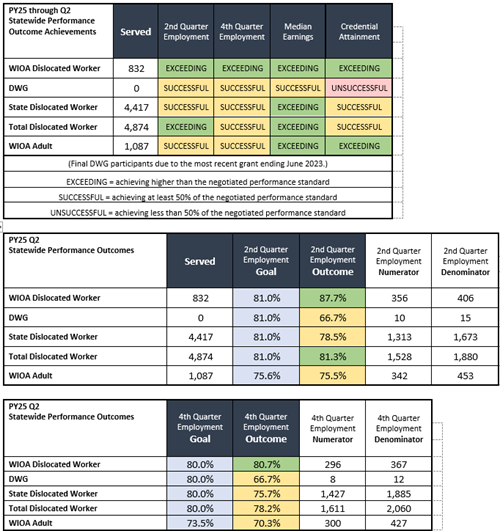
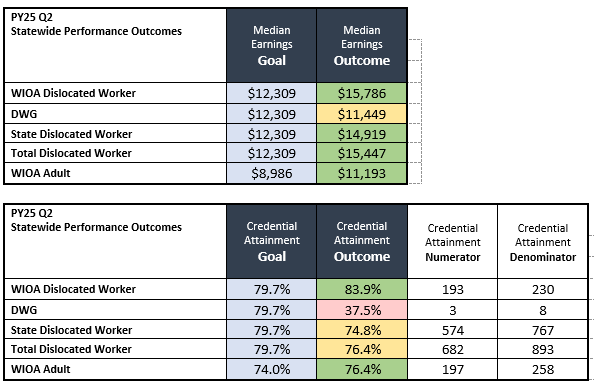
Program Year (PY) 2025 Quarter Two (Q2) Performance Outcomes Compared to Negotiated Goals:
Attached you will find the performance outcome spreadsheets for WIOA Dislocated Worker, DWG, State Dislocated Worker, Total Dislocated Worker, and WIOA Adult programs. These are best when printed landscape, in color, and on 11x17 size paper.
  If needed in an alternative format, please contact performanceap.deed@state.mn.us
- Performance goals are based on negotiated standards for PY2025.
- Color Key:
- Blue are the negotiated performance standards.
- Green means the set goal was met or exceeded.
- Yellow means at least 50% of the goal was met.
- Red means less than 50% of the goal was met.
- Served are all participants accessing the program during the actual program year (real-time).
- Getting a Job results based on participant exits July 1, 2024 – December 31, 2024, except those exited with exclusion. This indicator measures each participant’s employment status during the 2nd quarter after exiting the program. Formula: Percent of employed exits divided by all exits during the reporting period.
- Keeping a Job results based on participant exits January 1, 2024 – June 30, 2024, except those exited with exclusion. This indicator measures each participant’s employment status during the 4th quarter after exiting the program. Formula: Percent of employed exits divided by all exits during the reporting period.
- 2nd Quarter Median Earnings results based on participant exits July 1, 2024 – December 31, 2024, except those exited with exclusionary reason and those showing zero earnings. This indicator measures the median earning during the 2nd quarter after exiting the program.
- Credential Attainment results based on participant exits January 1, 2024 – June 30, 2024, except those exited with exclusionary reason and those who did not attend credential type training. This indicator measures the percentage of participants who received a credential after attending training.
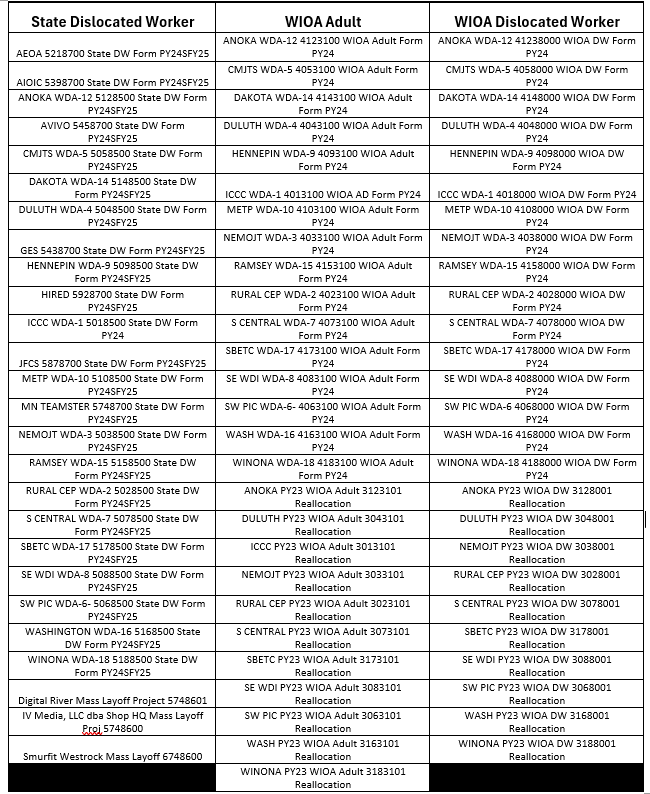
PY2024 Allocation, PY2023 Reallocation, and expiring mass layoff project Closeouts for the Dislocated Worker (DW) and WIOA Adult (AD) Programs.
Reminder: PY2024 allocations and PY2023 reallocations will be expiring on June 30, 2026.
All Workforce One (WF1) cases showing these funding streams within an open activity will need your attention.
 If needed in an alternative format, please contact performanceap.deed@state.mn.us
If the participant will be continuing receiving a service currently supported by PY2024 allocations, PY2023 reallocations, or expiring mass layoff projects after June 30, 2026, a new activity will need to be opened for each continuing service the participant will move forward receiving.
Reminder: All Dislocated Worker and WIOA Adult program year formula allocations (small layoff grants/WIOA Adult allotments) remain active for two years.
- PY2024 = July 1, 2024 – June 30, 2026
- PY2025 = July 1, 2025 – June 30, 2027
- PY2026 = July 1, 2026 – June 30, 2028
This means their new activity will need a PY2025 or PY2026 formula grant selected within them depending on your agency’s budget. PY2026 allocation funding streams will be activated as soon as those contracts are executed through DEED’s Fiscal team.
IMPORTANT PY24 ALLOCATION & PY23 REALLOCATION WF1 CLOSEOUT INFORMATION
- All activities with a PY2024 allocation, PY23 reallocation, or expiring mass layoff project selected within them cannot have a start date after June 30, 2026. They must also have an end date no later than June 30, 2026.
- If any participant will continue receiving a service captured in an activity that is currently showing a PY2024 allocation, PY23 reallocation, or expiring mass layoff project supporting that service financially, that activity needs to be copied within the participant’s WF1 activity detail screen.
- The new activity will need a start date of July 1, 2026.
- An active funding source (PY2025 or PY2026) will need to be selected as the grant financially supporting the continued service.
- To help in this funding source transition
- Mohamed Farah will mass close all currently open PY24 allocation, PY23 Reallocations, and expiring mass layoff project funded activities with an end date of June 30, 2026, which means you will only need to open/copy the old activities.
- If you want to close the old activities yourself with a date no later than 06/30/2026, that is perfectly fine.
- If you choose not to close them yourself, it will be taken care of for you.
- This mass activity closure will begin August 3, 2026.
- If there are cases without open activities on record showing an active grant as the funding source, the mass closure will not work for those cases.
- Any cases that show they cannot be included in this mass activity closure will be emailed to the management team for the COFFR funding the case.
- This communication will include directions on how the case manager will need to correct their data.
- Shortly after July 1, 2026, new funding streams will be added to your dropdown lists for PY2026 allocations.
- The date these new funding streams will be available depends on when PY2026 contracts are in place.
- Your management teams will be alerted as soon as your agency’s PY2026 funding streams are available in WF1.
Requests for Technical Assistance:
Please email the performance team’s general email address with your technical assistance needs: performanceap.deed@state.mn.us
Please email all requests, reports, and technical assistance questions to the performance team’s general email address: performanceap.deed@state.mn.us

Preparing for Your Financial Reconciliation: What to Expect and How to Get Ready
The completion of a financial reconciliation is key part of the monitoring process, which includes a review of a specific Reimbursement Payment Request (RPR)/ Financial Status Report (FSR), your organization’s General Ledger, and proof of payment information. Being prepared in advance will help ensure a smooth and efficient review.
What to Expect
You will receive a Notification of Intent to Monitor, which includes a request for specific fiscal documentation. These materials are used to reconcile:
- Monthly expenditures (based on the selected RPR/FSR period)
- Year-to-date (YTD) cumulative expenditures
- Supporting documentation for selected transactions
The goal is to confirm that reported costs align with your financial records and are properly supported.
Key Documents to Prepare
Your monitoring notice will outline required materials. Common requests include:
-
Administrative Cost Allocation Method Provide your written methodology for how administrative costs are allocated.
-
Year-to-Date General Ledger (GL) Submit the GL for the grant from the start date through the most recent reporting month.
-
Detailed General Ledger for Selected Month Include itemized expenditures, totals by cost category, and ensure all totals align with the selected RPR.
-
Cost Category Identification Color‑code or clearly organize each cost category under its category title in your GL to match each cost category reported in the RPR.
-
Personnel Costs (if applicable) If salaries are included, provide staff names, titles, and the method used to allocate their time to the grant.
-
Support Services Documentation For expenses such as participant support services, include receipts, disbursement logs, and signed acknowledgments (e.g., for gift or gas cards).
Understanding the Financial Reconciliation
Your monitor will compare the selected RPR/FSR against your financial records. Below is a sample of how costs may be reviewed:
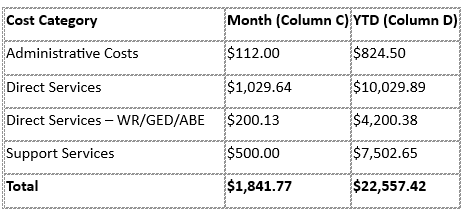 If needed in an alternative format, please contact shannon.rolf@state.mn.us
Your documentation should clearly support both the monthly and cumulative totals reported.
Tips for Success
- Reconcile your GL to your RPR/FSR before submission
- Use consistent cost categories across all documents
- Clearly label or highlight relevant transactions
- Ensure all totals match across reports
- Keep backup documentation organized and accessible
Proper preparation not only helps ensure compliance but also minimizes follow-up requests and delays. If you have questions at any point, reach out to your monitor for clarification—we’re here to support you throughout the process.
If you have questions about Monitoring content, please email shannon.rolf@state.mn.us.
  Training Program Finder
Use the CareerForce Training Program Finder to market your training opportunities!
We’re making it easier for you to get started using this helpful tool. Now providers new to the Training Program Finder just need to fill out this form to get your training programs listed.
The Training Program Finder page gets thousands of views a month
Partners using this tool to promote their training programs have told us they’ve seen an increase in enrollment. We need more providers to use this valuable tool!
If you have a training program not listed in the Training Program Finder, what are you waiting for?
The Training Program Finder is a great opportunity for partners who offer occupation-based training programs to market upcoming opportunities that will assist job seekers on their career pathway. Content added must be for no-cost-to-the-customer training, such as:
- Drive for 5 training programs
- Pathways to Prosperity training programs
- Other state-funded training programs
- Training programs funded by cities, counties, or local workforce development boards
- Training programs funded by foundations and other non-profits
Check out the Training Program Finder on CareerForce.MN.gov—and make sure to add your no-cost training opportunities to this easily searchable listing today!
Contact the CareerForce Information and Assistance line at 651-259-7500 or careerforce@state.mn.us if you have questions.
 In the December issue of Minnesota Economic Trends, our writers examine the High-Quality Jobs Framework and the benefits of implementing job quality efforts, the gender divide in trades careers, small business contributions to Minnesota’s economy and the shifting demographics of Minnesota’s workforce.
Careers in the Trades: A Tale of Two Genders
Careers in the trades are becoming more popular among high school students thanks to their affordability. However, as shown by the earnings outcomes of trades-related educational programs, well-paying jobs in the trades are significantly more accessible to men than to women.
Minnesota’s Workforce Since the Pandemic: More Diverse, More Female, More Self-Employed
Minnesota has added a net gain of just over 20,000 jobs since the pandemic, but the composition of the workforce holding those jobs has shifted substantially. Workers of color drove all employment gains while white workers declined; women now outpace men in employment rates for the first time in modern history; teenagers and seniors surged back into the workforce; and self-employment exploded among young adults.
If you'd like to learn more about how to use our data tools in your work, our Regional Analysts have a series of Labor Market Information training sessions scheduled for the spring and summer, starting with a session on April 14, and running through June 18. These sessions are all held virtually, so you can attend from anywhere in the state, and will cover a wide range of topics including Career Exploration, Occupations in Demand, Occupational Employment & Wage Statistics, and regional economic conditions.
If you have questions about Labor Market Information, please email deed.lmi@state.mn.us.
This newsletter is meant for DEED Grantees, Providers, and Employment Counselors. We want this e-Newsletter to meet your needs! We encourage you to send your comments and suggestions to deed.taa@state.mn.us.
Past issues of the Partner Express
Subscribe to the Partner Express
|