January 2026
Welcoming 2026 with Gratitude
As we close the chapter on 2025 and step into the new year, we extend our sincere gratitude to all of you, our partners. Your dedication empowers Minnesotans to achieve meaningful employment and economic growth.
Your work brings hope and transforms it into real opportunities. Thank you for your continued collaboration, innovation, and dedication to improving lives. Your impact is helping build a more equitable economy and a brighter future for all. You are the foundation of Minnesota’s workforce development success, and we deeply appreciate all that you do.
Sincerely, Employment and Training Programs group
 CanTrain Competitive Grant Request for Proposal
The CanTrain program request for proposal was released Monday October 13, 2025, for eligible organizations to train people for work in the legal cannabis industry. Organizations seeking funding must be capable of providing training relevant to the legal cannabis industry, particularly for individuals facing barriers to education or employment.
Eligible organizations may include educational institutions, nonprofit organizations, private businesses, community groups (with the legal structure eligible for contracting and receiving payments), units of local government, labor organizations that represent cannabis workers in the state, or partnerships between different types of organizations. The due date was extended, and applications are due January 8, 2026 (time-stamped received by 5:00 pm CST).
Competitive Grant Awards: Pathways to Prosperity, Drive for 5 and Adult Support Services
Congratulations to those who received awards for the Pathways to Prosperity (On-Ramp, Bridge, and Individualized Training), Drive for 5 and Adult Support Services Competitive grants! Your ACP Coordinator will continue to work with newly awarded grantees to move the contracting process forward.
Reminder: Grant Awards
As award letters are being sent to applicants, we kindly remind you not to make any public announcements about your award until DEED issues an official press release, which is expected within a few weeks of award notifications.
SFY26-27 Adult Career Pathways Competitive Grantee Onboarding
The Office of Career Pathways (ACP) is hosting in-person onboarding training for all ACP competitive grant recipients, with several in-person sessions across Minnesota and one virtual option. Each organization must send at least one representative (up to three), and each person must register individually. In-person attendance is strongly encouraged, especially for new grantees.
Training will cover important information regarding with DEED, program components, program requirements, fiscal responsibilities, and monitoring. Please register for one session; details will be sent after registration. In-person sessions are capped at 30 participants.
SNAP E & T 50% Reimbursement
Thank you for your interests in the SNAP E&T 50% Reimbursement program with DEED. We are currently at provider capacity and are no longer accepting new providers for the FY2026 program year. The goal of this program is to prepare providers to apply for expanded funding through DCYF’s SNAP E&T 50% Reimbursement program. Please check the DCYF Grant RFP Programs webpage for more information about this opportunity in Spring 2026.
Quarterly Reports
The next quarterly report is due to your Coordinator on January 30, 2026.
Submitting a quarterly report is a requirement of your contract with DEED. Per State of Minnesota’s Office of Grants Management Policy 08-09, “Grant payments shall not be made on grants with past due progress reports unless the state agency has given the grantee a written extension.” You will find Quarterly Report Instructions in the Resources and Guides section of the ACP webpage. Quarterly reports should be submitted by the 30th of the month following the close of the quarter.
Co-Enrollments
Grantees can find a “Co-Enrollment Rules for DCYF and ETP” spreadsheet in Workforce One under Resources > User How To Guides. The spreadsheet shows WF1 rules related to co-enrollment between Department of Children, Youth, and Families (DCYF) and Department of Employment and Economic Development (DEED) Employment and Training Programs (ETP). There are two tabs in the spreadsheet that include program-level and funding stream-level co-enrollment rules.
For ACP specific co-enrollment guidance, please see page 14 of the ACP Operations Guide.
Adult Career Pathways Webpage
Check out the ACP home page for resources and tools to assist in the management of ACP Grants.
Success Stories
We'd love to learn about the amazing work you're doing and how it is positively impacting the lives of participants throughout the State of Minnesota! To submit a success story, please fill out this brief ACP Success Stories Form.
Participant Success Stories
Story #1
When Jane started in the Pathways to Prosperity On Ramp program in October 2024, she did not have a consistent place to live and had not had a steady job for several years. Saint Paul Public Schools’ Career navigation staff and the teacher worked with her on her resume, helped her find job leads, and assisted her with free bus cards so she could have reliable transportation. In mid-May, Jane got a full-time position as a Shipping Specialist. A few months later, Jane was no longer working there (the company seemed unstable/disorganized). Jane recently got a job with Amazon and is working full-time again and taking math classes at Hubbs Center so she can finally pass her GED tests. She’s almost there. Also, she brought her adult daughter to St. Paul and helped her enroll at Hubbs Center for college readiness classes, so they come to school together. Jane even looks healthier now! More confident, happier, and feeling good about her future. It has been great to see her transformation.
Story #2
Alfred was an architect in his home country of Ethiopia and had been a building inspector in the United States. His business goal is to use his skills to build affordable housing in the Twin Cities area, but when he joined the “Introduction to Small Business” class through the Pathways to Prosperity On Ramp grant, he was overwhelmed by the steps required to build this kind of business in the U.S. When he learned strategies for research and information-gathering from class and had discussions with other students who have been involved in construction business here, it renewed his confidence. By the end of the class, he had registered for housing development workshops and had started working with a realtor to find land. The class allowed him to proceed with his original goal, develop the confidence he needed to pursue it, and find resources beyond the class that would help him with his next steps.
Story #3
XT is originally from Vietnam and had held solid employment positions in Vietnam, including administrative jobs in the recycling industry and with an oil and gas company. She achieved a Microbiology degree at college in Ho Chi Minh City. However, XT has been in the U.S. for quite some time and not obtained work while acclimating to the culture and the English language. After the On-Ramp course, XT was selected to participate in the Business Professional Pathways program at Goodwill Easter Seals, then obtained her first job in the U.S., working at Collins Aerospace in Burnsville, MN.
Please contact your Adult Career Pathways Grant Coordinator directly with any questions regarding Adult Career Pathways Programs.

Seeking Waiver Ideas for WIOA Adult & Dislocated Worker Programs
DEED invites service providers to submit waiver concepts/ideas inspired by TEGL 05‑25 to modernize service delivery and improve outcomes. Share ideas that remove barriers, strengthen work‑based learning and apprenticeship, and advance sector strategies, within U.S. Department of Labor’s (DOL) waiver authority and guidance.
Send brief proposals covering the required elements (statute/regulation to waive, goals, measurable outcomes, monitoring, and populations impacted) by Jan 12, 2026 to DWFAPrograms@state.mn.us.
Senior Community Service Employment Program (SCSEP)
DOL Monitoring Updates:
As part of the U.S. Department of Labor (DOL) monitoring corrective action process, seven findings were initially identified. By September 24, 2025, six of these findings were successfully resolved and closed. The remaining finding focused on the execution of updated Workforce Development Area Memoranda of Understanding (MOUs). After reviewing documentation provided by MN DEED, the regional office administratively closed this final finding on December 9, 2025.
The State is still expected to have all updated MOUs fully executed per federal requirement. DEED will continue collaborating closely with the remaining Workforce Development Areas to ensure the completion of all remaining the MOUs.
Strengthening SCSEP Outcomes Through Supportive Services
Supportive services are a core component of SCSEP. They enable participants to fully engage in training, successfully transition to employment, and maintain long-term stability. When implemented effectively, supportive services do more than meet immediate needs, they remove barriers and build confidence for lasting success.
Why Support Services Matter: Older workers often face challenges such as transportation difficulties, technology gaps, and limited access to affordable healthcare. Supportive services address these barriers so participants can focus on skill-building and job preparation. SCSEP data consistently shows higher placement and retention rates among individuals who receive timely, well-documented support.
- Begin with a Holistic Assessment: Use initial and semi-annual assessments to understand each participant’s personal, financial, and technological circumstances. Go beyond standard questions to explore housing stability, caregiving responsibilities, and access to digital tools. Document needs clearly in the Individual Employment Plan (IEP) to align services with employment goals.
- Prioritize Early and Preventive Support: Early intervention prevents minor issues from becoming major setbacks. Transportation assistance at the start of training, for example, can improve attendance and engagement. Encourage participants to communicate challenges as they arise.
- Partner Strategically: Collaborate with local agencies, community action programs, and transportation providers to extend limited SCSEP resources. Many Workforce Development Areas (WDAs) use referral networks to connect participants to housing, food, utilities, and healthcare supports.
- Track and Document Impact: Accurate documentation in GPMS ensures compliance and demonstrates effectiveness. Record the type of support provided, the amount, and the resulting outcome. These details strengthen performance reports and support continued investment in supportive services.
- Integrate Support Into Retention Strategies: Support should continue after job placement. Resources such as clothing vouchers, technology refreshers, or short-term transportation assistance help sustain employment, especially during the first 90 days.
Supportive services are essential, not optional, for participant success. Identifying needs early, coordinating community resources, and documenting outcomes ensures older workers can thrive during and after SCSEP participation.
Policy
Starting January 5, 2026 DWFAP will begin using two types of advisories as an additional means of officially communicating and posting program policy guidance, announcements and more.
Technical Assistance Response (TAR) Letters:
TAR Letters are used to transmit DWFAP policy and operational guidance in response to questions from stakeholders. These documents are intended to provide clarity regarding existing requirements under Federal and/or State law, policy, and/or procedure. TAR Letters are labeled by Calendar Year (January 1 – December 31). TAR Letters can be requested at any time by submitting questions to your appropriate DEED staff (Grant specialist, etc.) or to Dwfaprograms.deed@state.mn.us.
Note that not all TA requests will result in a TAR Letter being published, for example unique TA requests that only relate to one stakeholder.
Technical Assistance Bulletin (TABs):
TABs are used to communicate DWFAP policy and operational guidance, announcements, publications, or information. These are published in addition to other DEED communications, including but not limited to: Partner Express emails, Gov Delivery emails, etc. TABs are labeled by Calendar Year (January 1 – December 31). Examples of topics that may be published in a TAB include but is not limited to:
- Announcement of annual allocations amounts,
- Announcement of important program updates, waivers, operational changes, and,
- Publication of policy or operational guidance that was not requested by stakeholders (as appropriate).
Advisories may be published for the following DWFAP programs:
- Workforce Innovation and Opportunity Act (WIOA) Adult Program,
- WIOA Dislocated Worker (DW) Program,
- State DW Program,
- Retaining Employment and Talent after Injury/Illness Network (RETAIN) Program,
- Senior Community Service Employment Program (SCSEP), and,
- Other special or pilot DWFAP-administered programs.
Other DEED programs including the WIOA Youth Program and programs within the Adult Carer Pathways unit may be included in advisories as appropriate.
Advisories are not official DWFAP policy and do not supersede DWFAP, and other Federal and State policy.
All published advisories will first be shared with the stakeholder that requested the guidance (if applicable) and then shared via email to other appropriate stakeholders. Stakeholders and members of the public can regularly check the DWFAP website for the latest advisories.
More information about DWFAP advisories is forthcoming. Questions can be directed to Dwfaprograms.deed@state.mn.us.
Please email all requests, reports, and technical assistance questions to the Dislocated Worker Federal Adult Programs general email at dwfaprograms.deed@state.mn.us.
  If needed in an alternative format, please contact, careerforce@state.mn.us.
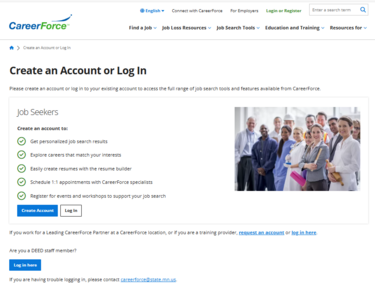
On Tuesday, December 16, several updates to staff and partner accounts on CareerForce.MN.gov were rolled out. Here is a recap of what’s new:
- Single sign-on for DEED staff accounts
- Two-factor authentication for LWDA and training partner accounts
- Account profile updates
- Account dashboard and menu updates
For more details, below are links to a short document for each account type: DEED staff, LWDA staff who provide services from a CareerForce location, and partners who post training programs. You can also find these documents on the Staff and Partner Reference Materials page of CareerForce.MN.gov.
Open the document for your account type to learn more!
Contact the CareerForce Information and Assistance line at 651-259-7500 or careerforce@state.mn.us if you have questions.
 The Effect of Childhood Poverty on the Wages of Minnesota High School Graduates
Childhood poverty is associated with reduced adult earnings. How big is this reduction among Minnesota high school graduates? A new data visualization tool documents the effects of growing up poor on wages and identifies factors that, if not addressed, can perpetuate the cycle of intergenerational poverty. In particular, the article explores the effect of race, school poverty, and postsecondary education on the protracted effect of childhood poverty on adult wages. For example, the study finds that youth of color are more likely to come from low-income families and take longer to attain a family-sustaining wage.
If you have questions about Labor Market Information, please email deed.lmi@state.mn.us.
This newsletter is meant for DEED Grantees, Providers, and Employment Counselors. We want this e-Newsletter to meet your needs! We encourage you to send your comments and suggestions to deed.taa@state.mn.us.
Past issues of the Partner Express
Subscribe to the Partner Express
|