 November 2025
What’s included this month?
- Meet SSB’s new Peer Ambassadors!
- Invite to College 101: Tuesday, November 25th at 6 PM
- Recent podcasts from Blind Abilities
- Tech Tidbits: Freedom Scientific 2026 releases
- Public resources and opportunities
Just for Fun
You know it’s November in Minnesota when:
- Pumpkin spice is replaced by peppermint mochas overnight.
- Everyone’s pretending we might skip snow this year (we won’t).
- You can’t tell if it’s fog, breath, or your soul leaving your body in the morning cold.
- Bundle up — it’s officially “that weird month” between leaf piles and snow shovels!
- The phrase “Uff da” makes a comeback in everyday conversation.
- You leave for school in daylight… and come home in darkness.
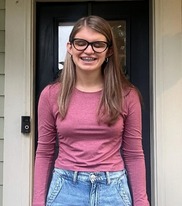
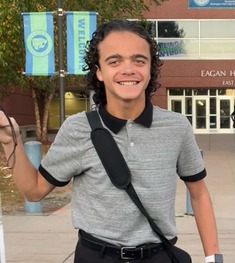
Meet our new Peer Ambassadors, Ava and Preston!
 |
|
Hello everyone! My name is Ava Huggins (she/they) and I am 16 years old. I am a junior at Saint Michael Albertville High School. I’m currently participating in several extracurricular activities, including Speech, touring choir, and Pit Orchestra for our school's fall musical. Outside of school, I love to read as much as possible, and I’m always looking for new recommendations for musical genres I haven’t explored yet. I also sometimes write poetry in my free time. I am very much looking forward to working with Preston on making the transition as smooth and exciting as possible for SSB students. I can’t wait to meet new people and take part in the many activities that make SSB so important for transition students. If you have any questions, feel free to email me at ahuggs09@gmail.com. Thank you!
|
 |
|
Hello everyone! I'm Preston Rose, and I'm thrilled to be joining the Minnesota State Services for the Blind Peer Ambassador team!
I am currently a sophomore at Eagan High School. For my entire life, I've lived with blindness due to Leber Congenital Amaurosis (LCA), and I'm ready to use that experience to make a difference.
I believe in staying active and involved! That's why I dedicate my time to Speech and Debate, choir, and piano, along with several other activities in school. For me, navigating high school successfully means proving that vision loss is never a barrier to pursuing your passions.
I'm incredibly energized to step into this role. I look forward to working alongside my fellow Ambassadors to mentor my peers, share strategies for success, and show everyone in the SSB community that they have the power to live life to the fullest. Get ready—I can't wait to connect with you all and help champion your limitless potential!
|
A Note from SSB Counselors
Hello, students! We hope your school year is off to a strong start and that you're enjoying this season, including any holidays or traditions that hold meaning for you. At SSB, we’re continuing to plan a variety of activities throughout the year, and we encourage you to stay connected and watch for upcoming opportunities.
If there’s a topic or area of training you’d like us to explore, please don’t hesitate to share your ideas—we’re always open to your suggestions!
Fall Opportunities
College 101 on Tuesday, November 25th, from 6:00 to 8:00 PM
Are you interested in attending college? Do you have questions about what the transition to college will look like and what skills are necessary to be successful in higher academics? If so, please consider joining State Services for the Blind at this webinar to learn more about preparing for college!
What: SSB is hosting a College 101 webinar for prospective college students to learn about the skills needed for success in higher education. Time will be available to ask questions and speak with current college students to hear about their experience and learn how they navigate higher academics.
Who: Blind, low vision, and DeafBlind prospective college students, as well as parents.
When: Tuesday, November 25th, from 6:00 PM – 8:00 PM
Where: This event will be held both in person and online over Microsoft Teams. Please complete this registration to sign up and indicate your attendance preference: College 101 Registration.
This is the kick-off to a college readiness series. SSB will host additional workshops in January, February, and March. Students who attend all four workshops will be entered in a drawing for a gift card!
Resources and Activities
EMPOWER VI
The goal of EMPOWER VI is to equip transition-aged students with visual impairments living in rural communities, their families, and the transition professionals who serve them with the virtual supports to improve postsecondary education and employment outcomes. These virtual programs create opportunities for connection and support, especially for those in rural areas who may not have access to in-person resources.
Bright Futures Vision
Bright Futures Vision is a student-led nonprofit organization that empowers young children who are blind or have vision loss, as well as provides support and resources for their families. Inspired by an older brother’s experience navigating life with vision loss, the founder wanted to create Bright Futures Vision to help young kids and connect families with the resources they need, as well as a community that understands their journey.
Our work focuses on :
- Partnering with local organizations to increase access to adaptive tools and learning opportunities
- Hosting workshops and events for kids, as well as parents
- Mentorship for kids as a learning experience
If you or someone you know could benefit from our resources—or if you’d like to collaborate—please contact brightfuturesvision25@gmail.com or follow us on Instagram @BrightFuturesVision
SSB Communication Center
The Communication Center is here to put your books into accessible formats that work for you. Custom audio, e-text, DAISY markup, and Braille – we can do it! The Communication Center is Minnesota’s Accessible Reading Source – we’re here for you. Email us at ssb.audioservices@state.mn.us
Scholarships and FAFSA Information
Check out a list of scholarships at SSB List of Scholarships. Scholarships for the 2026-2027 academic year are being created and will be updated soon. The 2026-2027 FAFSA is now available and can be completed at the FAFSA Application. If you need help completing the application, don't hesitate to get in touch with your SSB counselor for assistance.
PACER
PACER Center “enhances the quality of life and expands opportunities for children, youth, and young adults with all disabilities and their families so each person can reach their highest potential. PACER operates on the principles of parents helping parents, supporting families, promoting a safe environment for all children, and working in collaboration with others.”
Disability Hub MN
“Disability Hub MN is a free resource network that helps you solve problems, navigate the system, and plan for your future. We support you in creating your best life.” This website offers resources on disability benefits via the DB101 website and many employment resources for individuals with disabilities. Visit the Disability Hub website for more information. They have a chat feature and a call-in number for questions or specific resources.
Youth in Transition Toolkit – This toolkit will introduce you to Minnesota's youth in transition framework. Explore tools and resources you can use with the youth you support to plan for their best lives.
APH
APH CareerConnect is “an employment information resource offered by the American Printing House for the Blind for job seekers who are blind or visually impaired. CareerConnect provides employment information, career exploration tools, and job-seeking guidance for individuals with vision loss and the professionals who work with them.” Visit their website at aphcareerconnect.com to learn more. Check out their new Getting Started Guides, featuring guides for families from birth to 3rd grade and 4th to 12th. Archived APH webinars are available on the APH ConnectCenter YouTube page.
Minnesota Association of Blind Students (MNABS)
My name is Ben Zheng, and I’m the current president of the Minnesota Association of Blind Students (MNABS), a proud division of the National Federation of the Blind of Minnesota. MNABS is comprised of blind students from all walks of life—traditional, non-traditional, and everything in between. At our core, we’re more than just a division; we’re a community of friends supporting one another through the shared experiences of blind student life and beyond.
Whether you’re navigating academics, looking for professional development opportunities, or just seeking connection with others who “get it,” we’re here for you. Throughout the year, we host a variety of events—some social, such as our hot chocolate and white elephant holiday gathering, and others more focused on building confidence and advancing careers. For example, we’ve held an employment seminar where blind students and professionals from different fields shared their stories and insights.
We also maintain a treasury that helps fund student participation in enrichment opportunities, including the Midwest Student Seminar, the NFB National Convention, and the NFB of Minnesota’s State Convention!
To help foster more ongoing connection, we’ve recently created a WhatsApp community for MNABS members to stay in touch, share resources, and support one another. It’s still new and growing, and we’d love for you to be a part of it. By joining, you’ll gain a circle of peers who understand your journey, a space to ask questions and share ideas, and opportunities to connect with friends who want to see you succeed.
👉Join our MNABS WhatsApp Community — come see what MNABS is all about, and how much stronger we are when we support each other. And if you’d like to learn more, have questions, or just want to say hello, feel free to reach out to me at any time at students@nfbmn.org.
Blind Abilities Podcasts
Visit Blind Abilities online at www.BlindAbilities.com. You can also download the app from the Google Play Store or activate the Blind Abilities Alexa skill on your Alexa device by saying, “Alexa, enable Blind Abilities.”
Here are some of the people and topics featured on Blind Abilities recently:
If you know a student interested in sharing their achievements, Blind Abilities would love to feature their perspectives. Send a note to info@blindabilities.com
Website Updates
Check out SSB’s Youth Services website to learn about upcoming events, access archived newsletters, read transition flyers, watch student videos, and more!
Tech Tidbits
Freedom Scientific has just released their 2026 versions of all its software: Jaws, ZoomText, and Fusion. For anyone on an annual subscription plan, they should be eligible for these new versions of the software they use. For anyone on a perpetual SMA plan, you can check to see if you are eligible for the 2026 update.
To check eligibility, open Jaws, ZoomText, or Fusion, and check the About option under the Help menu. You can also find more information at www.freedomscientific.com
Envision is starting to ship its new Ally Solos smart glasses to early pre-order users and will continue to ship the glasses as more become available. The Solos glasses work with the Ally AI Assistant app for Android and IOS. They are an alternative to the popular Meta Ray-Ban glasses. You can learn more about these glasses here: https://www.ally.me/glasses
Here’s a reminder of some useful apps and tools that may be helpful for both high school and college:
Bookshare is an accessible reading service that has many digital textbooks and other reading materials, and SSB highly recommends that students have access to this service www.bookshare.org
Desmos is a commonly used calculator for school, and there are free graphing and scientific calculator apps available in the Google Play Store and Apple App Store. Students can also use Desmos on their computers from the Desmos website: www.desmos.com
Windows Calculator is also a reliable free calculator built into Windows, offering several modes, including scientific and graphing modes. Just type "calculator" into the Start Menu search box to find it easily.
Fast Forward: Potential and Possibilities – Laurie McBride
 |
|
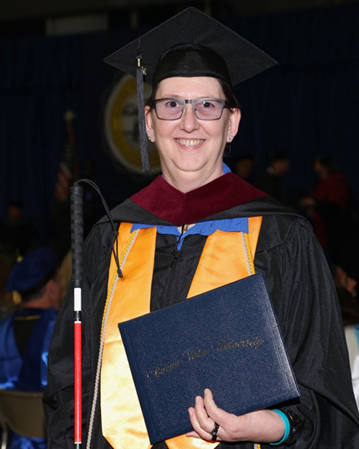
My name is Laurie, and I live with Usher syndrome, the leading cause of combined hearing and vision loss. I’ve worn hearing aids since the age of five, so I was already familiar with adapting to hearing loss. But when I was diagnosed with Usher syndrome in 2012, it introduced an entirely new challenge: vision loss. Suddenly, I was navigating not just one sensory loss, but two. That dual sensory loss has a unique impact on my communication access and daily life, requiring me to find new ways to connect, learn, and work.
At first, I resisted. I wanted to keep life the same, but close calls driving at night made it clear that things had already changed. Letting go of my driver’s license was one of the hardest milestones for me. It felt like a piece of my independence had been stripped away. But it also forced me to ask: What’s next? How can I move forward?
For me, moving forward meant going back to school. I earned a certificate in Human Services from North Iowa Area Community College (NIACC) in 2016, graduating with an Associate of Arts degree, honors, and receiving Phi Theta Kappa recognition. I then transferred to Buena Vista University (BVU), where I completed my Bachelor of Arts in Human Services with honors in 2019, and later my Master of Arts in Organizational Leadership in 2025. Pursuing higher education while navigating vision loss wasn’t easy, but it taught me that with persistence, creativity, and the right tools, barriers can be overcome.
I rely heavily on Apple products, utilizing the magnification features built into my iPhone, iPad, and MacBook. I often enlarge the screen, adjust contrast, and utilize accessibility shortcuts to read materials. I also use digital textbooks in PDF format and combine magnification with listening to maximize comprehension. These tools allow me to stay organized, read, and keep up with my work. Support also came from classmates who served as notetakers during classes. Those simple accommodations made a huge difference. I had to learn that asking for help wasn’t a weakness, but a way to create success.
In 2019, I began working as a DeafBlind Employment Specialist at the Helen Keller National Center (HKNC). That job gave me the chance to support others while continuing my own journey. Through HKNC, I received cane training at the Center in New York. That training gave me the confidence to travel independently and safely.
|
 |
|
One of the biggest turning points in my journey was learning about Support Service Providers (SSPs), trained guides who provide environmental, mobility, and communication support to individuals who are DeafBlind. At first, I was stubbornly independent and thought I didn’t need that kind of help. But colleagues and friends showed me that SSPs don’t take away independence; they expand it. With an SSP, I’ve been able to present at international and national conferences, co-facilitate workshops for youth, and even discover fireflies for the very first time. That moment, with my SSP guiding my hand so I could track the light of the fireflies, stays with me. It was a reminder that vision loss doesn’t mean losing out on life, it just means finding different ways to access it.
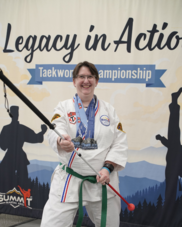
Another step in moving forward came when I joined the local ATA Taekwondo Summit Martial Arts school in 2024. I began training for both my physical and mental well-being. Today, I hold the rank of Blue Belt, and Taekwondo has become an unexpected source of confidence, discipline, and strength. My instructor encouraged me to step out of my comfort zone and compete, and that challenge led me to win the 2025 Iowa State Championship in my division. Taekwondo continues to remind me that barriers are often within us, and that with determination, growth, and support, new possibilities are always within reach.
Living with dual sensory loss has taught me the power of persistence, creativity, and self-advocacy, along with the importance of accepting support. Speaking up for my needs and being open to help have given me access to tools, confidence, and opportunities I might not have found otherwise. My advice to students is this: don’t be afraid to advocate for yourself and accept support when it’s offered. These are not signs of weakness, but strengths that open doors and allow you to reach your true potential.
Living with Usher syndrome has taught me that while I can’t control every challenge, I can control how I rise to meet them. And that choice, to keep moving forward, is where the real possibility begins.
|
 |
|
Building BRIDGEs
As students navigate the world of high school and begin thinking about the future, we offer services and resources that provide a foundation for success. Each of the core areas of our BRIDGE framework highlights an essential component that teenagers need in order to succeed after high school:
-
Basic Skills
-
Role Models
-
Initiative
-
Discovery
-
Goal Setting
-
Experiences
|
Vision Loss Disclosure
When should vision loss be disclosed to an employer? Every situation is different, and here are three resources that can help you decide this question:
Media and Public Opportunities
-
Lighthouse Guild Tele-Support for Teens: Connect with other teens from across the country! Telephone support groups for high school students who are blind or have low vision are available every other Monday.
-
BlindNewWorld, powered by Perkins School for the Blind, is a first-of-its-kind social change campaign that aims to empower the blind and visually impaired community while demystifying blindness and breaking down the barriers to inclusion at school, work, and in the world at large. BlindNewWorld is a place for exchanging experiences, promoting advocacy, demanding accessibility, and fostering inclusion
-
org This site is designed for teachers, families, and others interested in literacy for children and youth with visual impairments, including those who are deafblind and/or have multiple disabilities.
Adjusting to Vision Loss
- Janice Barrocas is a counselor in Georgia who specializes working with individuals adjusting to their vision loss. She writes a blog with valuable insight from her work: adjustingtovisionloss.com/blog.
- The article "Emotional Adjustment to Vision Loss: It’s a Family Matter" emphasizes that vision loss is not only a deeply emotional experience for the individual affected but also significantly impacts their loved ones, who often take on caregiving roles. It outlines the seven emotional phases of adjustment to vision loss and highlights the importance of learning adaptive skills to regain independence and reduce long-term caregiver burden.
-
Development of Young Adults with Blindness or Low Vision: Here you will find resources that address the complex emotional and social challenges teenagers face, especially those who are blind or have low vision. It covers areas like emotional support, adapting to blindness, the social implications of not driving, academic independence, and navigating social media safely.
Ideas?
We are always looking for ideas you’d like to see featured in this newsletter. Please email shane.desantis@state.mn.us with any suggestions or brainstorming.
|