|
|
Office of Inspector General - Licensing Division - September 22, 2026
|
|
|
This monthly newsletter provides highlights of key changes about the revised child care licensing standards taking effect July 1, 2027.
|
|
Spotlight: Community-based family child care
Beginning July 1, 2027, special family child care will be renamed community-based family child care (CBFCC). The revised licensing standards also make a change to how these programs may operate.
What is changing?
-
A new name. Special family child care will become community-based family child care (CBFCC).
-
Up to six programs may operate in one building. Currently, up to four special family child care programs may operate at the same location or under one contiguous roof. Beginning July 1, 2027, up to six separately licensed community-based family child care programs may operate at the same location or under one contiguous roof when applicable requirements are met and the location does not have an R-2 residential occupancy designation. Applicants can determine an R-2 occupancy designation by contacting the local building official. If there is no local building official, the State Fire Marshal Office can assist. Applicants are encouraged to reach out prior to moving into the location to confirm the occupancy of the space.
What is staying the same?
-
Each program must remain distinct. Each licensed program must operate separately and maintain its own program operations.
-
Shared spaces must be used at different times. Programs may share common spaces, including outdoor play areas, but the programs cannot use those shared spaces at the same time.
-
Shared space must be planned for. Programs must identify in their program plans how shared spaces will be used separately to maintain distinct program operations. For example, if programs will share a playground, each program must identify which times of the day they will be using that space, and they must all be at different times.
You can read the updated standards related to community-based family child care on the state Revisor’s website. Later this year, the revised statute will be codified as MN Statutes, section 142I.22.
Spotlight: Overnight care requirements established
Effective July 1, 2027, the revised licensing standards will establish specific requirements for family child care programs that provide overnight care. These requirements apply when a child is in care after 11 p.m. and before 5 a.m. This includes children who are in care for any portion of that time.
What is changing?
Programs providing care will need to:
-
Have an adult caregiver awake at all times. At least one adult caregiver must remain awake and available to respond to children’s needs. Required caregiver-to-child ratios must continue to be met. Additional caregivers may sleep if ratios are maintained and they are available when needed.
-
Provide a separate space for children who are awake. Awake children must have the opportunity to participate in age-appropriate activities in a separate room away from children who are sleeping.
-
Plan for emergencies during overnight care. The program’s child care emergency plan must include how the program will respond to emergencies when children are sleeping.
You can read the updated standards related to overnight care on the state Revisor’s website. Later this year, the revised statute will be codified as MN Statutes, section 142I.07, subdivision 5.
|
|
Spotlight: Outdoor learning environment and play space
Beginning July 1, 2027, child care centers will have updated requirements for outdoor play equipment, fall zones, and the use of natural features.
What is changing?
-
Outdoor equipment will be based on capacity. Providers must provide enough outdoor play equipment and materials so that every child can choose from at least one activity when all children are outdoors. Equipment or materials which allow multiple children to do the same activity counts as an activity choice for multiple children, provided there is still room for children to join. The quantity of outdoor equipment and materials provided must be based on the maximum licensed capacity of the outdoor play area. While the law doesn’t specify “of the outdoor play area” in the text, this requirement was intended to mirror the indoor activity requirement which is based on the maximum licensed capacity of the classroom. This requirement applies when any children are outside in an outdoor play area.
-
Fall zone requirements are more specific. Providers must ensure there is a fall zone around installed outdoor equipment. The fall zone must be equipped with an energy-absorbing surface under climbing equipment, swings, and slides. An energy-absorbing surface can be loose sand, pea gravel, or mulch, at a depth of at least nine inches; any material that meets ASTM F1292 specifications; or shredded rubber and poured energy-absorbing surfacing installed to manufacturer’s specifications based on the height of the equipment.
-
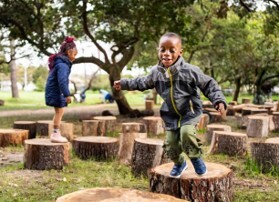
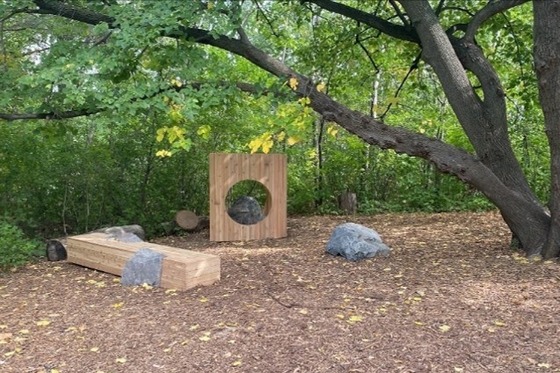
Natural features may be used for play. When a child uses natural features for outdoor play, a program staff person must remove hazardous objects and mitigate hazards whenever possible from the area where children might fall. For example, children may play on tree stumps or logs if the provider has made sure there are no broken or sharp branches or other hazards present. Natural features used for outdoor play must be appropriate to the age and size of children, in safe condition, and used under the supervision of a program staff person.
What is staying the same?
-
Outdoor space requirements remain the same. Centers that are operating as a day program for more than three hours per day must provide an outdoor play space. The outdoor space must be at least 1,500 square feet in size and provide 75 square feet per child. Additionally, the outdoor space must be within 2,000 feet of the center.
-
Enclosure requirements remain the same. The outdoor activity area must be enclosed if it is located near a hazard, including but not limited to traffic, railroad tracks, water, or machinery, unless the area is a public park or playground.
See the chart below for a side-by-side comparison of the current requirements (MN Rules 9503.0155, subpart 7) and the revised requirements.
|
Topic
|
Current requirement
|
Revised standards
|
|
Outdoor space available
|
Required for all programs except night care, drop-in care, sick care, or programs operating fewer than three hours a day.
|
No change.
|
|
Size
|
Minimum 1,500 square feet, 75 square feet per child.
|
No change.
|
|
Where outdoor space may be located
|
Within 2,000 feet of the center for children under school age unless transportation is provided; no farther than one half-mile from the center.
|
No change.
|
|
Enclosure requirement
|
Must be enclosed if adjacent to hazards (including traffic, railroad tracks, water or machinery) unless the space is a public park or playground.
|
No change.
|
|
Equipment requirement
|
For toddlers, preschoolers and school-age children, three pieces of durable, outdoor, large muscle equipment per group.
|
The license holder must provide sufficient outdoor play equipment and materials so that every child can choose from at least one activity when children are outdoors.
The quantity of outdoor equipment and materials provided must be based on the maximum licensed capacity of the outdoor play area.
|
|
Hazards
|
The area must be free of litter, rubbish, toxic materials, water hazards, machinery, animal waste, and sewage contaminants.
|
The statute removes litter and rubbish and adds broken glass, unlocked vehicles, and feces as example hazards:
“The play area must be free of potential hazards, including but not limited to broken glass, toxic materials, machinery, unlocked vehicles, feces, and sewage contaminants.”
|
|
Fall zone
|
The area must be free of hazardous objects, as specified in MN Rules 9503.0140, subpart 17.
|
An energy-absorbing surface (fall zone) is required under installed climbing equipment, swings, and slides.
An energy-absorbing surface can be loose sand, pea gravel, or mulch at least nine inches deep; any material that meets ASTM F1292 specifications; or shredded rubber and poured energy-absorbing surfacing installed to manufacturer’s specifications based on the height of the equipment.
|
|
Natural features
|
Not specified
|
Natural features used for outdoor play are not subject to the requirements for fall zones around climbing equipment, swings, and slides. When a child uses natural features for outdoor play, a program staff person must remove hazardous objects and mitigate hazards whenever possible from the area where children might fall. Natural features used for outdoor play must be appropriate to the age and size of children, in safe condition, and used under the supervision of a program staff person.
|
See the photos below for examples of acceptable natural features.
You can read the updated standards related to outdoor learning environment and play space and outdoor play equipment on the state Revisor’s website. Later this year, the revised statutes will be codified as MN Statutes, sections 142H.34, subdivision 7; and 142H.14, subdivision 3, respectively.
Credit: Getty Images
Photo Credit: Brandon T.
|
|
|
Questions and feedback may be submitted to ccregmodernization.dcyf@state.mn.us and will help inform future guidance and communications. While we may not be able to reply to each message individually, we are reading each one and using your questions and feedback to directly inform our implementation planning.
Sign up for future revised licensing standards newsletters by subscribing to the family child care or child care center email list
You received this email because you are a child care provider, licensor, county supervisor, licensing employee, or you subscribed to the Child Care Regulation Modernization or other Licensing listservs.
|
|
|
|
|