Child care center FAQs
Question: The revised standards prohibit “posting content of children in care on a personal social media account.” Is an employee resharing one of the center's own public posts to a personal account (for example, sharing a center Facebook post to their personal story or feed) considered "posting content of children in care on a personal social media account"?
Answer: If a center follows all requirements, including obtaining written parental consent, in creating a public post, a subsequent reposting of that public post by a staff person would not fall under the prohibitions outlined in the revised standards (MN Statutes 2026, section 142H.22).
Question: Some employees have personal relationships with enrolled families (relatives, neighbors, family friends) and may photograph or post those children in a purely personal context outside the program. Does the prohibition in the revised standards extend to content of enrolled children captured outside of care in a personal capacity, and if so, how should a center's policy address it?
Answer: The revised standards apply to conduct while providing care for children enrolled in the program. They are not intended to cover personal conduct outside the program that are unrelated to the operation of the child care program.
Centers may create their own requirements so long as they meet the minimum requirements of the statute. For example, a center may prohibit any and all posting of photos from the center.
Family child care FAQs
Question: When is a fence or natural barrier required, and when can I use a supervision and safety plan?
Answer: The June newsletter introduced the new requirements related to fences, natural barriers, and supervision and safety plans. This month additional guidance is being provided to clarify when each option applies.
Water hazards:
If there is a water hazard on or adjacent to the family child care site, children in care must be prevented from accessing the water except during supervised use. This means a fence, building wall, or other physical barrier must separate children from the water hazard. Examples include: Lakes, ponds, swimming pools, hot tubs, reservoirs, wetlands, or other similar water hazards.
The fence or other physical barrier must be at least 4 feet high and may include an exterior wall or the home if it prevents children from accessing the water hazard. The exterior wall of the home can count as part of the required physical barrier if it does not have a door or window that provides direct access to the enclosed water hazard space (e.g., an emergency escape (egress) window).
Providers may choose to fence the entire outdoor play area, or only the area around the water hazard (like the swimming pool or hot tub), depending on their property and how children use the outdoor space.
If you already have a fenced pool or hot tub, you are likely already meeting these new requirements. However, it is always good to check with your licensor to confirm your arrangement meets the requirements.
You can read the updated rules related to water hazards on the state Revisor’s website. Later this year, the revised statute will be codified as MN Statutes, section 142I.14, subdivision 7.
Other outdoor hazards:
A supervision and safety plan may be used for other nearby outdoor hazards, such as: Roads, railroads, construction sites, temporary hazards, or other hazards identified with the licensor.
A supervision and safety plan should describe the specific steps the program will take to keep children safe. For example, instead of simply stating “children will be supervised,” the plan should describe specific actions the caregivers will implement to adequately supervise the children in care, such as:
- How caregivers will establish clear play boundaries;
- How caregivers will be positioned between children and the hazard;
- How the outdoor play space will be set up and secured from potential hazards;
- How caregivers will remain available and in close proximity to school-aged children in outdoor play area;
- If proposing to supplement supervision with electronic monitoring devices, how they will be used and checked for proper functioning.
DCYF is developing a supervision and safety plan template that will be shared before July 1, 2027.
You can read the updated rules related to other outdoor hazards on the state Revisor’s website. Later this year, the revised statute will be codified as MN Statutes, section 142I.14, subdivision 3.
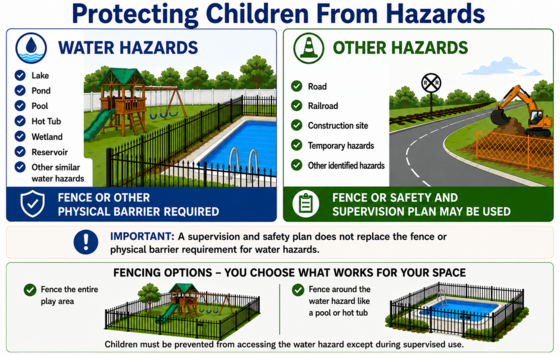 This image was created using artificial intelligence
Question: Can my pets be in the kitchen or food preparation area?
Answer: Pets are not always prohibited from being in the kitchen or food preparation area. However, when food is being prepared or served, pets and other animals must be prevented from accessing food preparation, storage, and serving areas unless they are confined in a cage or kennel.
The purpose of this requirement is to help keep food preparation and serving areas sanitary. The licensing standards do not require a specific method for keeping pets out of these areas. Providers may choose the approach that works best for their program and animal, such as using a gate, closing a door, or another effective barrier that prevents animals from accessing the area while food is being prepared or served.
You can read the updated rules related to pets in food preparation areas on the state Revisor’s website. Later this year, the revised statute will be codified as MN Statutes, section 142I.19, subdivision 4.
CCC and FCC Miscellaneous FAQs
Question: Where can I find previous newsletters about the updated licensing standards and implementation?
Answer: Previous monthly newsletters are available on the Revised Child Care Licensing Standards webpage. Each newsletter includes a Licensing Standards Spotlight and Frequently Asked Questions about the updated licensing standards. Providers are encouraged to review previous newsletters to see if their question has already been answered. Additionally, the Office of Inspector General has created a new webpage dedicated to the implementation of the revised licensing standards for child care centers and family child care.
|



