|
Welcome to Gaining
Green -- news you can use about renewable energy, including innovative
initiatives in our state, technological advancements, financial incentives,
trainings, and events. If you would like to change preferences for the
newsletters you are currently subscribed to or if you want to unsubscribe, use
the links provided at the bottom of this message.
- Minnesota Department
of Commerce, Division of Energy Resources
EQB issues Minnesota Environment and
Energy Report Card
Minnesota
utilities are meeting—and in many cases exceeding—their renewable energy
electricity standard milestones. That is one of several findings contained in
the energy section of the Minnesota
Environment and Energy Report Card, compiled and recently released by the
Minnesota Environmental Quality Board.
The
report, which looks at the areas of water, land, air, energy, and climate, says
the state’s “heightened emphasis on renewables” stems from an ambitious Minnesota
Renewable Energy Objectives statute that requires at least 25 percent of electric
utilities’ total electric sales to retail customers in Minnesota be generated
from renewable sources by 2025, and that Xcel provide at least 30 percent by
2020. The report also notes that state-mandated energy conservation programs
enacted by utilities have cut the growth rates of natural gas and electricity consumption
in half.
The
report card set the stage for a series of statewide citizen forums held earlier
this month that gathered public input on the environment. It also leads up to
an Environmental Congress that will be held March 2013 (date and location TBD).
The report was prepared to fulfill Executive Order 11-32 and is the
first of what will be an annual report. The Environmental Quality Board is
chaired by the Governor’s Office and includes five citizens and the heads of
nine state agencies that play a vital role in Minnesota’s environment and
development. For more on the Environmental Quality Board, visit www.eqb.state.mn.us.
Will Steger, Fresh Energy climate change
forums attract over 2,500
More than 2,500 people from across Minnesota
attended the recent eight-forum series on Clean Energy, Climate, and Health,
and more forums may be held this spring. The forums featured noted Minnesota
polar explorer Will Steger and J. Drake Hamilton, science policy director for
Fresh Energy.
Steger presented a
firsthand account of climate change with stunning photographs from his
expeditions, while Hamilton offered the audience effective clean energy and
clean air solutions to help improve our environment.“In every case, the
forums were well attended, with community leaders including state legislators,
Congressional staff, business leaders, mayors and city council members, and
faith leaders participating,” said Hamilton. “We also received great media
coverage to help spread our message.”
Hamilton said funding is being sought
for more forums this spring. The Division of Energy Resources attended several
of the recent forums and provided resources to attendees; it hopes to
contribute to future forums. Watch the Fresh Energy website for dates and
details of upcoming forums.
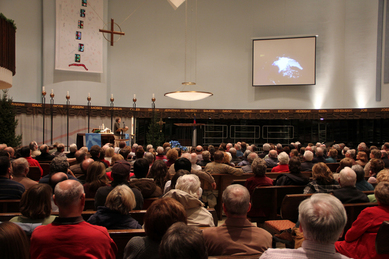
Nearly
400 people turned out on Dec. 4 to hear Will Steger and J. Drake Hamilton
present at a Clean Energy forum at Vinje Lutheran Church in Willmar.
Agenda, early registration now available
for 2013 CERTs conference
The
agenda for the 2013 Clean Energy Resource Teams (CERTs) statewide conference is
now available, along with information on early bird registration that ends Jan.
15. The conference will take place Feb. 20-21 at the St. Cloud River’s Edge
Convention Center in St. Cloud and is open to anyone with an interest in clean
energy. The meeting will celebrate successful energy efficiency and renewable
energy projects from the last 10 years and will address some clean energy projects
planned for CERTs regions in 2013. More information on the conference,
including registration, is available here.
DER urges consumers to practice energy
efficiency during holidays
In
a recent news release, the Minnesota
Department of Commerce, Division of Energy Resources (DER) encouraged consumers
to practice energy efficiency for this holiday season and holidays to come. DER
points out that ENERGY STAR®-qualified LED decorative lights are
exceptionally energy efficient, many using up to 90 percent less energy than
incandescent bulbs. The U.S. Department of Energy estimates the cost of buying
and operating LED lights for 10 holiday seasons would be $17.99 compared with
$122.19 for incandescent bulbs. Other advantages of the LED lights are cited,
and information on recycling old lights is included.
Minnesota Solar
Challenge workshops set for Duluth, St. Paul
The
series of Minnesota Solar Challenge best practices workshops will continue with
events set for Jan. 15 from 12:30-4 p.m. at the Hartley Nature Center in Duluth
and Feb. 6 from 12:30-4 p.m. at the Minnesota Counties Intergovernmental Trust
in St. Paul. The workshops are geared to inform local government officials about
solar energy best practices in planning, zoning, and permitting, as well as the
free assistance offered by the Minnesota Solar Challenge.
The
workshops will review the rapidly evolving world of community-scale solar
energy markets, technologies, and regulation, with a special emphasis on
addressing renewable energy resources in plans, development regulation and
building code permitting. For more workshop
information and to register…or contact Catherine
Dubbe at GTS Educational Events at cdubbe@mngts.org
or 651-222-7409, ext. 200
The
Minnesota Solar Challenge provides free technical assistance to communities
that want to implement the best practices presented in the workshops.
Communities in need of technical assistance should contact Laura Cina at laurac@mnrenewables.org. More
information on the Solar Challenge and the Solar Technical Assistance Helpline
is available here.
MPCA,
DOE offer videos on electric vehicles
Two videos to help introduce consumers
to electric vehicles are offered by the Minnesota Pollution Control Agency (MPCA)
and the U.S. Department of Energy (DOE). The MPCA provides “Will Your Next
Car Be Electric?”—which
profiles two Twin Cities electric vehicle owners and shows their positive
experiences with EVs—and the DOE provides “Energy 101:
Electric Vehicles”—which
provides the basic principles of electric vehicles and describes some myths
about EVs.
DER website features Electric Vehicle
section
The
Division of Energy Resources offers several resources about electric vehicles
on its website. It includes a section from Drive Electric Minnesota, a
partnership working to bring electric vehicles and plug-in charging
infrastructure to Minnesota, and information on EV charging stations throughout
Minnesota and the nation. The web resources cover the benefits of EVs, the
expansion of charging stations, and links to other EV resources. The DER web
content is available here.
Minnesota ALA gets grant to advance
alternative fuel vehicles
The
U.S. Department of Energy (DOE) on Nov. 19 announced 20 new projects, including
one for Minnesota, to help states and local governments cut red tape and develop
infrastructure, training and regional planning to help advance alternative fuel
cars and trucks, including those that run on natural gas and electricity.
The
Minnesota chapter of the American Lung Association and project partners
received a $248,788 grant for its Accelerating Alternatives for Minnesota
Drivers project. The project, part of DOE’s Clean Cities Initiative, will
provide alternative fuel and vehicle first-responder safety trainings; develop
a natural gas vehicle workgroup; establish a Minnesota green fleet recognition
program; and further the deployment of electric vehicles and EV supply
equipment through workshops, trainings and resource development.
U of M to receive $1.8 million grant to
improve biofuel production
The
University of Minnesota was selected to receive a $1.8 million grant to develop
an ultra-thin separation membrane to improve the production of biofuels,
plastics, and other industrial materials, it was announced Dec. 6 by U.S.
Department of Energy Secretary Steven Chu. Today’s separation methods are
energy intensive and costly. If fully implemented by industry, such a new class
of membranes could reduce U.S. energy consumption by as much as 3 percent.
Minnesota’s
project is one of 66 cutting-edge research projects selected by DOE’s Advanced
Research Projects Agency—Energy. The projects are considered transformational
technologies that have potential to produce breakthroughs in energy technology.
View more information
on the projects.
|