|
Welcome to CIP News, where you will find
the latest news and information on a wide range of Conservation Improvement
Program (CIP) topics. Use the links at the bottom to update your existing
subscription profile or to sign-up as a new subscriber.
If you have comments or questions, please
send your inquiry to the email address at the bottom of this newsletter.
CERTs
series features Paul Twite of Delano Municipal Utilities
In last month’s issue, the featured
source in the second part of the CERTs Q&A series on compressed air leaks
was reported incorrectly. Paul Twite of Delano Municipal Utilities was the
source in Part 2 of the
two-part series.
CARD
Grant Program update
The purpose of the Conservation Applied
Research and Development (CARD) grant is to identify new technologies,
strategies and program approaches that utilities can implement to help achieve
the annual state energy conservation goal of 1.5 percent as established by the
Next Generation Energy Act of 2007. Two ongoing CARD projects are described
below.
More sites sought for convenience store pilot, particularly
from municipals
In our March 2012 CIP newsletter, we
described the Convenience Store Energy Efficiency CARD grant pilot project
awarded to Michaels Energy. This project
focuses on optimizing the performance of existing equipment, lighting, motors,
air infiltration and controls rather than major equipment replacements (see Figures
1 and 2). Any convenience store that has older equipment could benefit from
this pilot project.
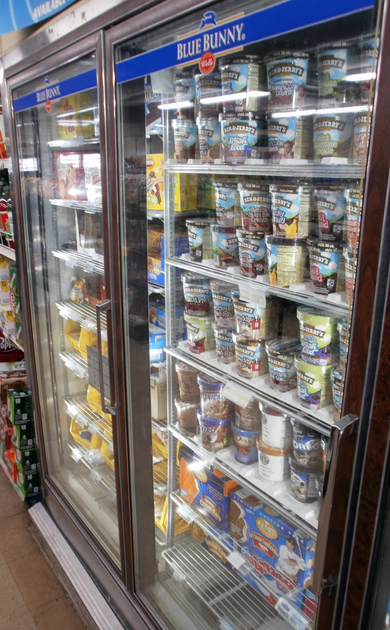
Figure 1. Operating costs for older coolers and freezers,
like the ones above, oftentimes can be reduced up to 20 percent by replacing
door seals, implementing lighting retrofits, and installing door heater
controls. (Photo courtesy of Michaels Energy)
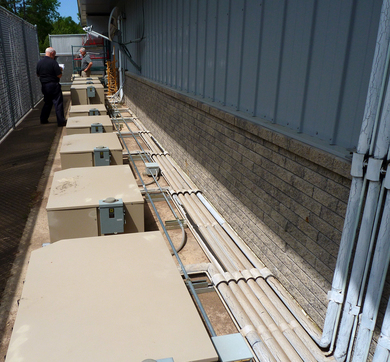
Figure 2. A typical bank
of outdoor compressor units like the one above usually represents about 50
percent of the total electric costs for a convenience store and can yield up to
10 percent in overall cost reductions if the right retrofits to optimize
operation are implemented. (Photo courtesy of Michaels Energy)
The project has completed audits on four
primary sites, which revealed opportunities to reduce annual operating costs by
15 to 17 percent per site. Results from these audits are being used to develop
a template for delivering services in an additional 46 Minnesota convenience
stores. Twenty of these additional sites
have been identified, but more sites are needed in order to adequately test
this pilot program. The end date for this grant is being extended accordingly.
Please contact Ralph Dickinson (651-900-4710) from Michaels
Energy if you know of any Minnesota convenience stores that could participate
in this pilot. Pilot sites located in the service territories of
municipal utilities are particularly sought, because the grant is
specifically aimed at helping municipals stretch limited resources to address a
customer type that is often difficult to impact. However, prospective sites
within investor-owned utility territories are also encouraged to participate.
Drainwater Heat Recovery in Existing Commercial Buildings
Heating hot water in commercial
buildings can account for a large proportion of overall energy consumption,
particularly in buildings with specific water-intense activities such as food
service facilities, commercial laundries, health clubs, and large multifamily
buildings. Potentially, a drainwater heat recovery (DHR) system, which recoups
some of the heat ordinarily lost when warm water goes down the drain, could
save a significant amount of energy in these applications.
In order to determine whether or not
this technology is one that utilities should be promoting in their CIP
programs, a CARD grant to field test DHR in existing commercial buildings was
awarded to the Energy Center of Wisconsin (ECW). The purpose of
this project, called “Drainwater Heat Recovery in Existing Commercial
Buildings,” is to characterize the performance of DHR systems in up to four
sites specifically selected for high hot water use and high potential savings. The
study will also look at installation and operational issues related to DHR
systems.
ECW has completed installation of DHR heat
exchangers and is collecting data at three sites, with a fourth installation
planned this month. The four sites include an apartment building, a restaurant,
a self-service laundry, and a college dormitory (see Figure 1).
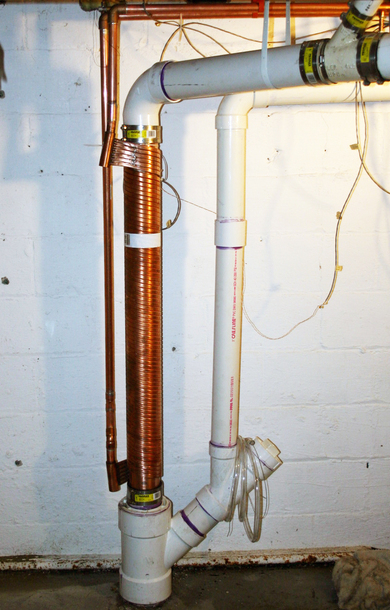
Figure 1. A drainwater heat recovery system was installed at
the self-service laundry test site located in St. Paul. (Photo courtesy ECW)
One result so far has been recognition
of many technical and other barriers to the installation of DHR systems as a
retrofit in commercial buildings, including the difficulty of finding drain
pipes that have adequate vertical height for installation of the heat
exchanger, and the high cost of re-plumbing in many commercial buildings which
have larger pipe sizes. The need to shut off water during the retrofit process
also means that installations sometimes need to be done at night.
Installation of DHR as part of new
construction projects reduces or avoids these barriers and may be more
supportable in CIP programs. The assessment of energy savings and operational
issues that results from this project will be applicable to new as well as
retrofit projects.
Bruce Nelson at the Division
of Energy Resources is the project manager on this CARD project, which is
scheduled for completion at the end of August 2013.
Midwest Energy Solutions Conference
extends early bird registration
The
2013 Midwest Energy Solutions Conference, to be held Jan. 16-18 at the Fairmont
Hotel in Chicago, has extended it early bird registration to Dec. 7 and is
offering travel support for government employees and nonprofit organizations.
The Midwest Energy Efficiency Alliance (MEEA) has secured funding to help pay
for the cost of attending the conference; deadline to apply for this funding is
Dec. 7.
The
conference is MEEA’s annual event to raise awareness about energy efficiency in
the Midwest. A range of efficiency topics are on the agenda, including how
utilities can engage industrial customers to achieve greater energy savings.
For more on the conference and how to register, visit www.meeaconference.org
Guaranteed Energy Savings Program
workshop is Dec. 7 in Minneapolis
A
workshop about energy savings performance contracting (ESPC) and the state’s
new Guaranteed
Energy Savings Program (GESP) will be held on Dec. 7 from 9 a.m. to 3 p.m.
at Xcel Energy (414 Nicollet Mall) in Minneapolis. The workshop is an
opportunity for executives, finance officers and facility directors from
Minnesota state agencies, colleges and universities, local units of government,
and K-12 school districts to learn about ESPC best practices and GESP. It will
cover the GESP technical, contractual
and financial assistance available to facilities considering energy efficiency
and renewable energy improvements.
The
workshop is hosted by the Minnesota Department of Commerce and the Minnesota
Chapter of the Energy Services Coalition. Register online at http://bit.ly/T7eqal or call Eric Rehm at
651-296-6446.
Will Steger, Fresh Energy lead forums on
clean energy, climate change
Will Steger and Fresh Energy’s J. Drake
Hamilton will continue their series of public forums on Clean Energy, Climate,
and Health with four presentations across the state. Steger, Minnesota’s
eyewitness to climate change, will document his account of climate change with
stunning photographs from his polar expeditions, while Hamilton, science policy
director for Fresh Energy, will discuss effective clean energy and clean air
solutions. The upcoming forums are free and open to the public. They will be
held:
- Nov.
29 at John Marshall High School in Rochester
- Dec.
3 at Bethlehem Lutheran Church in St. Cloud
-
Dec.
4 at Vinje Lutheran Church in Willmar
- Dec.
9 at Bethel University in St. Paul
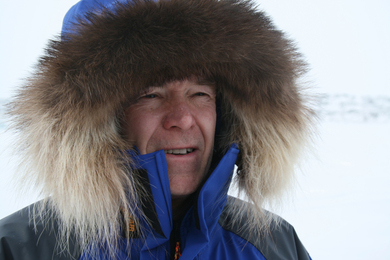 Will Steger
Minnesota Department of Commerce,
Division of Energy Resources staff will attend several of the forums and will
provide information and materials on energy-saving opportunities for homes and
businesses. Access more information on the forums.
2013 CERTs annual meeting is Feb. 20-21
in St. Cloud
The
fifth statewide Clean Energy Resource Team (CERTs) meeting to explore and celebrate
successful energy efficiency and renewable energy projects is set for Feb.
20-21 at the St. Cloud River’s Edge Convention Center in St. Cloud. Learn more about
the conference.
Opower study shows the energy efficiency of smartphones
The energy used on a smartphone to send emails, surf the Internet, and watch videos pales in comparison to the energy used to do those things with traditional electronics such as laptops, PCs, or TVs with video game consoles, so says a study by Opower. The study found that charging an IPhone 5 from zero power to full power once a day for a year costs only 41 cents, while the annual electricity cost for a laptop PC is $8.31, $28.21 for a desktop PC, and $41.13 for a plasma 42-inch TV.
Opower blogger Barry Fischer analyzed the study and highlighted two key facts:
- the huge trend of smartphones (106 million used in the United States) to perform functions traditionally done on computers, televisions, and gaming consoles, and
- that smartphones and tablets use much less energy than the larger devices they’re displacing.
However, Fischer is also quick to point out that the study’s energy stats represent only in-home energy consumption; they don’t reflect the energy requirements of data centers, whose massive computer servers sustain the huge Internet traffic boom generated by smartphones and carry a heavy energy price tag of their own.
Sign up for new energy efficiency newsletter for homeowners
A new energy efficiency newsletter geared for homeowners and consumers will debut in December. The newsletter, produced by the Minnesota Department of Commerce, Division of Energy Resources (DER), will feature information and resources to make homes more energy efficient. Topics will range from no-cost and low-cost energy-saving tips to financing energy-related home improvements. To subscribe, go to our sign-up page located here and check the box next to "Efficiency News."
DER consumer guide highlights energy conservation
About 30 percent of the energy used in a typical Minnesota household goes toward operating appliances, lighting and electronics. To learn about ways to conserve energy used to power these devices and equipment, check out “Lighting, Appliances, Electronics,” a consumer guide published by the Minnesota Department of Commerce, Division of Energy Resources (DER). The guide is downloadable via the DER website and is available in hard copy by contacting energy.info@state.mn.us.
|