|
Welcome to CIP News, where you will
find the latest news and information on a wide range of Conservation
Improvement Program (CIP) topics. Use the links at the bottom to update your
existing subscription profile or to sign-up as a new subscriber.
If you have comments or questions,
please send your inquiry to the email address at the bottom of this newsletter.
CARD
Grant Program update
The purpose of the Conservation Applied
Research and Development (CARD) grant is to identify new technologies,
strategies and program approaches that utilities can implement to help achieve
the annual state energy conservation goal of 1.5 percent as established by the
Next Generation Energy Act of 2007. Two of the ongoing CARD projects are
described below.
Capturing Energy Savings from Large Building Envelope Leakage
Reduction
Infrared scans and air leakage
investigations in large commercial and institutional (C&I) buildings
suggest that air leakage from the building envelope is a substantial problem
that remains unaddressed (see photos below). In fact, modeling conducted by
the National Institute of Standards and Technology suggests that infiltration
is responsible for 33 percent of the total heating energy use in U.S. office
buildings.
Nevertheless, most energy practitioners
working with C&I buildings in Minnesota disregard opportunities to improve
the energy efficiency of the building envelope. The reasons for this include
the conviction that such buildings are already fairly airtight, the expectation
that such buildings will be operated under positive pressure most or all of the
time, the belief that there are no cost-effective opportunities to reduce
envelope leakage, the lack of tools and expertise to diagnose opportunities to
reduce leakage, and the need for accurate methods to quantify energy savings
from air sealing work.
To overcome these impediments, a CARD
grant for the Large Building Envelope Leakage Reduction project was awarded to
the Center for Energy and
Environment
located in Minneapolis. Goals of this project include:
·
Developing,
field testing, refining and validating protocols to screen curtain wall
buildings for envelope leakage and to generate reliable retrofit cost
estimates;
·
Developing,
refining and validating tools to model the energy impacts of envelope leakage
and the energy savings achievable;
·
Preparing
a recommissioning provider toolkit to make the protocols and tools available to
practitioners in Minnesota for use in utility CIPs.
Work on this project has been underway
since May 2010. To date, initial investigations and reports have been completed
in 25 C&I buildings, with pressure monitoring accomplished or in progress
for 15 of these. In addition, five of these sites have been identified for
intensive testing to validate and refine protocols and tools, and three sites
have been identified for validating cost and savings of air sealing retrofits.
This
project is scheduled to be completed at the end of June 2013. The Division of
Energy Resources project manager for this CARD project is Subodh Patel.
Restaurant Energy Conservation Operation and Maintenance
Project
Results of the U.S. Energy Information
Services Commercial
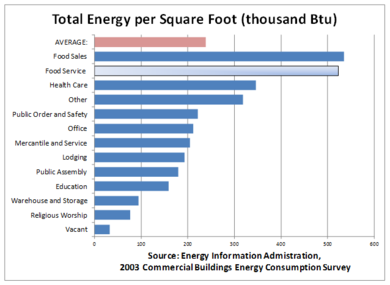
Buildings Energy Consumption Survey continually show that businesses in the
food service industry (for example, restaurants, convenience stores, and
grocers) are among the most energy intense (Figure 1).
 While many strategies and technologies
are well documented to improve the efficiency of end-uses in the food service
industry, most small business owners and managers lack the time, resources and
expertise to implement these modifications on their own.
The purpose of the Restaurant Energy
Conservation Operation and Maintenance Project is twofold. The first is to
document market potential specific to Minnesota, including how many food
service businesses there are in the state, what specific opportunities apply in
those businesses, and, by partnering with businesses for a three-year period,
tracking the energy savings that result from implementation of applicable
measures. The second is to demonstrate which components or aspects of the
project are most successful in terms of motivating business owners and managers
to implement recommended measures.
The Food Service Energy Leadership
Program, created by the original grant recipient (the Green Institute) and
subsequently transferred to Eureka
Recycling in
Minneapolis, administers this CARD project to participants. In progress since
May 2010, 50 food service businesses are receiving a range of assistance including:
·
energy
use assessments with identification of site-specific opportunities;
·
customized
technical support;
·
analyses
of custom rebate options and assistance with application;
·
education
regarding energy saving operation and maintenance procedures;
·
training
for management and operational staff regarding behavioral changes that save
energy;
·
quantification
of actual energy savings;
·
follow-up
to ensure best practices for optimizing and sustaining energy savings.
Additional
resources for the food service industry and case studies on a similar Eureka
Recycling project can be found at the Food
Service Energy Efficiency Toolkit webpage, housed on the Clean Energy Resources
Teams (CERTS)
website.
Results of this pilot will help to
inform the design of similar programs for inclusion in CIP portfolios, and
provide the data analysis necessary to determine the potential for prescriptive
rebates. Joe
Plummer
at the Division of Energy Resources is the project manager on this CARD
project, which will be completed at the end of July 2013.
Energy
Savings Platform™ Update: Measure-level reporting postponed
As
previously communicated, the Division of Energy Resources planned on requiring
measure-level reporting for all utilities starting with program year 2013 data.
Those organizations that intend to use their own internal tracking systems
rather than Smart Measures require DER to provide a measure-level reporting
specification that describes what information must be reported with each
measure installed.
Due
to higher priority obligations and the fact that final measure specifications for
2013 have not been determined yet, DER and Energy Platforms have been unable to
complete the measure-level reporting specification. Therefore, we have
decided to postpone the measure-level reporting requirement by one year, to
take effect beginning with 2014 data. We are targeting release of a draft
reporting specification by the end of Q1 2013 to allow utilities sufficient
time to review the specification, offer feedback, and implement the final
version.
Coops
and municipal utilities will continue to report their CIP achievements at the
program level in Energy Savings Platform (ESP®) by June 1 in
2013 and 2014. In ESP version 1.5, targeted for release in early 2013, we
plan on providing an interface for investor-owned utilities to report
program-level data as part of their 2012 CIP status reports.
Please
note that Smart Measures are operational and available to use now. We
encourage all utilities that haven’t already done so to make the switch
beginning January 2013.
Thank
you for your patience as we continue to develop and improve ESP. We hope these
updates are useful to you. Please contact project manager Joe Plummer at joe.plummer@state.mn.us or 651-296-6807
with any questions or concerns.
Utilities do not have to file Cold
Weather Rule report with DER
The Energy Information Center at the
Minnesota Department of Commerce, Division of Energy Resources (DER) wants to
inform Minnesota utilities—including cooperatives, municipals, and
investor-owned utilities—that they no longer are required to file a Cold Weather
Rule annual report with DER. The requirement for DER’s Energy Information
Center to compile data on disconnections or denials of fuel during the Cold
Weather Rule period was removed in 2011 from Minnesota
Statute 216C.11, Section 27.
Investor-owned utilities are required to
report Cold Weather Rule data to the Minnesota Public Utilities Commission,
according to Minnesota
Statute 216B.096, subdivision 11. Coops and municipals do not
have to report on the Cold Weather Rule to the PUC.
Lstiburek to present
building science seminar on Nov. 10
Noted
building science expert Joseph Lstiburek will present a Minnesota Society of
Housing Inspectors (MSHI) continuing education seminar on Saturday, Nov. 10 at
the University of Minnesota St. Paul campus. The seminar will cover a range of building science topics,
including “Stucco Update—What Is New with the Old,” “Basements in New and Old
Houses: Concrete to Block to Rubble,” “Vented and Unvented Roofs and Ice
Damming and Shingle Life,” and “Odor Problems with Low and High Density Spray
Polyurethane Foams.” The seminar is free to MSHI members and costs $100 for
nonmembers. Registration deadline
is Nov. 2. More seminar
information.
CEE to host Oct. 26 Lunch and Learn on E
Source Forum
On
Friday, Oct. 26 from noon to 1:30 p.m., the Center
for Energy and Environment (CEE) will host a Lunch and Learn debriefing
on the 2012 annual E Source Forum, which was held the week of Oct. 1 in Denver,
Colo. E Source is a subscription-based
service that provides information and primary research on industry best
practices, new technologies, and market intelligence to utilities, energy
service providers, government agencies and others. More than 400 people
attended this year, three of whom will be on Friday’s panel: Lester Shen, director
of Innovative Technologies at CEE; Nancy Lange, manager of Policy and
Engagement at CEE’s Innovation Exchange; and Mary Sue Lobenstein, R&D
program administrator at the Minnesota Department of Commerce, Division of
Energy Resources. Hot topics, new technologies, and innovative program
strategies from the forum will be discussed in a relaxed, informal setting.
Bring your own bag lunch.
Strong utility performance leads Minnesota
to top 10 ranking in 2012 Energy Efficiency Scorecard
Thanks largely to its strong utility-sector energy efficiency programs, Minnesota earned a top 10 national ranking for energy efficiency for the sixth straight year, according to the 2012 Energy Efficiency Scorecard released on Oct. 3 by the American Council for an Energy-Efficient Economy (ACEEE). Minnesota tied for ninth with Maryland; Massachusetts was first for the second straight year and was followed by California, New York, Oregon, Vermont, Connecticut, Rhode Island, Washington, Maryland, and Minnesota.
The Scorecard rates all 50 states and the District of Columbia according to policies and programs that encourage the efficient use of energy in many sectors of the economy. The report examines six policy areas: utility and public benefits programs and policies; transportation policies; building energy codes; combined heat and power; state government-led initiatives around energy efficiency; and appliance and equipment standards.
Minnesota scored second highest in the utility and public benefits programs and policies category, with 19 points, just behind Massachusetts. This category accounts for 40 percent of the Scorecard’s grade. Minnesota ranked fourth in net incremental electricity savings resulting from energy efficiency programs and was fifth in Energy Efficiency Resource Standards. The ACEEE report highlighted Minnesota’s performance in this category, stating:
“Minnesota’s investor-owned and publicly owned utilities offer broad portfolios of energy efficiency programs that have benefitted from consistent and strong regulatory support, allowing them to evolve and improve for many years. The state allows utilities to earn an incentive for successful energy efficiency program performance, and, in 2007, the state enacted the Next Generation Energy Act, which set aggressive energy-saving goals for utilities equal to 1.5 percent of sales each year. The impact of the Energy Efficiency Resource Standard is evident in the steadily increasing savings figures in the state.”
Minnesota was lauded for its long record of customer energy efficiency programs offered by utilities. “These programs and efforts have remained steadfast in Minnesota without any of the interruption or upheavals that have occurred in other states that restructured their electric utility industries,” said the report.
View more details on the Scorecard.
ACEEE white paper looks at utility
financial concerns of EE programs
A
white paper by Dan York and Marty Kushler from the American Council for an
Energy-Efficient Economy highlights the financial concerns facing utilities
relative to customer energy efficiency programs. The paper, titled “The Old Model
Isn’t Working: Creating the Energy Utility for the 21st Century,” outlines
three concerns: recovery of program costs, removal of the “through-put”
incentive (profits linked to increased energy sales, and providing earnings
opportunities for shareholders comparable to alternate utility investments. It
goes on to examine regulatory changes which could help create a new business
model that aligns utility financial objectives with meeting energy resource
needs through a balanced, lowest cost portfolio of both supply and demand
options.
CERTs
series highlights energy savings from fixing compressed air leaks
Compressed air leaks are a major
source of energy waste among commercial and industrial customers of utilities.
By recognizing and fixing air leaks, companies can reduce leakage and realize
extensive savings. A two-part series by Clean Energy Resource Teams (CERTs)
recently featured John O’Neil of Southern Minnesota Municipal Power Agency and
Joel Haskard of Delano Municipal Utilities. Both offer tips for fixing the air
leaks. View Part 1 and Part 2 on the
CERTs website.
Workshop
examines costs, benefits, policy options for DG
Stakeholders
gathered on Oct. 11 for a public workshop at the State Office Building in St. Paul
to talk about costs, benefits and policy options to facilitate and integrate increasing
levels of distributed generation (DG). The workshop, part of the Distributed
Generation Workshop Series coordinated by the Minnesota Department of Commerce,
Division of Energy Resources, featured presentations by guest speakers followed
by panel discussions. Lena Hansen, a principal with the nonprofit think tank
Rocky Mountain Institute, presented on “National Perspectives on DG Impacts,”
while Lisa Schwartz, a senior associate at the Regulatory Assistance Project,
presented on “National Perspectives on Net Metering and Related Policies.”
The
goal of the DG workshop series is to assess the level of DG penetration in
Minnesota and other states, explore policy options to support the use of DG,
and identify pathways to accommodate increasing levels of DG technologies in
Minnesota. Content from the Oct. 11 workshop and from past workshops, along
with comments from DG stakeholders, are posted on the DER website. DER welcomes
additional comments on next steps for DG policy research and development to
supplement the ideas discussed in the Oct. 11 workshop. Comments can be sent to
dg.energy@state.mn.us.
|