|
Funding Opportunities & Updates
Training Opportunities
Technical Information & Resources
|
|
Welcome to CIP News, where you will find the
latest news and information on a wide range of Conservation Improvement Program
(CIP) topics. Use the links at the bottom to update your existing subscription
profile or to sign-up as a new subscriber.
If
you have comments or questions, please send your inquiry to the email address at the bottom
of this newsletter.
CARD
Grant Program update
The purpose of the Conservation Applied
Research and Development (CARD) grant is to identify new technologies,
strategies and program approaches that utilities can implement to help achieve
the annual state energy conservation goal of 1.5 percent as established by the
Next Generation Energy Act of 2007. Two of these projects (one ongoing and the
other completed in 2011) are described below.
Energy Savings Platform™
The
Energy Savings Platform (ESP®) is a data
management, collaboration, and reporting platform for energy efficiency
programs developed by Energy
Platforms, LLC,
a Minnesota-based company. The Minnesota Department of Commerce, Division of
Energy Resources has funded a significant portion of ESP through CARD grants.
To date, ESP has been used for three rounds of data collection from Minnesota
electric cooperatives and municipal utilities covering the years 2008-2011. ESP
has introduced a number of innovations and improvements to the CIP process,
including:
·
Streamlined
reporting and data validation
·
Program
categorization enabling program performance benchmarking
·
A
cloud-based, centralized database of Minnesota utility CIP information and
sales data
·
Improved
data visibility and accessibility
·
Built-in
data analytic functions
With
the release of ESP v1.3 in May 2012, a major industry milestone was reached
through the introduction of Smart Measures™.
Smart Measures are object-oriented models of energy efficiency measures
that calculate savings and costs based on project-specific inputs. Once a draft
project is approved by the program manager, the savings and costs are then
applied to the utility’s CIP totals, enabling real-time tracking of progress
towards savings and budgets goals.
In
ESP v1.3, the entire Minnesota Technical Reference Manual (TRM), formerly known
as Deemed Savings Database, was implemented as Smart Measures, providing
utilities with State-approved savings formulas and assumptions. In ESP v1.4,
planned for November 2012, users will have the ability to design their own
Smart Measures using a graphical design editor.
Utilities and third-party implementers will also have the ability to
create their own Smart Measure libraries that they can choose to share with
other organizations. As more utilities get on the Platform and design new
measures, we envision that this feature will facilitate a continuous
improvement process whereby new measures, once piloted and reviewed by a
technical review committee, can be adopted in the State TRM.
ESP
v1.5, planned for early 2013, will include Minnesota-specific reporting
features such as savings carryover and savings goal calculations (including
weather-normalization). We also intend to implement a simple cost-benefit
calculator to enable utilities to monitor the cost-effectiveness of their
programs and portfolios.
Energy
Platforms continues to aggressively market ESP outside Minnesota, attracting
interest from a variety of organizations around the country including
utilities, regulatory agencies, energy service companies, and regional energy
efficiency organizations. Minnesota will benefit from having other states and
organizations using ESP through access to more energy efficiency information
that can help inform program design and performance benchmarking.
Feel
free to contact Joe Plummer at Joe.Plummer@state.mn.us or 651-296-6807
with any questions about ESP or how to set up an account so that you can start
reporting data on your Minnesota CIP programs using ESP.
Emerging Energy Efficiency Financing Mechanisms
The intended goal of this CARD grant, awarded to Franklin Energy and completed in January 2011, was to understand how innovative financing mechanisms are being applied to remove first-cost barriers to investment in energy efficiency. However, an essential finding of the study was that while money on the table is essential, money on its own cannot bring the customer to the table. Instead, the study found that successful financing mechanisms achieve success through collaborations which combine financing strategies with customer demand to leverage action.
The final report on this project
provides a wealth of knowledge on the topic of financing energy efficiency
including:
·
An
overview of relevant program stakeholders and their interests, providing an
understanding of the interrelationships between stakeholders and their
influence on the customer
·
A
summary of program best practices and lessons learned identifying takeaways
that can be applied in new program contexts
·
Insights
from model programs, including real examples of how program partnerships and
design elements serve to overcome barriers
·
Program
considerations for specific market/customer segments
·
An
analysis of contextual factors which explores broader industry, demographic,
and macroeconomic trends that have relevance to energy financing programs.
The report also contains six pages of
references and resources, with links to more than 70 industry reports and
publications, which are useful for exploring program models, case studies and
topics in greater detail.
Dakota Electric’s EnergyWise Expo is Oct.
4 in Eagan
Dakota Electric will hold its third-annual EnergyWise Expo for businesses on Oct. 4 at the Eagan Community Center in Eagan. The Expo offers businesses of all sizes a chance to learn about energy-saving technologies, ask questions, and reduce energy bills. Dakota Electric energy experts will help determine how businesses can save energy and save money. Presentations will be provided on water conservation and operational efficiency. More information is available here.
Minnesota Energy Efficiency & Load Management Symposium on Oct. 12
Make plans to attend this utility and trade ally symposium on energy efficiency and load management on Oct. 12 from 8 a.m. to 3 p.m. It will be held at the Buffalo Civic Center. Registration deadline is Oct. 5. Register today by emailing events@mncee.org or calling 612-244-2404. More information is available on the CEE website.
The Center for Energy and Environment (CEE) is co-sponsoring
the event with CenterPoint Energy, Great River Energy and the City of
Buffalo.
ENERGY STAR®
Partners Meeting Oct. 22-24 in St. Paul
The 2012 ENERGY STAR® Products Partner
Meeting for Lighting, Appliances, Water Heaters and Electronics will be held in
St. Paul on Oct. 22-24. The meeting is an opportunity to discuss new program
initiatives, product specifications, and other outreach activities, as well as
to develop relationships and collaborations to promote ENERGY STAR. The meeting
is open to all ENERGY STAR partners and stakeholders. More information on the
ENERGY STAR meeting, including a link to the agenda, is
available here
2012 ACEEE Summer Study on Energy Efficiency in Buildings
The American Council for an Energy-Efficient Economy (ACEEE) held the 17th biennial Summer Study on Efficiency in Buildings on Aug. 12-17 in Pacific Grove, Calif. This premier conference provided a forum for attendees to exchange the latest research results; share innovative implementation approaches; debate ideas for cutting-edge technologies or policies; strategize future directions; and generally discuss building energy efficiency and sustainability with a diverse group of professionals from around the world. This year’s Summer Study theme was “Fueling Our Future with Efficiency” and included work in the following areas:
- design, operations, and performance of buildings
- program design, implementation, and evaluation
- utilities
- market transformation
- human behavior and social dynamics
- climate change and energy efficiency policy
- training and education
- sustainable and net zero energy economies
- information technologies
- visions for the future
NASEO report helps advance state building energy codes
The National Association of State Energy Officials (NASEO) recently published a report titled “ Leveraging State Energy Office-Utility Partnerships to Advance Building Energy Code.” The report documents the results of several months of research on current and potential approaches to State Energy Office (SEO) and utility collaboration on building energy codes. The research is intended to serve as a resource for SEOs and utilities seeking to team up in order to improve the adoption and implementation of and compliance with state building energy codes, potentially by incorporating energy code programs into energy efficiency portfolios and resource planning.
Schoeneborn highlights plant implementation of EE projects
Moving
energy efficiency projects from assessment to implementation was the topic on
August 1 presented to plant managers at the 3M/U.S. Department of Energy Fan
and Pump System Training Assessment workshop in St. Paul. Energy specialist
Fred Schoeneborn of FCS Consulting Services, Inc., neatly laid out a process
for overcoming obstacles to implementation and offered helpful tracking tools,
tactics and scorecards for project implementation. The presentation featured
best practices and information on DOE’s “Guiding Principles for Successfully Implementing
Industrial Energy Assessment Recommendations.”
Report: Combined heat and power could replace coal-fired electricity regulation
Utilities across the country could
use highly efficient combined heat and power (CHP) to more cheaply replace a
substantial portion of the coal-fired electric-generating capacity that is expected
to retire in the near term, according to Coal Retirements and the CHP Investment Opportunity,
a new report issued Sept. 19 by the American Council for an Energy-Efficient
Economy (ACEEE). The report estimates coal retirements in 12 energy-intensive
manufacturing states. Coal-dependent states such as West Virginia, which
expects to see up to 11 percent of its total electric-generating capacity
retire, could replace about one-third of that lost generation with
utility-owned CHP.
New spray valves, faucet aerators offer water, energy savings
Local
schools, hospitals, restaurants and other commercial enterprises can buy efficient
pre-rinse spray valves and faucet aerators at low prices and realize dramatic
savings in water and energy use, thanks to a Minnesota Water Saving Bulk Buy
Program led by the Clean Energy Resource Teams (CERTs) and Niagara Conservation.
Users can save 60 percent on Niagara Conservation spray valves and get 75
percent off on faucet aerators. In addition, several utilities are offering rebates on the pre-rinse spray valves, reducing
costs to the end-user even more.
The
upgraded spray valves, used to pre-rinse dishes, offer the same pressure and
quality performance that you get from current spray values, but use 57 percent
less water. The faucet aerators save over 75 percent on water, sewer, and
energy costs. For more information, check out this CERTified campaign on the CERTs website.
The
Minnesota Department of Commerce, Division of Energy Resources is allowing
utilities that offer rebates for pre-rinse spray valves and commercial faucet
aerators distributed through the CERTs campaign to claim savings in 2012 based
on deemed savings. View more information on the deemed savings specifications.
 Estimated 250,000 visit Energy Solutions Home at State Fair
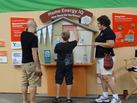
About 250,000 people visited the Eco Experience at this year’s Minnesota State Fair and virtually all of those fairgoers checked out the Energy Solutions Home (ESH), sponsored and coordinated by the Minnesota Department of Commerce, Division of Energy Resources (DER). The EHS exhibit, covering more than 6,000 square feet with 11 displays, was a showcase of energy efficiency and energy conservation for Minnesota homeowners.
The ESH exhibit featured three displays created and staffed by DER: a Home Lighting Options display, a Home Performance feature, and a Home Envelope display. All three included interactive components designed to engage visitors and encourage them to seek answers to home improvement questions.
The overall exhibit will serve as the foundation for the Fair’s Green Homes exhibit for the next two years, with some additions and improvements to take place.
|
|