Solar News
Stacy Miller earns MnSEIA's Ralph Jacobson Lifetime Achievement Award; CERTs receives Nonprofit Partner Award
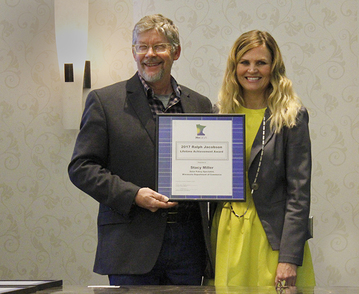
Stacy Miller, solar
policy specialist for the Minnesota Department of Commerce, received the
fourth-annual Ralph Jacobson Lifetime Achievement Award on Nov. 15 at the
Midwest Gateway to Solar Conference in Bloomington, Minn. The award is in honor
of Ralph Jacobson, a solar pioneer of Minnesota, and recognizes an individual’s
outstanding and sustained contributions to the solar industry.
The award was established
by the Minnesota Solar Energy Industries Association (MnSEIA) in 2014, with the
inaugural award presented to Ralph Jacobson at the MnSEIA Gateway to Solar
Conference. In photo above, Jacobson presented the award to Miller.
“I am immensely
honored and privileged to receive this award,” said Miller. “MnSEIA has done so
much to advance the solar industry in Minnesota, and so much of what I’m
charged to do at Commerce is to keep that momentum going. I’d like to
acknowledge the efforts and leadership of my solar colleagues at Commerce,
where we have a number of people who are working toward achieving the state
goals of 1.5% solar by 2020 and 10% by 2030.”
Miller is a
nationally recognized solar policy expert with a unique combination of
technical, policy, and business knowledge gained through 15 years of experience
in various aspects of the solar industry, said MnSEIA. “She has co-developed
and promotes strategic plans leading to solar market transformation in pursuit
of federal, state, and local clean energy policy goals.”
Miller has been
with Commerce since 2006. She was on the executive team for the U.S. Department of Energy (DOE)-funded
“Minneapolis Saint Paul Solar America Cities” initiative. Miller was
project manager for the development and adoption of solar-ready building guidelines and construction specifications
tailored to the Twin Cities region and Minnesota. She served as project
manager for the SunShot/DOE-funded
“Minnesota Rooftop Solar Challenge” that supported 22 organizations working to spur solar
power deployment by cutting red tape and improving finance options. She
is currently project manager for another DOE competitive grant award received
by the state. This grant funds “Minnesota
Solar Pathways: Illuminating Pathways to 10% Solar,” a collaboration to
find least-risk, best-value strategies for Minnesota to achieve its solar
energy goals.
Clean Energy Resource Teams (CERTs), a Commerce partner in our state’s clean energy action, earned the 2017 MnSEIA Nonprofit Partner Award.
|
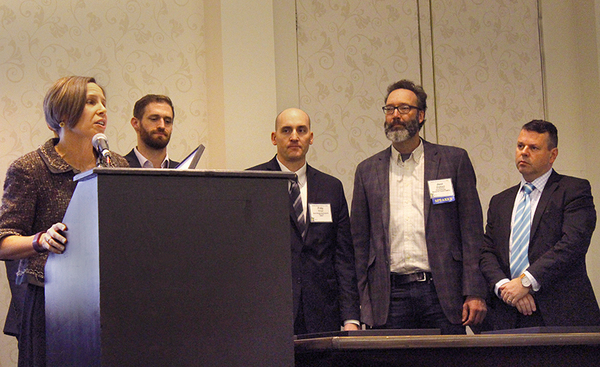
CERTs’ Lissa Pawlisch accepted the 2017 MnSEIA Nonprofit Partner Award along
with CERTs team members (left to right) Trevor Drake, Fritz Ebinger, Joel
Haskard, and Kim Havey.
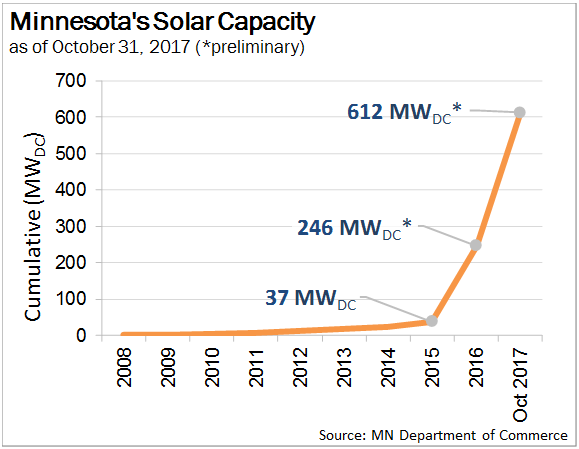 The Department of Commerce
tracks solar photovoltaic capacity in direct-current (DC) megawatts for consistency
with industry tracking (because solar panels produce DC power). The Department
assumes an AC:DC derate ratio of 0.87 for projects where the DC rating is not
known.
Minnesota adds 114 MW of solar from
July-October, hits 612 MW total
Minnesota solar capacity increased by 114 MWDC over the past
four months (July-October), giving Minnesota 612 MWDC of total solar
capacity, according to preliminary figures compiled by the Minnesota Department
of Commerce. In the first 10 months of 2017, Minnesota solar capacity increased
by 366 MWDC, more than doubling the total capacity at the end of 2016,
which was 246 MWDC. The recent solar capacity gains came mostly from
new community solar gardens built for Xcel Energy’s Solar*Rewards Community
program. Through Oct. 31, 2017, the state has 200 MWDC of community
solar gardens, with 197.5 MWDC of this designated for Xcel’s
program. Approximately 180 MWDC of solar capacity is expected to be
added by the end of this year.
 |
|
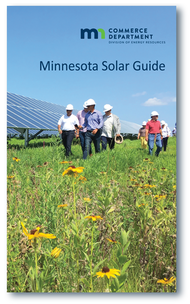
Commerce publishes Minnesota Solar Guide
The Minnesota Solar
Guide has been published by the Minnesota Department of Commerce and copies are
now available. The guide is a listing of solar businesses in the state, from
solar manufacturers and system developers and installers to the agencies that
help finance solar projects. It helps solar businesses connect with one another
and helps consumers find the solar products and services they need to plan and
install solar on their homes and businesses. Printed copies can be obtained by
contacting solar.help@state.mn.us. The guide is also
available for downloading as a
pdf on the Commerce website.
|
NREL offers free Solar PV
Training Program for city and county staff
The National
Renewable Energy Laboratory (NREL), in support of the U.S. Department of Energy
Solar Energy Technologies Office, is offering a no-cost solar photovoltaic (PV)
training program for cities and counties seeking to add solar energy to their
facilities (on both buildings and land). The training commitment will be
approximately 20 hours over a 12-month period, primarily in 2018. To
apply, please complete and submit the short application
form by Thursday, Nov. 30. For detailed information on the training
program, view
the City and County Solar PV Training Series Kickoff Webinar.
Farmington schools’ 3.1 MW solar project is largest for Minnesota
school districts
The largest solar project ever built to serve
a Minnesota school district began producing energy early this month, according to a
report in Midwest News. The Farmington public school district’s 3.1 MW project
places photovoltaic panels on the rooftops of several buildings. The first
project to go live is the 715 kilowatt, 2,200 panel installation on the roof of
Dodge Middle School, with more buildings to follow. The initiative represents
an increasing investment in solar energy by a growing number of schools in the
state. Read more.
Minneapolis parks tap solar power
The Minneapolis Park and Recreation Board has installed solar power
systems in five parks across the city over the past two years in an effort to
reduce heating costs, minimize the agency’s carbon footprint, and increase usage
of sustainable energy. It installed 374 solar panels on the roof of the north
rink at Parade Ice Arena, the park system’s largest energy user. The Park Board
says the arena’s energy upgrade will save taxpayers more than $80,000 annually.
Other parks with the new systems: East Phillips, Dr. Martin Luther King Jr.,
Webber, and Lake Nokomis’ main beach. The solar
project was paid for with nearly $1 million from Xcel’s state-mandated Renewable
Development Fund. The Park Board contributed $150,000 in matching funds. Read
more in a Star
Tribune report.
DOE announces four solar topics in
SBIR/STTR funding
The U.S.
Department of Energy has announced
topics for the next round of funding in the Small
Business Innovation Research and Small Business Technology Transfer
(SBIR/STTR) funding program. For the 2018 fiscal year, DOE plans to fund
feasibility demonstration SBIR/STTR projects in four solar topics:
- Devices and Methods for De-Energizing a Photovoltaic System.
- Cybersecurity for Solar Energy Devices.
- Peer-to-Peer Energy Transactions.
- Research in Autonomous and Augmented Systems to Reduce Solar Costs.
Applications
will be accepted starting November 27. Learn
more about the solar topics.
Clean Energy News
MPCA
offers $200,000 in diesel emissions reduction grants
The
Minnesota Pollution Control Agency (MPCA) is taking applications for its Diesel
Emissions Reduction Act grant program. The grant encourages owners of older,
heavy-duty diesel engines to apply for funding to upgrade or replace old diesel
engines. Since 2008, MPCA clean diesel grants have kept about 14.5 tons of soot
out of the air, which is equivalent to taking 263,000 cars off the road. This
summer, MPCA grants helped owners replace two beverage delivery trucks, two
moving trucks, eight garbage and recycling trucks, several marine engines, and
a crane engine. Applications
are now available.
Solar panel installers, wind turbine techs to be fastest growing jobs
Solar panel installer jobs will increase by 105% over the
next decade and will be the fastest growing job in the United States, according
to estimates from the Bureau of Labor Statistics. The solar panel installer
jobs will increase from 11,600 in 2016 to 23,200 in 2026, according to the
report. Wind turbine tech jobs are projected to have the second fastest job
growth at 96%. Read
more.
NREL tracks U.S. voluntary green power market
The U.S. National
Renewable Energy Laboratory (NREL) has released Status and Trends in the
U.S. Voluntary Green Power Market (2016 Data). The report is part of an annual series tracking the
U.S. voluntary green power market, where retail electricity customers make
voluntary purchases of renewable electricity. The U.S. voluntary green power
market represents about 28% of all U.S. non-hydro renewable electricity sales
and continues to grow, with about 6.3 million voluntary customers buying 95
million MWh of renewable electricity in 2016, a 19% increase in sales from
2015.
Tool helps cities plan, implement clean energy projects
A new series of city-specific fact sheets showcase how the National
Renewable Energy Laboratory can assist cities through the State and Local
Energy Data (SLED) Tool. Does your city want to lower its greenhouse gas
emissions, reduce local air pollution, increase low-income household energy
savings, or expand renewable energy generation or electric vehicle
infrastructure? The SLED Tool will provide the steps to use data
and analysis in a city’s energy decision making. Browse or download all the
fact sheets and case studies at City
Energy: From Data to Decisions. Find data for your city in the SLED City Energy Profiles.
Wind News
Minnesota firm lands two large Xcel Energy wind projects
Xcel
Energy announced on Oct. 24 the prime contractors for four Upper Midwest wind
energy projects, and Golden Valley-based Mortenson landed two of the deals. The
projects are part of Xcel’s plan to add 1,850 MW of wind energy in the Upper
Midwest over the next four years, enough power for nearly one million homes.
The contracts cover 750 MW of generation capacity. Mortenson won bids for the
Blazing Star 1 and Blazing Star 2 wind farms in Lincoln County in southwestern
Minnesota. Construction on the Blazing Star wind farms will start in 2019. Xcel
has been the largest wind energy provider among U.S. utilities for over a
decade. Read
more.
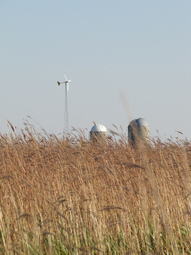 CESA provides new free toolkit: Distributed Wind Energy Zoning and Permitting
The Clean
Energy States Alliance (CESA), a national
nonprofit coalition of public agencies and organizations working together to
advance clean energy, has published a free toolkit to help local governments
and planning agencies facilitate the efficient and appropriate development of
distributed wind in their communities. This toolkit, Distributed
Wind Energy Zoning and Permitting: A Toolkit for Local Governments, covers a wide range of topics including zoning and permitting considerations, how to permit a project that
maintains the character of a community, and model ordinances.
Distributed wind—generally defined as small and medium-scale
wind energy systems—offers an opportunity to power a variety of buildings,
facilities, and homes with reliable, renewable energy. Distributed wind
projects often face more zoning and permitting challenges than other renewable
energy technologies, which prevents many residents and businesses from obtaining
the many benefits distributed wind provides.
The Minnesota Department of Commerce recommends
using only wind turbines that are independently certified to meet industry
performance and safety standards, and siting on tall towers in wide open
spaces, free of obstructions from the wind resource. See the Department’s
website for Minnesota wind resource maps. (Photo by Katherine Draeger)
|
Workshop, webinar features
Competitiveness Improvement Project
The
National Renewable Energy Laboratory’s National Wind Technology Center will
host an in-person workshop and webinar for the distributed wind Competitiveness
Improvement Project on Wednesday, December 6, 2017. The project is a periodic
solicitation issued by NREL on behalf of the U.S. Department of Energy’s Wind
Energy Technologies Office. It aims to make wind
energy cost competitive with other distributed generation technologies and
increase the number of wind turbine designs certified by international
standards for the U.S. market. Register for the workshop.
Electric Vehicles
NREL projects the number of EV charging stations needed
As
sales of plug-in electric vehicles (PEVs) increase in the United States, a key
question comes to mind: How many charging stations are needed to support these
new vehicles? A recent report from the National
Renewable Energy Laboratory (NREL) outlines several potential PEV and charging
station scenarios, with an estimated 15 million PEVs on the road in 2030. It
suggests just a few hundred corridor fast-charging stations could support
long-distance traveling between U.S. cities and roughly 8,000 would be needed
to serve urban and rural areas nationwide. Read
more.
Biofuels
Record number of Minnesota stations now offering E15
Minnesota’s ethanol industry surpassed a milestone in early November
when the Minnesota Bio-Fuels Association announced that Minnesota now has 202
stations offering E15. "The EPA approved the use of E15 in all cars 2001 and newer
in 2012, and in 2013 there were only four stations in Minnesota offering E15.
In the past 10 months, 141 stations throughout the state have begun offering
E15," said Tim Rudnicki, executive director of the Minnesota Bio-Fuels
Association. According to the Minnesota Department of Commerce, E15 sales in the state this year (as of the end of
August) totaled 6.45 million gallons, surpassing the 6-million gallon mark for
the first time. In 2016, the total E15 volume sold in Minnesota was 5.68
million gallons.
Renewable News is a newsletter that covers a range of renewable energy topics, including innovative initiatives in our state, technological advancements, financial incentives, trainings, and events. If you would like to change preferences for the newsletters you are currently subscribed to or if you want to unsubscribe, please use the links at the bottom of this page.
|