
CARD Grant Program Update
The purpose of the Conservation Applied Research
and Development (CARD) Grant Program is to identify new technologies,
strategies, and program approaches that utilities can implement to help achieve
the annual state energy conservation goal of 1.5% as established by the Next
Generation Energy Act of 2007. One recently completed CARD grant project is
summarized below.
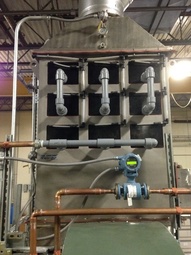 Demonstration project shows potential of Ultramizer advanced heat recovery system
For this CARD project, Gas
Technology Institute (GTI) and Cannon
Boiler Works (CBW), in cooperation with CenterPoint
Energy, demonstrated an advanced heat recovery system
called the Ultramizer® on a 1,000 HP boiler at Michael Foods’ Northern Star
Potato plant in Chaska, Minn. This is the first demonstration
of the Ultramizer technology in Minnesota. The Ultramizer technology
simultaneously captures waste heat and water vapor from boiler exhaust gases.
The goal of the project was to demonstrate and deploy the Ultramizer technology
on commercial and industrial boilers in the 250 to 1,200 boiler HP (8,600 to
41,400 pounds of steam per hour) output range to assist Minnesota gas utilities
in meeting their energy conservation goals. Read
more (pdf). (Photo: An Ultramizer heat and water recovery system image, courtesy of GTI.)
|
News & Resources
Minnesota is partner in DOE's Zero Energy Schools Acelerator program
Minnesota and California
along with six school districts and several national organizations will be
implementing partners in the U.S. Department of Energy’s (DOE) new Zero Energy
Schools Accelerator program, the DOE announced on Dec. 6. The Minnesota
Department of Commerce, Division of Energy Resources will be Minnesota’s
collaborating partner on the Accelerator effort, with the goal of increasing
market adoption of Zero Energy Buildings in schools. It will identify one or
more K-12 school projects appropriate for pursuing zero energy goals and will
prepare a road map to outline key zero energy design parameters and address
barriers to achieving zero energy. Read more
(pdf).
ACEEE paper: 'Pathway to Cutting Energy Use and Carbon Emissions in Half'
A new white paper, “Pathway to
Cutting Energy Use and Carbon Emissions in Half,” looks at how much energy
efficiency can reduce U.S. energy use by 2040 and what this might mean for
savings in 2050. Specifically, the American Council for an Energy-Efficient
Economy (ACEEE) analyzes 13 packages of energy efficiency measures and finds
that together they can reduce 2040 U.S. energy use by 34% and U.S. carbon
emissions by 35%, both relative to the most recent U.S. Energy Information
Administration forecasts. These reductions put us on a path to 50% savings by
2050. Read the full report.
DOE
publishes Uniform Methods Project protocols for CHP
The U.S. Department of Energy (DOE) and the
National Renewable Energy Laboratory have published an additional protocol for estimating energy savings. The new
protocol is for combined heat and power (CHP) and
was developed in close collaboration with the nation's leading experts. The
Uniform Methods Project (UMP) protocols provide a straightforward method for evaluating
gross energy savings for each of the most common residential and commercial
measures and programs offered by ratepayer-funded energy efficiency programs in
the United States. The protocols can be adopted by public utility commissions,
utilities, program administrators, evaluators, and others. Read more about the
project and protocol development process on the DOE Uniform Methods Project website.
2016 MnTAP summer interns
identify ways to reduce energy, waste, CO2 at 14 companies; applications for
2017 program are due Jan. 20
The University
of Minnesota’s Minnesota Technical Assistance Program (MnTAP) recently
published 2016 MnTAP Solutions (pdf),
a publication that highlights the success of 14 summer intern projects. The
publication features the efforts of industrious interns who identified
environmental reductions that could save their companies $2,063,000 annually as
well as:
- 2,273,000 pounds of waste
- 3,526,000 million kWh
- 145,000 therms of energy
- 173,840,000 gallons of water
per year
These
results translate into impacts equivalent to eliminating CO2 emissions from 170
passenger vehicles and waste equal to the weight of approximately 23 metro
transit light rail cars. The proposed reductions also equal the energy used to
power 367 Minnesota homes and the water used by 8,500 Minneapolis residents.
Companies that would like to participate in the 2017 intern program need to
complete an online project
proposal
by Jan. 20, 2017 to apply for the program. MnTAP will support up to 15 interns/projects
that could focus on water conservation, energy efficiency, solid waste, and
pollution prevention.
DOE announces 28 universities
to lead Industrial Assessment Centers
The U.S. Department of Energy's Office of Energy
Efficiency and Renewable Energy (EERE) recently announced nearly $35 million
for 28 higher education institutions from 25 states across the country to set
up and operate regional Industrial Assessment Centers (IACs). The centers will
provide site-specific recommendations to small manufacturers with opportunities
to improve productivity, secure information, reduce waste, and lower energy
costs. The University of Illinois, Chicago, and the University of
Wisconsin-Milwaukee are two closest centers to Minnesota. Read more. The DOE recently issued a Notice of Intent to extend IACs to underserved
areas.
Funding Opportunities
Applications open Jan. 1 for 2017 Made in Minnesota Solar Incentive Program
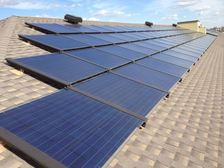 Applications for the fourth year of the Made in
Minnesota Solar Incentive Program will be accepted beginning Jan. 1, 2017,
and ending Feb. 28, 2017. The 10-year, $150-million program helps fund new
solar electric and solar thermal systems for Minnesota residents, businesses,
and communities. The program is administered by the Minnesota Department of
Commerce. During the first three years of the program, funding was awarded for
1,048 solar electric projects and 36 solar thermal installations. The solar
electric projects equal about 15 megawatts (MW) of electric capacity. Read more (pdf). (Photo courtesy of Silicon Energy)
|
DOE announces $6 million to deploy energy efficiency, clean energy on Indian lands
The U.S. Department of Energy recently announced a
new funding opportunity announcement for up to $6
million to install energy efficiency measures and deploy clean energy systems
on Indian lands. The Office of Indian Energy is soliciting applications from
Indian tribes and tribal energy resource development organizations to install
energy efficiency measures and clean energy systems on tribal buildings and
deploy clean energy systems on a community scale.
*********
CIP News provides the latest news and information on a wide range of
Conservation Improvement Program (CIP) topics. Use the links below to update
your existing subscription profile, unsubscribe, or sign up as a new
subscriber. If you have comments or questions, please contact us at cip.info@state.mn.us.
|