
|
|
|
March 2025 Legislative Update

Recent budget projections anticipated a small surplus soon, followed by a large deficit later. The February Forecast, released on March 6, 2025, predicts a smaller surplus of $456 million for the 2026–2027 budget and a larger deficit of $6 billion for 2028–2029.
Minnesota law requires a balanced budget, so it's less likely new or optional funding requests will pass this year. Over the next few months, we'll focus on protecting funding for disability programs and services vital to our communities.
We've been busy updating our disability bill tracker. We're currently following 194 of the 4,459 bills introduced this year. Another helpful resource for the 2025 session is our collection of public policy letters, which explain MCD's positions on bills heard in committee. For example, we oppose HF 514, a proposal that would allow schools to suspend students in grades K–3. These suspensions disproportionately affect students with disabilities and are linked to poorer educational and health outcomes.
Finally, we'd like to share a staffing update. Trevor Turner, our Public Policy Director, has accepted a new position. We will soon post the opening for the renamed Legislative Affairs Director role through our communication channels and on Minnesota State Government Careers.
MCD 2025 Legislative Forum Recap
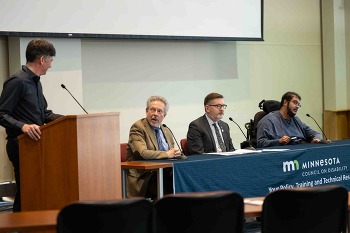
The bi-annual MCD 2025 Legislative Forum was a tremendous success, marking our return to a live, in-person format for the first time since the COVID pandemic.
This year's event featured a new, extended format that differed significantly from previous sessions.
Because the forum included a variety of segments, we chose a flexible drop-in format, enabling attendees to join the segments that best fit their schedules.
Throughout the day, attendees experienced a dynamic combination of live panel discussions, engaging speakers, and prerecorded statements from advocates. We also paid tribute to several disability trailblazers whom we've sadly lost, honoring their long-standing dedication and impactful advocacy work. Those who stayed for the full program described the experience as energizing, leaving them motivated and inspired. Several hundred participants attended the event, both in person and online.
The legislative portion opened with remarks from Republican State Representative Danny Nadeau. As always, the MCD Legislative Forum maintained a non-partisan environment, inviting participants from both sides of the aisle. Several members of the Minnesota House of Representatives joined us. We specifically want to thank these members for participating in discussions and panels:
- Representative Brion Curran
- Representative Steve Elkins
- Representative Peter Fischer
- Representative Kim Hicks
-
Representative Danny Nadeau
We also appreciate Representative Robert Bierman and Representative Katie Jones for attending.
We were honored to host two state senators as well. Senator Scott Dibble participated in a key panel discussion focused on accessible on-demand transportation. Senator John Hoffman provided a poignant prerecorded tribute honoring Damon Lievestad, a cherished community member we lost last year.
Notably, Minnesota Attorney General Keith Ellison and Secretary of State Steve Simon delivered powerful speeches that resonated deeply with members of the disability community.
We collaborated with more than 15 advocates statewide who courageously shared their personal stories, lived experiences, and special tributes through prerecorded statements. These advocate segments covered critical issues such as Medical Assistance for Employed Persons with Disabilities (MA-EPD), Medicaid, and transportation challenges. MCD staff and council members also significantly contributed to the success of this year's forum.
We value your feedback! If you attended the forum, either online or in-person, please share your thoughts by completing our event survey: Share Your Feedback on the MCD 2025 Legislative Forum. The survey also provides an opportunity to ask questions or offer direct feedback to legislators and constitutional officers who participated.
We will provide an accessible recording of the forum in the coming month and notify you when it's ready for viewing.
A heartfelt thank you to everyone who attended or supported the event in any capacity. Your participation strengthens our mission of creating a barrier-free, inclusive Minnesota for people with disabilities. We greatly appreciate you and look forward to continuing this important journey together!
|
Protect Medicaid: Defending Disability Services from Harmful Cuts
Medicaid, known as Medical Assistance in Minnesota, is a state and federally funded program. It provides affordable healthcare coverage to roughly 72 million people nationwide—including 10 million people with disabilities.
In Minnesota, Medicaid serves 1.4 million people, including about 125,000 with disabilities. While people with disabilities make up just 15% of enrollees, they account for about 60% of program spending (PDF).
Medicaid is more than just healthcare coverage. It funds critical home and community-based services that help people with disabilities live independently. These services are essential and often unaffordable without Medicaid support.
Recent Developments
Proposals under consideration include:
- Implementing per capita caps (limits on funding per person)
- Adding work-reporting requirements
- Reducing the federal government's share of Medicaid spending
- Loss of coverage for people with disabilities
- Reduction in essential benefits
- Tighter eligibility requirements
Minnesota cannot afford these cuts. They would jeopardize services and supports across the state—especially in rural communities (PDF), which often rely heavily on Medicaid-funded care.
MCD’s Response
MCD is closely monitoring these federal proposals. We are committed to keeping our community informed about how to take action and protect Medicaid.
Take Action to Protect Medicaid
Now more than ever, it is crucial for the disability community to advocate in defense of Medicaid. Share your experiences. Call your representatives. Urge Congress to reject these harmful cuts.
Together, we can defend the services that make independent living possible for so many.
|
A Farewell Message from Trevor Turner
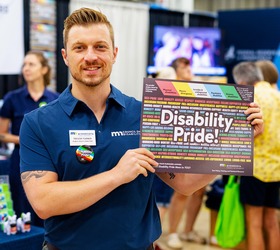
It has been an incredible honor to serve Minnesotans with disabilities as the Public Policy Director at the Minnesota Council on Disability (MCD) for the past four and a half years.
Before joining MCD, I worked in international development, serving people with disabilities in communities around the globe. I’m excited to return to that work as Vice President of International Programs and Development at the Starkey Hearing Foundation, where I’ll advocate for hearing healthcare for people with hearing loss—like me—around the world.
Still, I have to say—it’s bittersweet. I’m returning to the work I’ve always loved, but I’m also leaving the meaningful work MCD has done with Minnesota’s disability community. While I’ll continue to advocate for people with disabilities, working in state government holds a very special place in my heart.
The biggest lesson I’ve learned—and something that has been at the core of my work at MCD—is the importance of people with disabilities serving in government and shaping the policies that affect our lives.
When I first stepped into this role, I knew disability advocacy in government wasn’t just important—it was essential. Policies are written every day that impact our access to healthcare, education, employment, transportation, and community living. And too often, those decisions are made without Minnesotans with disabilities in the room.
That’s why I’ve been so passionate about this work: because when people with disabilities lead, when we serve in government, when we advocate, we change the conversation. We bring lived experience, we bring expertise, and we bring a perspective that’s far too often missing.
It’s not enough for state leaders to acknowledge our experiences—we, people with disabilities, must have a seat at the governing table!
I know that government work—whether in advocacy, public service, or policymaking—can sometimes feel intimidating. Many of us grow up in a world that tells us we don’t belong in these spaces, that leadership is for someone else. But I’m here to tell you: we don’t just belong—we should lead.
Leadership from public servants with disabilities isn’t just good for the disability community—it benefits everyone. The empathy, resilience, and compassion that people with disabilities bring make for incredible public leaders.
There are so many ways to get involved in government. Maybe you want to work in a state agency, advising on policy or improving disability services. Maybe you want to serve on a commission or task force, helping your city, county, or state make decisions that include the disability community. Maybe you want to run for office yourself! Or maybe your role is showing up at the Capitol, testifying, telling your story, making sure our elected officials hear directly from the people their decisions impact.
Whatever way you can serve in government—do it. Rise up, speak out, and lead! Because your experience is powerful. And when we show up, we don’t just advocate for ourselves—we make things better for the entire state.
I’ve seen firsthand how change happens. I’ve seen bills pass because people with disabilities showed up and demanded action. I’ve seen policies shift because we made it clear that access, equity, and inclusion are non-negotiable. We in the disability community have always chanted the mantra, “Nothing about us, without us,” but perhaps it’s time to start saying, “If it’s about us, it’s led by us!”
So, I want to end by saying thank you. Thank you to my colleagues at MCD, to the disability advocates, to elected officials, and to every person who has written an email, made a call, testified at a hearing, or simply spoken up for what’s right. Your work matters so much to me.
Let’s make sure that every space, every decision-making table, and every policy discussion about us, is led by us.
With deep gratitude and appreciation,
|
2025 Disability Advocacy Day
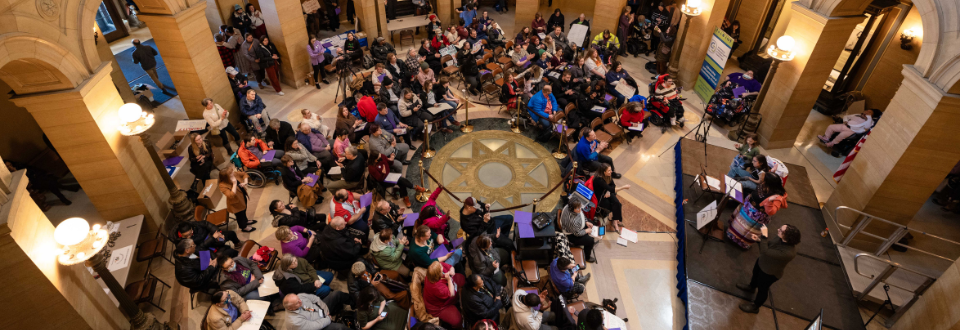
Please join us for the 2025 Disability Advocacy Day at the Capitol on Tuesday, March 25!
Disability Advocacy Day is an opportunity for people with disabilities, allies, and supporters to come together, share their stories, and advocate for meaningful policy change. This year, we return to the Minnesota State Capitol with the theme: Disability Justice: Defining Our Future, Remembering the Past.
Register
Event Details
Pre-Rally 9:30 – 10:45 a.m. Minnesota State Capitol Rotunda
Check in, make posters, connect with other Disability Justice advocates, and learn about the 2025 Policy Agenda from the Minnesota Consortium for Citizens with Disabilities (MNCCD).
Rally 11:00 – 11:45 a.m. Minnesota State Capitol Rotunda
Join the community in celebrating disability pride while honoring the past, highlighting the urgent need to protect disability programs and services, and reaffirming our shared commitment to a more equitable future.
Legislator Meetings All day
Schedule time to meet with your legislators and tell them about the issues that are important to you.
Accessibility and Accommodations
- ASL and CART services will be provided.
- Seating includes chairs and a bariatric bench.
-
A designated space will be available for individuals who use wheelchairs. A sensory-friendly space will be provided.
If you have questions or would like the registration form in an alternative format, please contact:
For more information, visit the event page. We look forward to seeing you there!
An Update on the Legislative Task Force on Guardianship
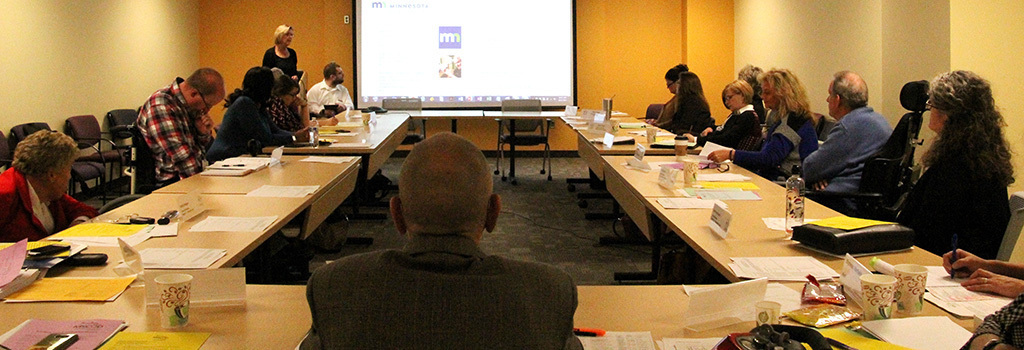
We are excited to announce that we held our first Guardianship Task Force meeting on Wednesday, February 26! It was a hybrid meeting, with attendees participating both in person at Wilder Research and remotely. Twenty-one task force members attended, along with seven guest attendees and five staff members from Wilder Research and MCD.
Task force members received an overview of the legislative directives guiding their work. The members then established group norms, discussed the structure of future meetings, and introduced themselves. They also shared their personal connections to guardianship and expressed their hopes for the task force's impact.
The group then divided into smaller breakout sessions to discuss their priorities. Here are the key points reported back from these discussions:
- "Being person-centered, not using cookie-cutter policies."
- "Supporting current guardians both professionally and through person-centered practices. How are guardians supported, and how do they support those under their guardianship?"
- "Finding ways to help people remain in their communities and ensuring guardianship is used only when necessary."
- "Brainstorming methods to reduce the frequency of guardianship by establishing more structural safeguards and providing judges with additional options.
- "Fewer and improved guardianship experiences."
Due to a scheduling conflict, we have rescheduled the next Guardianship Task Force meeting from March 25 to April 1. It will take place from 9:30 AM to 11:30 AM.
Apply to the Minnesota Council on Disability
Why join the Minnesota Council on Disability as a council member?
It's a unique opportunity to shape policies and initiatives that promote access and rights for individuals with disabilities in Minnesota.
Be a part of shaping the future of disability policy as we engage policymakers, government leaders, and the public to make a positive difference.
The Governor appoints council members from all over the state to represent the interests of the people. Council members provide guidance and oversight for MCD as we advise the governor's office, the legislature, state agencies, and the public on various disability issues.
If you are someone who has a disability, someone who works with people with disabilities, or a family member of a person with a disability, council membership may be for you!
|
MCD in the News
For 50 years, MCD has been at the forefront of advocating for members of the disability community across our state. As we look ahead to the next 50 years, we are encouraged by the media's increased efforts to bring attention to crucial issues affecting so many of our constituents. From personal journeys to legislative actions, critical concerns to joyous celebrations, your stories are becoming part of community conversations. We want to highlight this ongoing media coverage and share some of these important news stories.
This information is available in alternative format upon request.
Minnesota Council on Disability cannot guarantee the accessibility of external content.
|
Please Add Us To Your Address Book
To help ensure that you receive all email messages consistently, please take a moment and add the following email address to your email safe senders list, address book, or contact list: MCD@public.govdelivery.com.
|
|