|
Having trouble viewing this email? View it as a Web page.
December 12, 2016 | Advocating for communication access and equal opportunity with the 20% of Minnesotans who are deaf, deafblind and hard of hearing.

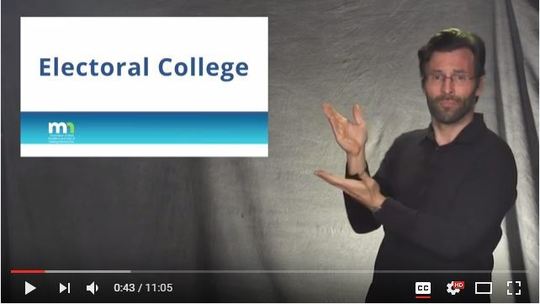 Still image from the ASL video announcment explaining the Electoral College, why we have it and how it works. In the video is Doug Bowen Bailey, wearing a black shirt. The background is gray. His hands are pointed towards the following words that appear on the screen, "Electoral College."
What is going on with the vote for president?
You may have seen that Hillary Clinton got more votes, but that Trump won the presidency. How can this be true?
The answer has to do with what is called the “Electoral College” (EC). It is confusing for everyone to understand – hearing people and deaf people. [Slide with the words, “Electoral College,” briefly appears.] It's especially confusing because the Electoral College is not a school or a place. The Electoral College is actually a group, and the people in it are called “electors.” [Slide with the word, “electors,” briefly appears.] So, the presidential election is actually decided by the vote of the electors.
Imagine the Electoral College as a game with points.
It might be easiest to understand the Electoral College if you think about it as a game where you keep score. Each elector is one point. The candidate who wins the majority of points wins the presidential election.
Every state is assigned a certain number of electors, based on the number of senators plus the number representatives in the house. The number of representatives is determined by the number of people who live in the state. [Slide with the words, “2 Senators + # Reps in US House = # of electors,” briefly appears.] For example, states with small populations, like Wyoming, get 3 electors (because they have 2 senators plus 1 representative). The bigger the state’s population, the more electors they get. The state with the largest population, California, has 55 electors. Minnesota has 10 electors. To win, a candidate has to get at least 270 electors. The number of electors each state gets is adjusted every 10 years after the census.
What were we voting on last November?
When we voted for president in November, it wasn’t really one nationwide election for president. Instead, we had 51 separate elections for president held at the same time, one in each state plus Washington, D.C. When you voted, you were helping to decide which candidate won in Minnesota and would get Minnesota’s 10 electors.
Minnesota and almost every state give all of their electors to the candidate who got the most votes in that state. This is sometimes called a “winner take all” method. Hillary Clinton got more votes in Minnesota than Donald Trump, so she will get all 10 of Minnesota’s electors. It doesn’t matter whether she got 5 more votes or 500,000 more votes than Donald Trump – she gets all 10 electors and he doesn’t get any.
Explanation about the Electoral College map.
You may have seen a map of the U.S. used to show who won the Presidential election. The map shows the number of electors in each state, with the states red for Republicans and blue for Democrats. So, Hillary won blue states along with their electoral votes. The map helps show who won the most electoral votes. [The U.S. map is displayed, along with the number of electoral votes that Clinton won (232) and that Trump won (306). Map source: Business Insider.] Based upon the electors, Trump got 306 electors and Hillary got 232. Trump got more than 270, so he will be the next president.
But Hillary got more votes? How does that work?
Hillary did get more votes from people, but not more electors in the Electoral College. How? The number of electors that each state gets is loosely based upon population. This gives states with big populations less of a say than they would otherwise have. When you compare California to Wyoming, for example, California’s population is more than 66 times larger. But California only has 18 times as many electors. [Graph of California (in blue)/Wyoming (in red) showing the population represented per electoral vote in both states (CA – under 700,000 and WY – under 200,000 briefly appears.]
So Hillary Clinton received millions of more votes in California and other states with large populations, but can only receive the electors they have. Because of this, she won more votes from people – called “the popular vote” [slide briefly appears with the words, “Popular Vote,”] and Donald Trump won the Electoral College and that is why he will become president.
Why do we do we have an Electoral College?
The U.S. Constitution requires that we use this process. It was designed this way to be sure that states with small populations had a voice in the election.
You said electors are actually people? Who are they? How are they chosen?
Yes, electors are actual people. The political party of the candidate who won gets to choose them. Here in Minnesota, the party selects 10 electors. Usually, they choose people who have been active in the party for a long time. So this year, since Hillary won Minnesota, the Democratic Party or DFL chose the 10 people who will be our electors. The Republican Party did not get to choose any of Minnesota’s electors but did get to choose the people in the states where Trump won.
On December 19, these 10 people will have a meeting at the Minnesota State Capitol. Each of the electors will cast their votes for president. Electors for the other states will meet at their own state capitols at the same time.
Do electors have to vote for the candidate who won the state vote?
Many states, including Minnesota, have a state law that requires that the electors vote for the person who won that state’s vote. Even without a law, electors almost always vote for the candidate who won the vote in the state, since it was that political party that chose them. However, there are rare cases in which the electors vote for another candidate.
This year there are some people who are trying to convince electors to vote for Hillary Clinton instead of Donald Trump. In theory, if they convince enough electors from states that Trump won to change their votes to Hillary Clinton, it could change the outcome of the election. However, the chances of this actually happening are extremely unlikely.
Do you have more questions about the Electoral College?
You can contact the Office of the Minnesota Secretary of State. Go to this website: tinyurl.com/mn-electoral-college.
|