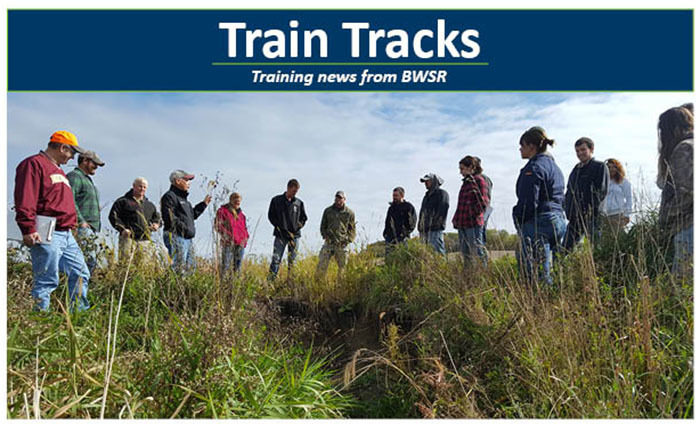
BWSR Academy Oct. 20-22
BWSR Academy will be Oct. 20-22 at Cragun’s Conference Center near Brainerd. Registration is scheduled to open early September. BWSR Academy is a training opportunity for BWSR’s programmatic partners in natural resources, conservation and water quality. Hope to see you there!

On Farm Communication
Formerly known as Ag 101, the On Farm Communications Training is being held again this year at Central Lakes College in Staples. This hands-on beginner training is an excellent introduction to agriculture for employees that are new to their positions or don’t have an agricultural background. New this year is an advanced series for more experienced staff looking for a deeper dive agricultural practices. Each set of training is set up to cover major agricultural activities during the cropping season, from planting through harvest. The remaining two sessions, scheduled for October, will focus on crop harvest and fall farming activities.
- The Beginner Series is designed for those newer to agriculture, and covers the full growing season from planting through harvest. The final session is scheduled for Oct. 7.
- The Advanced Series is a deeper dive for more experienced participants. Topics include precision agriculture, mapping, crop budgeting, and emerging technologies. The final session is scheduled for Oct. 8.
For additional information, and links to register, please visit the On Farm Communications Training Series page.
Plant ID Training
Join Karin Jokela of the Xerces Society for a field based plant identification training at Sogn Valley Farm near Cannon Falls on Aug. 31. Participants will explore native habitat plantings of different ages, practice identifying and teaching others about native and weedy plants, and evaluate seed mix establishment three to five years after planting. The day will also include discussion of pollinator identification, grassland management, and conservation practices that improve wildlife habitat.
Space is still available – visit the Plant ID Training page for more information and a link to register.
Minnesota Agroforestry Institute
Join experts, practitioners, and fellow conservation professionals for the Minnesota Agroforestry Institute, a two-and-a-half-day training focused on integrating trees and perennial systems into working agricultural landscapes. Through classroom sessions, field tours, and hands on design exercises, participants will explore agroforestry practices such as alley cropping, silvopasture, forest farming, riparian buffers, and windbreaks.
This interactive institute, planned for Sept. 15-17 at the Sherburne National Wildlife Refuge in Zimmerman, will help technical staff and educators understand how agroforestry can improve farm profitability, water quality, wildlife habitat, soil health, and climate resilience, while providing practical tools to support landowners interested in adopting these practices.
For more information and a registration link visit the Agroforestry Institute page.
Conservation Cohort: Herbaceous Vegetation Establishment
Build confidence in herbaceous vegetation establishment and take your seeding skills to the next level through this four month, small group On the Job Training (OJT) Cohort. Working with experienced facilitators and peers, you’ll develop the skills needed to independently plan, design, and certify herbaceous vegetation establishment practices, including Conservation Cover (327), Wildlife Habitat Planting (420), and Restoration and Management of Rare or Declining Habitats (643).
Participants will complete a real project that can be used to demonstrate competency for Job Approval Authority (JAA) while receiving individualized coaching throughout the cohort. Reserve all cohort session dates on your calendar before registering. The sessions build on one another, and consistent participation is essential to getting the full benefit of this hands on learning experience.
Additional information, including scheduled dates and a link to register, can be found on the Seeding Practices Cohorts page.
Conservation Cohort: Critical Area Planting - Shoreland
Advance your shoreland restoration skills and take the next step toward Job Approval Authority (JAA) for Critical Area Planting (342). This small group, virtual On the Job Training (OJT) Cohort provides individualized coaching as participants plan, design, and certify a Critical Area Planting practice in a shoreland setting using native seed mixes, seedling plugs, and supporting practices that meet NRCS standards.
This cohort is intended for participants who already have a baseline knowledge of practice planning and design and are ready to build the skills and confidence needed to independently certify projects. Reserve all cohort session dates on your calendar before registering. Sessions build on one another over several months, and consistent participation is essential to successfully completing your project and demonstrating competency for JAA.
Additional information, including scheduled dates and a link to register, can be found on the Critical Area Planting Seeding – Shoreline page.
High Tunnel Systems
Join us on Sept. 24 at Waxwing Farm near Webster to learn about the planning, contracting, and management of High Tunnel Systems (CPS 325). This on farm training will cover the contracting process between producers and NRCS staff. Topics covered will include identifying resource concerns, planning considerations, and the basics of different high tunnel designs. This open discussion format is designed for staff to get their questions answered.
Natalie Hoidal, UMN Extension, will present on the agronomy of growing in high tunnels based the 100-farm study, including the challenges of maintaining soil health and fertility, irrigation and water management, and the risks of excess nutrient loading and leaching that can occur with high tunnels.
Resources related to high tunnel management and design, including local suppliers, will be available. An important consideration for growers new to high tunnels is understanding what it takes to construct their own high tunnels.
If you are interested in attending, please RSVP by Sept. 11 to Aaron Janz (aaron.janz@usda.gov).
Windbreak & Shelterbelt Establishment and Renovation Workshop
Ready to build your windbreak planning and design skills? This interactive field and classroom workshop will be offered in four locations statewide, and will cover windbreak and shelterbelt design, establishment, evaluation, maintenance, and renovation through real world site visits and hands on design exercises. Although the in person sessions are not until the week of Oct. 12, don’t wait to register! The first prerequisite webinar, Tech Talk: Conservation Tree Shrub Groups (CTSGs), was held on July 27, and two Tech Talk sessions are coming up on Aug. 17 and Oct. 5. The workshop is also the required first step for those interested in participating in the Windbreak/Shelterbelt Cohort that will be offered later this year or in early 2027.
You can find additional workshop details, prerequisite requirements, and a link to register on any of the Windbreak/Shelterbelt Establishment and Renovation pages.
Starting Oct. 26: GIS Tech Talks
Reserve the fourth Monday of each month for a GIS based Tech Talk. TTCP staff, NRCS, and others will take turns covering specific GIS tasks each month. These trainings will be a chance to ask questions and learn a task that may apply to your everyday GIS usage. This first session will be on the NRCS Engineering Watershed Toolbox, and cover where to download the toolbox, how to install it in ArcGIS Pro, and some tips on how it can be used. Session topics and descriptions, a link to join the live session, and links to replays can all be found on the Tech Talk page.
Feel free to submit your ideas for future GIS Tech Talks.
Complete Your 2026 Individual Development Plan
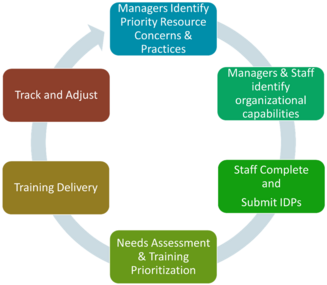
The Individual Development Plan (IDP) cycle begins each year with identifying local conservation priorities. These local priorities could be identified in Local Work Group meetings, One Watershed One Plan plans, watershed assessments, or by other methods. This process will identify the local priority resource concerns and the conservation practices that will treat them.
Once the local priorities have been established, managers and technical staff should work together to assess the local capabilities to perform assessments as well as plan, design, and install the priority practices identified. If technical staff lack the technical skills and/or conservation practice credentialing, such as Job Approval Authority, these missing capabilities become the priority training needs for those employees.
This year we are asking everyone to complete or update their IDP by Friday, Oct. 2.
Have you previously completed an IDP? Please review your technical training requests to ensure they are up to date. For the coming year, we will not consider any training needs dated prior to Jan. 1, 2026. Having an accurate assessment of technical training needs is critical to ensure our training delivery will address local needs. There are a couple of things you can do to improve the accuracy of your training needs:
- Review and update your existing training needs. You identified a training need last year, but is it still a training need? It only takes a few moments to either remove outdated training needs or to update them as a current request.
- Be as specific as possible. When requesting training, there is a space to enter additional comments to identify the topic or content of the training you need, such as specific wildlife species or plant regimes.
- When identifying a practice as a training need you can select which phases – planning, design, construction – you are requesting training on. There is also an option to identify On the Job Training (OJT), classroom, field, or virtual training preferences.
- If you are a newer employee and need some examples of typical practices by land use, check out the common practices by land use tab in the New Employee Training Guide.
To assist both managers and technical staff in completing IDPs, we have put together several resources. This includes two short videos that have bookmarks so you can jump to the specific section you need help with.
Do you prefer visuals and written instructions? Check out the IDP User Guidance resources.
If you have questions or need further assistance, please contact us.
Tyler’s Three Things: Conservation Practice Physical Effects
The Conservation Practice Physical Effects (CPPE) matrix predicts the expected effects of a conservation practice on soil, water, air, plants, animals, humans, and energy.
A practice designed to address one resource concern can have positive, neutral, or negative effects on other resources.
Understanding physical effects helps planners select appropriate practices, identify potential resource concerns, and determine when additional practices or mitigation may be needed.
Want to learn more? Visit section 5 of the Field Office Technical Guide.
2026 Shared Training Calendar
An updated working version of the 2026 training calendar is available. This 12-month view of training offerings is regularly updated and provides information about upcoming training events, including potential dates and locations. Please see the legend at the top and note that the further out a training is proposed the more likely adjustments will need to be made. The dates, locations, and other details are always tentative until the event is posted on the Training Calendar.
|
BWSR Sponsored Training Events
October
 |
|
Minnesota Wetland Professional Certification Program |
Upcoming Minnesota Wetland Professional Certification Program Course Schedule:
Aug. 31 - Sept. 4 - Introduction to Wetland Delineation & Regulation - Cloquet
Sept. 14-18 - Introduction to Wetland Delineation & Regulation - Brainerd
Oct. 13 & 14 - Functional Assessment Method - Shoreview
Nov. 18 - WCA Rule Virtual Training (registration opens summer 2026)
Dec. 8 - New Normal?: Emerging Topics in the Wetland World - St. Paul
MWPCP Registration Information:
Registration for Introduction to Wetland Delineation & Regulation opens March 9: Registration Link
Registration for all remaining courses opens March 16 (unless noted otherwise): Registration Link
Technical Training & Certification Program Trainings
Tech Talk Webinars: Mondays at 1 p.m.
- Aug. 17, Windbreak/Shelterbelt Design
- Aug. 24, How to Talk Wetland Restoration
- Sept. 21, Individual Development Plan Tool
- Oct. 5, Living Snow Fence
- Oct. 19, P-Index
- Oct. 26, GIS: NRCS Engineering Watershed Toolbox
- Nov. 16, Technical Training Resources
August
September
- Sept. 1, Nutrient and Pest Management Administrative Review Training, Thief River Falls
- Sept. 2, Nutrient and Pest Management Administrative Review Training, Detroit Lakes
- Sept. 9, Nutrient and Pest Management Administrative Review Training, Baxter
- Sept. 15, Seeding Practices Cohorts 2026, (Registration Deadline), Online
- Sept. 15, Nutrient and Pest Management Administrative Review Training, Marshall
- Sept. 15-17, 2026 Agroforestry Institute, Sherburne National Wildlife Refuge
- Sept. 16, Nutrient and Pest Management Administrative Review Training, Owatonna
- Sept. 21, Seeding Practices Cohorts 2026, Online
October
- Oct. 1, Critical Area Planting Seeding - Shoreland Cohort, Fall 2026, (Registration Deadline), Online
- Oct. 7, On Farm Communications Training Series, – Beginner, Staples
- Oct. 8, On Farm Communications Training Series, – Advanced, Staples
- Oct. 13, 2026 Windbreak/Shelterbelt Establishment and Renovation Training, Dodge/Olmsted
- Oct. 14, 2026 Windbreak/Shelterbelt Establishment and Renovation Training, Litchfield
- Oct. 15, 2026 Windbreak/Shelterbelt Establishment and Renovation Training, Hawley
- Oct. 16, 2026 Windbreak/Shelterbelt Establishment and Renovation Training, Sleepy Eye
- Jan. 13-Oct. 13, SFEC’s 2026 Webinar Series, SFEC, Online
- Feb. 9-Oct. 29, Livestock 101 Webinar Training Series - Part II, Conservation Webinars, Online
- Aug. 31, Southeast Plant ID Training, PF and Xerces, Cannon Falls
- Sept. 23, Timber Sale Preparation and Administration, SFEC, Two Harbors
- Sept. 22-24, River Ecology Unit 2026 Workshop, MN DNR, Marshall
- Oct. 7-8, Forest Management and Wildlife Habitat Symposium 2026, SFEC, Cloquet Forestry Center
- Oct. 13-14, Minnesota Water Resources Conference, Water Resources Center, Saint Paul RiverCentre
Not all training takes place in a classroom. Check out the links below to learn at a time and place of your choosing.
We’ve also put together a searchable library of recorded modules, webinars, videos and other resources to help our staff and partners find professional development information on a variety of topics. You can visit BWSR’s Online Learning page to find web-based technical training resources sorted by category
New:
Program Contacts
|