|
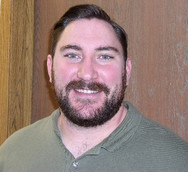
BWSR has a new Technical Training and Certification Coordinator: Welcome, Jon Sellnow!
BWSR is pleased to announce Jon Sellnow is the new Coordinator for the Technical Training and Certification Program! Over the past 17 years Jon has worked throughout Minnesota for the Natural Resources Conservation Service, most recently as the District Conservationist in the Duluth Field Office.
Jon brings a wealth of knowledge of NRCS conservation practices, conservation planning, and Job Approval Authority. If you have questions or suggestions for Jon, he can be reached by email at jon.sellnow@state.mn.us or by phone at 218-340-3521.
|
|
|

Sharing information? Tips for keeping people interested in what you have to say.
In your role, you will find yourself needing to provide information to your audience. Approaching this opportunity and designing from a training perspective rather than simply the dissemination of information can enhance the experience and retention of the attendees. This means the sharing of information should be designed as experiential for the attendees.
Experiential means attendees are engaged in the session and have an opportunity to interact with the learning. The opposite of this is passive learning where the attendee sits and views a PowerPoint or listens the entire time to someone else speak. The learning environment is full of opportunities for distractions to the attendee. Attendees now come with notepads, laptops and cell phones and are tempted to check out of the session and check in on their email, the web, etc.
The next time you find yourself sharing information to inform an audience about a program, an update, or a report, design it to engage your audience and keep them away from the typical distractions. Tips to do this include:
- Start your presentation off with a question to the audience about what they currently know about whatever the session topic is. This also provides an opportunity for you to hear what misperceptions may be out there that you can address during your session.
- Periodically during the informational session, ask attendees to talk among themselves in pairs, triads or small groups about what surprises, or concerns, them about what they heard during the session. Have each group pick one item and share it back with the large group.
- At the end of the session, in pairs, triads or small groups have attendees talk about what the information means for them moving forward. Have each group pick one item and share it back with the large group.
Designing an informational session to engage the audience rather than allowing them to be passive, brings them into the conversation and provides an opportunity to reflect on the information while they are there. This supports retention of the information after the session. Design your next informational session to distract them away from their typical distractions of cell phone, notepads and laptops!
|
|
|
Introductory Nutrient Management Training
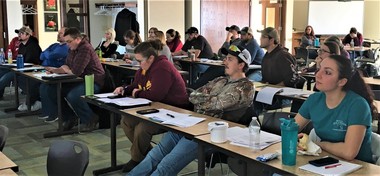
Earlier this month 67 people took part in Introductory Nutrient Management trainings in Oronoco and Morris to learn about soil testing, crop nutrient requirements, and NRCS conservation practice standards. These training sessions, in addition to three additional sessions scheduled throughout the state in February, are intended to provide a basic understanding of fertilizer formulations and nutrient recommendations as well as best management practices for reducing resource concerns related to nutrients in the environment.
The Nutrient Management practice is commonly needed in watersheds where waters are listed as impaired due to excess nutrients in surface water or where groundwater is contaminated with nitrates. The Introductory Nutrient Management training sessions will be followed by two additional rounds of training statewide to provide employees with knowledge and skills toward obtaining Job Class I and Job Class II Job Approval Authority for Nutrient Management (Practice Code 590).
Keep your eye out for additional information in future Train Tracks newsletters or on the training calendar at: https://bwsr.state.mn.us/training-calendar.
|
|
|
 |
Show me the training!
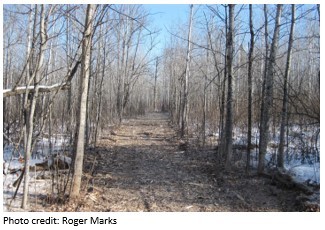
In October you hustled to fill out your new IDP in eLINK, included several training requests, and now you patiently await that TTCP email announcing a training session near you. The only problem, you work in Faribault County along the Iowa border and you requested training on 655-Forest Trails and Landing (there are no trees in Iowa!). That practice specific course is probably not going to be offered nearby. So now what?!
The training needs inventory in the IDP process allows the Technical Training and Certification Program (TTCP) to better assess training needs on a large scale. Through Area Technical Training Teams, the TTCP can also work to meet more localized needs and focus training curriculum. However, in many cases, specific requests came in at very low volumes or are spread throughout the state. Your request is still important to you, so how do you obtain the skills you are after? Here are several recommended options:
- Keep your eyes on the BWSR Training Calendar: https://bwsr.state.mn.us/training-calendar. Since emails announcing upcoming trainings are generally sent out in the vicinity of a session, you may not hear about all training opportunities in the state. But all trainings are posted on the calendar. If you need a specific training, and are willing to drive, watch the calendar for that opportunity. Feel free to contact us if you want an idea of upcoming course offerings.
- Use the online resources TTCP has gathered: https://bwsr.state.mn.us/online-learning. A number of webinars and other training resources from BWSR, SWCDs, NRCS, DNR, etc. can be found in this one spot. Maybe that basic training you requested is in webinar format and you can watch it right now.
- Find a trainer. If you have a project on your to-do list, but don’t have the JAA or training to complete it, find someone to walk you through all or parts of the process. BWSR trainers or technical staff from NRCS, TSA, and SWCDs may be able to help you out. Known as on-the-job-training (OJT), these experts can help you in person, over the phone, or maybe over the computer. Working through an actual project helps you complete your work and reduces the trainer’s prep time in having to find examples.
- Find a mentor. Very similar to the option above, you can use the Profile tab of the eLINK training module to locate other staff with JAA on your practice specific training need. Help them with their projects to get experience or ask them to help with yours; either way, this person can be a valuable resource to develop skill sets that normally can’t be obtained in the classroom.
- Contact someone from your Area Technical Training Team. Especially if you feel other local staff would benefit from the same training topic, the ATTT can use its resources and members to create a training fitting the needs of your area. Overall, keep in mind that professional development happens on an individual level. While the Technical Training and Certification Program was “designed to efficiently provide training to develop and maintain a highly trained, technically skilled workforce,” each employee must pursue training opportunities in line with your organization’s and your own priorities to gain the experience necessary to become an independent practitioner.
|
|
|
Technical Training and Certification Program Events
February
June
Related Partner Training Opportunities
January
- Jan 6-7 Agricultural Conservation Planning Framework, UMN Water Resources Center, St. Cloud
- Jan 21-23 Minnesota Erosion Control Association 2020 Conference, MECA, Plymouth
- Jan 21-May 3 Watershed Specialist Training UMN Water Resources Center, Online
- Jan 29-30 Fire in Minnesota Ecosystems, SFEC, Cloquet
- Jan 30 Stearns County Shoreland Training, College of St. Benedict, St. Joseph, MN Call 320-656-3613
February
June
- June 24-26 “Hold the Date” MAWD Summer Tour
|
|
|
Not all training takes place in a classroom. Check out the links below to learn at a time and place of your choosing.
-
Basic Grassed Waterway Trainings: A 3 part video series covering the practice standard contens and design concepts has been added to BWSR's Online Learning Library.
-
Cattle Grazing on Cover Crops in Northern Minnesota: Producer Thor Didrikson discusses the benefits and challenges of grazing their large herd of cattle on cover crops on their farm in Roseau County, Minnesota. Videography by Dan Balluff. Link to video
-
Profiles in Partnering - Great Plains: Public-Private Partnerships in Kansas and South Dakota strive to sustain rural landscapes for people and nature. Featuring ranchers Bill Sproul (KS) and Jim Faulstich (SD) along with their conservation partners in their own words. Link to video
-
Prairie Pod: MN DNR staff are conducting a podcast where they talk informally about various prairie-related topics. Link to podcast
-
The Pasture Project: A movement of farmers and farmland supporters helping land managers reintegrate livestock rotation in the heart of Upper Midwest farming. Webinar recordings link (scroll down past events to get to the webinars)
New: Tillage Implements - A review of tools for estimating erosion, primary and secondary tillage equipment, and the effects of the equipment on erosion calculations, SCI and STIR.
We’ve also put together a searchable library of recorded modules, webinars, videos and other resources to help our staff and partners find professional development information on a variety of topics. You can visit BWSR's Online Learning page to find web-based technical training resources sorted by category.
|
|
|
|
|