Multi‑State Notification on Terrestrial Rabies Activity in the Upper Midwest
Recent detections of the North Central skunk variant of the rabies virus in cattle from Iowa, Minnesota, and South Dakota, and detections of both the North Central and South Central skunk variants in Nebraska, have prompted this joint notification. Rabies cases in livestock are relatively infrequent. However, they serve as indicators of active rabies virus transmission between skunk reservoirs and livestock within agricultural communities. This indicates ongoing circulation of the North Central skunk variant across the Upper Midwest.
While rabid cattle have been detected in these states historically, there have been notable rabid skunk detections since 2024 in Iowa, Minnesota, and South Dakota, and investigations link the recent cattle infections to exposures from rabid skunks. The North Central skunk variant, the primary terrestrial rabies strain in the upper Great Plains, circulates widely in these states. Nebraska has not reported a rabid cow since 2021, but the ongoing presence of both the North Central and South Central skunk variants in Nebraska wildlife highlights the importance of sustained vigilance across all four states.
Since 2024, 10 cattle tested positive for rabies across Iowa, Minnesota, and South Dakota, affecting dairy (7), beef (2), and show cattle (1).
Across the four-state region, 25 skunks tested positive for rabies during the same timeframe. In Nebraska, three skunks were infected with the South Central rabies strain and two rabid raccoons were found with the same strain, suggesting exposure to rabid skunks. In Minnesota, South Dakota, and Iowa, only the North Central variant was detected.
Because rabies testing in livestock is largely dependent on animals being reported and tested after showing signs of illness, the true number of cases is potentially higher than what is confirmed.
The following map illustrates where confirmed cattle events (yellow dots) signal ongoing terrestrial rabies activity in regions with dense skunk and cattle populations.
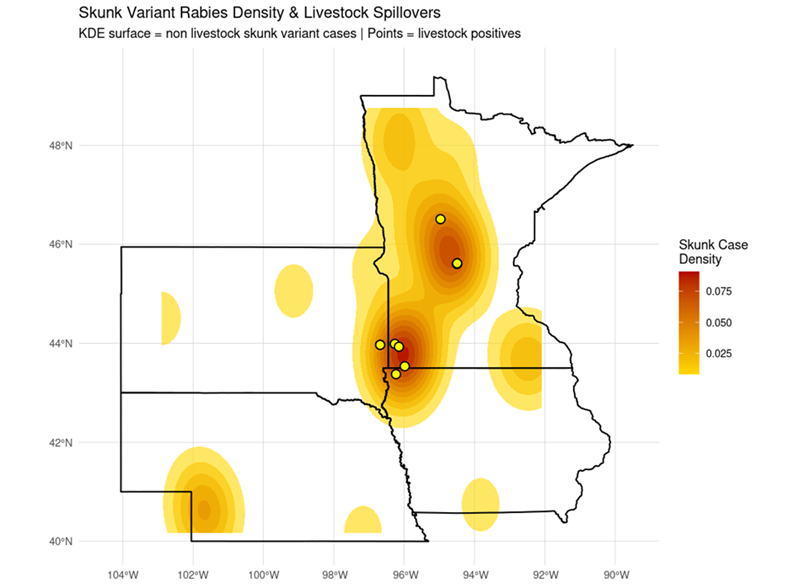 Skunk Varient Rabies Density & Livestock Spillovers
However, the absence of cattle cases outside these areas does not eliminate risk. Any direct interaction between wildlife, including skunks, and livestock can facilitate the spread of rabies and other diseases. This is why strong biosecurity practices are so important.
In the Upper Midwest, agricultural landscapes within the Prairie Pothole region support high densities of striped skunks, creating favorable conditions for sustained wildlife‑to‑livestock transmission and contributing to the pattern of recent spillover events.
Skunks are opportunistic foragers and readily enter cattle areas in search of spilled grain, calf feed, mineral supplements, or partially covered feed bunks. They may also shelter in barns, silage piles, haystacks, or windbreaks. These behaviors increase the likelihood of close contact with cattle, especially young animals that tend to investigate wildlife. As skunk rabies activity increases, so does the risk of cattle exposure, consistent with historical trends in which increases in cattle rabies cases paralleled higher skunk rabies prevalence.
Veterinarians are encouraged to discuss rabies vaccination with producers, particularly for high-value animals such as show stock, breeding cattle, or animals that frequently interact with people. Vaccination typically costs between $12 and $30 per head, depending on the vaccine and administration fees.
Rabies outbreaks can result in substantial economic losses. A 2024 cluster in a Minnesota dairy herd led to approximately $35,000 in direct costs. Estimated loss in sales value for the 10 cattle described in this report equals $13,008 in 2026 inflation‑adjusted dollars; this figure does not include additional costs such as veterinary care, disposal, or replacement. With cattle prices currently at or near all‑time highs, the loss of even a single high‑value animal carries significant financial impact, making proactive prevention an important component of herd health planning.
Anyone who observes a skunk behaving abnormally should consider rabies. Concerning behaviors include daytime activity, loss of fear, unprovoked aggression, disorientation or staggering, and unusual vocalizations. Skunks that bite or attack a person or animal should be humanely euthanized without damaging the head and submitted for rabies testing. Skunks that appear normal and have had no contact with people or domestic animals should be left undisturbed and may be observed from a safe distance, as testing is not needed in those situations.
Cattle with rabies may first show vague signs such as reduced appetite, isolation, abnormal vocalization, or subtle behavioral changes. These signs may be mistaken for conditions like “choke,” as early throat and facial paralysis can cause difficulty swallowing and drooling. As the disease progresses, animals may develop sudden aggression or restlessness, increased sensitivity to touch or sound, stumbling, or hindlimb weakness. These signs typically worsen rapidly, leading to paralysis and inability to stand. Any combination of these signs, especially if sudden or rapidly progressive, should raise suspicion for rabies and prompt immediate veterinary evaluation.
Anyone who believes they may have been exposed to rabies should immediately assess whether the animal involved can be safely captured or tested, as ruling out rabies in the exposing animal is the best way to determine risk. If the animal cannot be located, tested, or confidently cleared, the exposed person should promptly contact a healthcare provider or public health officials to discuss the need for rabies postexposure prophylaxis. Rabies is not a food safety concern.
For questions, contact the Minnesota Board of Animal Health at animalhealth@state.mn.us or 651-201-6808.
Acknowledgements
Our thanks to CDC’s Rabies Program within the Division of High‑Consequence Pathogens and Pathology for producing the heat map shown above and to the Iowa State University Center for Agricultural and Rural Development for assisting with the 2026 inflation‑adjusted market estimates for cattle lost.
Having trouble viewing this email? View it as a Web page.
|