Diverse jurisdictions can collaborate.
Good collaboration involves a shared vision, good communication, role clarity, and the ability to work side by side. But collaborating across complex government entities can be challenging, especially when issues are contentious and there is a deficit of trust. One of the first steps to developing strong collaboration is simply being in the same space together, talking, finding common ground, maybe even sharing a meal. Little things can go a long way to opening doors to collaboration, for example:
- finding a welcoming and neutral meeting space where all parties can feel comfortable;
- defining the goals of a collaboration at the outset, so people don't feel left in the dark about an effort's purpose;
- providing coffee, snacks, or a meal at meetings to create an inviting atmosphere;
- writing thank you notes or giving a follow up call to parties after their participation in a contentious process;
- continuing to check in after a resolution is found to make sure parties have what they need to keep going.
Small efforts, added up, can make a difficult process smoother and fractured relationships more productive. What other tips would you recommend to set collaboration up for success?
 Shakopee Mdewakanton Sioux Community Tribal Administrator Bill Rudnicki and City of Prior Lake Mayor Kirt Briggs sat down with OCDR for an interview about the Scott County Association for Leadership and Efficiency (SCALE), an association that was created in 2003 to ”maximize the value of taxpayers’ money through cooperating in mutual service areas, such as public safety, parks and recreation, transportation, community development, and general government.” SCALE members include elected and appointed officials from townships, school districts, watershed districts, cities, Scott County, and the Shakopee Mdewakanton Sioux Community (SMSC). Minnesota State Senator Eric Pratt, on OCDR’s Advisory Council, recommended OCDR learn more about SCALE’s work on multijurisdictional collaboration.
Here is OCDR's interview with Administrator Rudnicki and Mayor Briggs.
OCDR: Talk about the origins of the SCALE and how the association functions.
Administrator Rudnicki: SCALE started during the Pawlenty administration when there was a multi-billion-dollar budget shortfall. Cities realized they needed to tighten their belts. For example, Public Works departments in each city had expensive equipment that they needed to buy and maintain. SCALE started because we asked, “Why aren’t we pooling our resources?” After about a year, one of the mayors invited the Shakopee Mdewakanton Sioux Community (SMSC) into SCALE. That opened up the whole spectrum of communication.
Different people host each meeting and share what’s working where they are. That spurs new thoughts and innovation.
Mayor Briggs: I have watched this volunteer organization grow over 20+ years. We have some light refreshments, coffee. All people need to do is show up. We try to onboard new people – like mayors – when they join. This is like “government without borders.” We have conversations inside and outside the monthly meeting space. At the end of the day, citizens just want to be helped.
OCDR: Why did you decide to join SCALE?
Mayor Briggs: Initially, I was skeptical about the value of SCALE. We had to talk about what it wasn’t. It’s not joint powers. It’s not another layer of government. We drew distinctions between our different governments and what this thing was and is.
I see it as an opportunity to develop relationships. Some people say, “familiarity breeds contempt.” I would say “familiarity creates understanding.” You “must be present to win” because where you put your body is where you put your priorities. I was “converted” after I became the SCALE chair, and they gave me the gavel. I realized it wasn’t about transactions. It was all about relationships. Tribe and cities, cities with each other. You never know when you need trusted relationships. You want them to be in place when there are challenges.
OCDR: How have communities benefitted from your participation in SCALE?
Administrator Rudnicki: The Tribe started a fire department in 2001/2002 that was staffed with 30+ people. Other cities had volunteer fire fighters. In 2004, I shared this with SCALE, and we created mutual aid agreements. SMSC’s Fire Chief and Prior Lake, Savage, and Shakopee fire departments meet regularly. We align what equipment we buy so it’s interchangeable. We do joint training. We work together on best practices. This helps the cities.
Another concrete example is that we now have a joint training facility. Our Fire Department does training there. The police have a shooting range there. It’s important to have joint discussions so we can make improvements together. It’s so much more efficient that way.
SCALE also allowed us to assess how the possible closure of the HERC in Minneapolis might affect us. We had three sessions talking about solid waste streams and recyclables. We needed to understand that if HERC closes, we may need additional landfills. We want everyone to understand the unintended consequences. We can have that collaborative conversation because of SCALE.
When the cannabis issue came up, we talked about it as a group. We had people from Colorado come and talk to us so we could learn together. We invite elected leaders and we learn together.
Before SCALE, there had been an absence of communication between our local and county governments and our tribal government. For example, the tribe wanted to put land in trust. Some cities and the county weren’t supportive of that. But SCALE was the group that facilitated a different kind of conversation between staff and elected leaders to enable this process to move forward.
OCDR: Is there anything unique about Scott County that makes SCALE possible?
Administrator Rudnicki: I think it works in Scott County because it’s part rural, part urban. It’s maybe the “farmer mentality,” which is, “hey, if you need to use my tractor or tiller, go ahead.” That’s built into the DNA of the SCALE members and staff. We talk about economic development together. We believe that if one does well, we all do well. Mayor Briggs, do you have that same idea that our “farmer mentality” helps us?
Mayor Briggs: Absolutely! At this point, I don’t know what it would be like to be all alone. We can’t just focus on ourselves. SCALE is both about our entities individually and about us together. Collectively we come up with better solutions.
OCDR: What collaborations are you especially proud of?
Mayor Briggs: Some tangible things include Prior Lake and the tribal community co-creating a water treatment plant. Taxpayer dollars were invested on sovereign land. The central issue here was trust and conversation. Sometimes we have had issues across our governments. There are always challenges, but seeing people through those challenges requires trust. Like OCDR, SCALE creates the opportunity to build the relationships. We build the network before the relationships are needed.
Now at the county building, you will see the State, POW, SMSC, and Prior Lake flags. We put this together after we created the water treatment facility together. The relationships need to endure. Someone might ask, “How did the SMSC flag find its way into the Prior Lake city chambers?” It sparks a conversation, a deep conversation. It’s an enduring and critical relationship.
Chairman Charlie Vig started this process to bring us closer together, beyond artificial municipality boundaries. Water from Prior Lake and from SMSC literally flow into the treatment plant together. That’s very symbolic.
OCDR: What do you most appreciate about SCALE, and how have you developed personally because of your involvement?
Mayor Briggs: With elected offices, you turn over every four years. I didn’t know what I didn’t know as a newly elected mayor. SCALE allowed me to benefit from mentors. In terms of personal development, I learned humility from the elected leaders I met at SCALE.
We have also been successful in legislation as a collective. Single cities don’t have the strength of voice. SCALE and these relationships have created some alignment and a coalition – eight cities, six townships, the county, and a sovereign nation into a collective voice.
Administrator Rudnicki: There is trust with a little “t” and a big “T.” We have been able to build trust across all organizations with a big “T.” By creating coalitions, we build trust. It’s so nice to see not another layer of government but for these governments to truly work together.
Mayor Briggs: When we first started SCALE, like Administrator Rudnicki mentioned, there was opposition toward trust land. Right now, we have some issues coming up with our comprehensive plan. Some of our cities are on opposite sides of the table and the county in the middle.
Administrator Rudnicki: To flesh that out, the Met Council looks at density, and they would include the tribe in two cities. But the cities didn’t actually have a say. The tribe gets to decide on density. With SCALE, we were able to get Met Council to change some of those things as a collective. SCALE members also came together about the Highway 169 corridor project. We got funding at federal and state levels – but if it was just the City of Jordan, that wouldn’t work.
OCDR: Anything else you would like to share?
Administrator Rudnicki: If you ever run into a situation where we can come in and talk about how to get governments to work better together, call us.
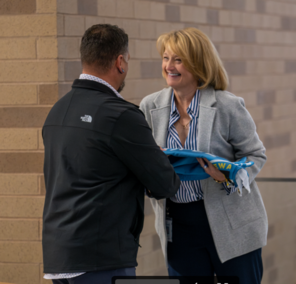
The Shakopee Mdewakanton Sioux Community and City of Prior Lake Flag Exchange ceremony is a symbol of multijurisdictional collaboration that more government entities could emulate. Here, Chairman Cole Miller presents a Shakopee Mdewakanton Sioux Community flag to 1st District Chief Judge Carrie Lennon.
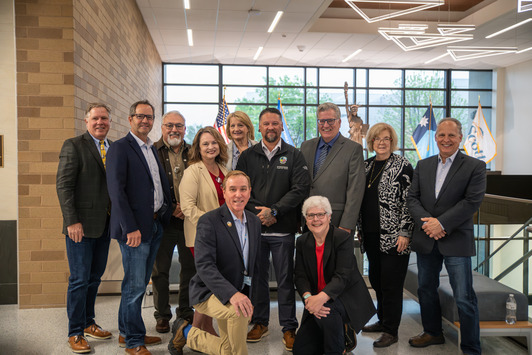 Elected officials attending the ceremony pose together for a picture.
Left to right: Kirt Briggs (Prior Lake Mayor), Dave Beer (Scott County Commissioner), Charlie Vig (former SMSC Chairman), Barbara Weckman Brekke (Scott County Commissioner), Bill Rudnicki (Tribal Administrator, kneeling), Carrie Lennon (Chief Judge 1st District), Cole Miller (SMSC Chairman), Lezlie Vermillion (Scott County Administrator, kneeling), Jon Ulrich (Scott County Commissioner), Jody Brennan (Scott County Commissioner), Tom Wolf (Scott County Commissioner)
Practice
Learn
-
Interview: OCDR’s interview with Mariah Levison (OCDR’s first director and now CEO of Convergence) focuses on best practices in collaboration.
-
Process: Building a Collaborative Governance Framework: A Five Step Process from the Portland State University’s National Policy Consensus Center (2020) includes definitions, models, and questions that support hearing all sides’ perspectives on difficult public policy issues.
-
Guides and resources: OCDR’s Problem-Solving Toolkit features guides and resources on collaborative problem-solving, public engagement, and other topics.
-
Article: This Participedia article on Collaborative Governance provides background on the pros and cons of collaborating across jurisdictions.
-
Article: Although written in 2013, this article on local government collaboration notes that “In an era where government at all levels, and increasingly, local government, which once seemed immune to this trend, is the target of suspicion, mistrust and downright derision, collaboration can be a powerful antidote.”
-
Report: Cross-Jurisdiction Collaboration: New Models for State, Regional and Local Governments (2011) includes case studies of different models for cross-jurisdictional collaboration that provide lessons learned for those interested in collaborating broadly.
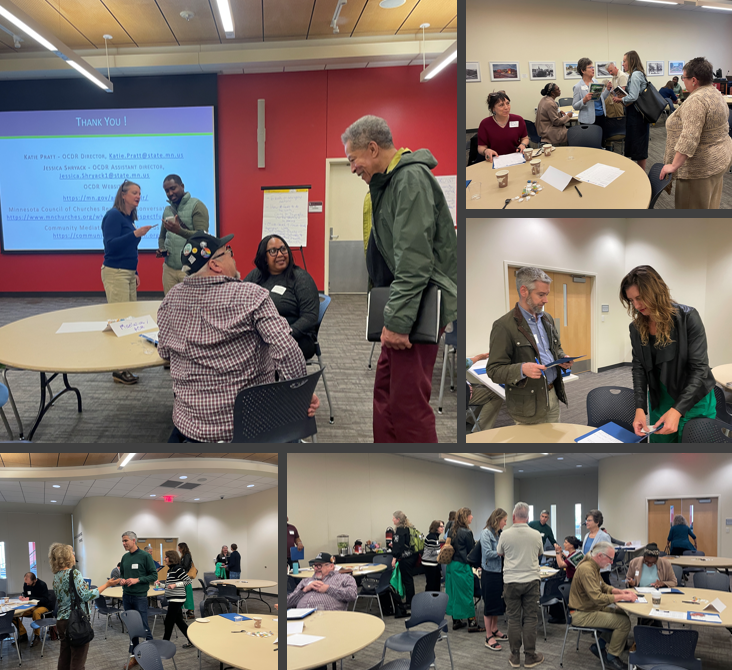
On May 1, 2025, OCDR and partners held a bridge-building convening that included over 30 individuals and organizations working in peacebuilding, mediation, restorative justice, journalism, and other fields, which was co-sponsored. This was an opportunity to network and build relationships in the growing field of bridge-building. One idea that came out of this gathering is holding an annual bridge-building conference to support deeper work together for the betterment of our state.
Stay tuned for more information on this initiative in upcoming newsletters or contact us to find out more.
OCDR links to a range of sources relevant to collaboration and conflict resolution. The newsletter is a very abbreviated compendium of interesting sources we find every quarter. We don’t endorse any specific approach or viewpoint beyond the relevance of the source to topics discussed in our newsletters.
|