|
June 23, 2020
 |
|
Funding and Reimbursement Programs |
There are now several funding and reimbursement programs available to clerks. Below is a rundown of the programs available and what clerks need to do to take advantage of these opportunities.
(1) Reimbursement of qualifying expenses for jurisdictions that held (or canceled) May 5 elections. The reimbursement program for canceled elections was explained in the May 8 news update. Contact Lori Bourbonais at BourbonaisL@Michigan.gov with any questions. The reimbursement claim forms for counties and local jurisdictions are available in eLearning. The deadline to submit your request is July 1, 2020. The form to request reimbursement for postage was mailed on May 18. The deadline to submit the form is July 31, 2020. Contact Charamy Cleary at Clearyc@Michigan.gov with any questions.
(2) August absent voter ballot envelopes. This purchase and reimbursement program for custom-printed absent voter ballot envelopes was explained in the May 4 and May 13 news updates. For jurisdictions that ordered absent voter ballot envelopes sufficient to cover 40 percent of their registered voters after the May 4 news update, the Bureau of Elections will pay the vendor. Those jurisdictions don’t need to take further action. Information will be coming soon for jurisdictions that had already purchased qualifying custom-printed absent voter ballot envelopes, or ordered envelopes for more than 40 percent of registered voters and are seeking reimbursement for qualifying expenses. Please contact Charamy Cleary at Clearyc@Michigan.gov with any questions.
(3) Reimbursement for August AV application mailings. Information regarding this reimbursement program will be coming soon.
(4) State-provided personal protective equipment (PPE). The state is providing all jurisdictions with PPE including masks, gloves, hand sanitizer, and cleaning supplies. The state will ship supplies to the counties for distribution to local officials. Local jurisdictions don’t have to do anything to receive supplies other than contact their county. Additional details on supplies and local distribution will be provided soon.
(5) Tabulator and software cost share. This program was explained in the June 10 newsletter. Local jurisdictions interested in a cost share with tabulators and software should fill out the application as soon as possible.
(6) Ballot drop boxes and (7) election supply form. These programs were explained in the June 17 and June 19 news updates. Clerks interested in a free ballot drop box should fill out this form as soon as possible. Clerks interested in purchasing supplies at no cost (using federal CARES funding) should fill out the supply order form by June 30. Clerks can choose additional funding rather than a free ballot drop box subject to some restrictions as explained on the ballot supply form.
 |
|
Absent Voter Ballot Application Mailing and List Maintenance |
The state mailing of absent voter ballot applications was completed last week. All registered voters who have not yet received an application should be receiving theirs by the end of the week. In some instances, voters have returned completed absent voter ballot applications to the state. The Bureau of Elections is forwarding these applications to local clerks.
When absent voter ballot applications are returned undeliverable, the Bureau of Elections will forward them to local clerks. Clerks should review the returned mail and process voter registration records using procedures for maintaining voter records on the Qualified Voter File. Clerks who receive undeliverable mail should use the following procedures for identifying individuals on the Qualified Voter File who have become ineligible to vote.
Election mail may be sent to registered voters who are inactive or who are on a “verify” or “challenge” status because a clerk has received information indicating that the voter may not be eligible. Voters on an inactive, verify, or challenge status are eligible to vote. However, voters with a verify or challenge status must confirm their eligibility in writing before being able to vote. Returning a complete, signed absent voter ballot application is sufficient to remove a verify or challenge status, but the clerk must, as always, review the application and signature before processing the application.
Consistent with United States Postal Service guidelines, the Bureau of Elections instructs residents who have received any election mail, including an absent voter ballot application, for an individual who no longer lives at that address to mark the envelope appropriately and put it back in the mail. Residents should write “no longer at this address” if the mail recipient no longer lives at the address, or “deceased” if the recipient is deceased. This will result in mail being returned as undeliverable. When undeliverable mail comes back to the Bureau of Elections, the Bureau will forward it to each local election jurisdiction as noted above.
Undeliverable mail is reliable third-hand initial evidence that a registered voter no longer lives at an address. Voter registration records cannot be canceled immediately based only on returned mail. However, you should begin voter list maintenance procedures based on this information.
Residency
If you receive mail returned undeliverable that is marked “no longer at this address,” or another similar message such as “no longer lives here” or “return to sender – bad address,” first look up the voter in QVF. If the voter is already marked as “verify” or “challenge,” based on residency, no further action is needed. The voter will be canceled after the appropriate number of federal elections has passed.
If the voter does not have a “verify” or “challenge” status, send the voter an NVRA confirmation notice. If the NVRA notice is also returned undeliverable, mark the record as “challenge.” If the NVRA confirmation notice is not returned, the voter is placed on “verify” status. If the voter returns the confirmation notice and confirms in writing that the voter has moved, mark the record as canceled.
Deceased
If you receive mail returned undeliverable that is marked “deceased” or something similar such as “died 2018,” you should first seek additional information to confirm that the individual has died. If you can confirm the individual has died based on county or state death records, a death notice printed in a newspaper, or personal firsthand knowledge, mark the voter as canceled – deceased. You should not cancel a voter based solely on the envelope being marked deceased – you must have additional evidence or firsthand knowledge as indicated above.
If you are unable to confirm whether the individual is deceased, follow the procedures for residency above.
Written confirmation from voter
You can also cancel a voter registration immediately upon a signed written request from a voter requesting cancelation. For example, if you have received reliable third-hand information that a voter has changed residency, and a family member also informs you that a registered voter has moved from the state, you can inform them that the voter is in (or will be placed in) the cancelation process and will be removed after the appropriate number of federal elections have passed. However, if the voter wants to be canceled immediately, he or she can send you a signed, written request to cancel the registration.
Instructions to residents who receive mailings
If a voter contacts you and says he or she has received election mail for another individual, instruct the resident on the proper procedure for marking the envelope and placing it back in the mail. This document is also available on eLearning:
If you receive election mail – such as an absent voter ballot application or a notice of a change in polling place – for a resident who no longer lives at the address to which the mail was sent, take the steps below to inform your local election clerk. Voters can receive absent voter ballots only after they have submitted a signed application and the clerk has reviewed the application, including the signature. An application being mailed to an out-of-date record does not mean that person will get an actual ballot. However, by informing your local clerk that a registered voter no longer lives at the address, you can help election officials maintain the voter registration list and keep it up to date.
(1) If the voter has moved, write “no longer at this address” on the envelope and place it back in the mail. Your election clerk will then send a confirmation notice to the voter, as required by law. If the voter does not respond to this notice and does not have other voter activity for a period of two consecutive federal elections, your clerk will cancel the voter registration. The clerk will also place the voter on a “verify” status, which requires the voter to fill out a form confirming eligibility before voting. If a voter wishes to have his or her registration canceled immediately, the voter can make a signed, written request to cancel the registration to the local clerk.
(2) If the voter has died, write “deceased” on the envelope and place it back in the mail. Your election clerk will review the record as required by law and will cancel the voter registration record upon confirming that the voter is deceased. If you have information confirming the voter is deceased such as a county health office record or an obituary, you may provide that information to your local clerk if you choose to do so. If you choose to do this, provide a copy – not the original document.
 |
|
Accessible Absent Voter Ballot Options |
Voters who have requested absent voter ballots prior to June 25, the 40th day before the August 4 election, should be issued absent voter ballots on June 25. Additionally, starting on June 25, voters may request absent voter ballots in person and be issued absent voter ballots in person. Whether requesting an absent voter ballot in person or by mail, clerks should be prepared to ensure voters with disabilities have accessible options for marking these ballots.
During hours in which absent voter ballots are issued in person, clerks should have Voter Assist Terminals available in the event that a voter would like to use the VAT to mark in in-person absent voter ballot. VAT’s should be available when in-person AV ballots are issued whenever possible.
Additionally, as discussed in last week’s news update, voters will have an additional option for an accessible absent voter ballot starting in August. Under a federal court settlement, the Bureau of Elections has developed an electronic absent voter ballot that voters with disabilities may mark remotely using assistive technology. The voter can then print the ballot and mail or deliver the ballot to the clerk. These ballots should be processed in the same manner as printed ballots sent by military and overseas (MOVE) voters.
Voters with disabilities will be able to apply for an accessible electronic absent voter ballot by completing a specific accessible AV application that will be available on the Bureau of Elections website. Voters may submit applications on paper or electronically. When a voter submits an accessible AV application to the local clerk, the clerk will issue an accessible AV ballot to the voter electronically.
The accessible ballot is available in the Qualified Voter File (QVF) AV Details screen. Clerks can fulfill the accessible ballot request by downloading the ballot and returning it as an attachment to the email request, similar to the MOVE Ballot process. The ballot is laid out in a linear fashion to ensure that it reads well with the accessible software used by voters with disabilities.
The process is outlined below:
 Below are the details:
1. Within AV Details, check the ACCESSIBLE box
 2. Click the ACCESSIBLE BALLOT button
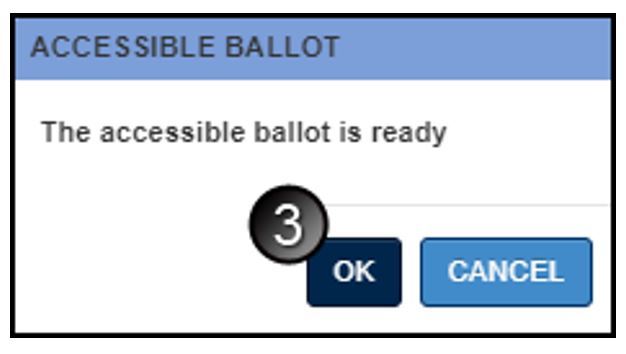
 3. When the ballot is ready, click OK
 Click to edit this placeholder text.
4. A PDF file of the accessible ballot will open. Save this file to your computer temporarily so that you may attach it to the email to be sent to the voter.
a. As an alternative, if you have a default email program like Outlook, you can click the SHARE button and it will create an email with the file attached for you.
 5. Don’t forget to record the ballot in AV Details
a. Ballot Number: Use the letter “A” as a prefix to a ballot number, like when you record a MOVE ballot.
b. Delivery Method: Email
c. Email Address
 We expect the accessible AV application and accessible AV ballot to be available as soon as Friday, June 26. Under the court settlement, this is an interim process that will be replaced by a permanent accessible remote ballot-marking solution starting in November, which will be implemented following a public bidding process.
|




