Conserve H20 by watering wisely
No matter how your drinking water is sourced, taking simple steps
to reduce outdoor water use at home can have a major impact
With more than 3,000 miles of Great Lakes shoreline, one may assume Michigan could never face water issues. But Ottawa County is facing such challenges. To understand why, we need to first look below the surface.
Groundwater challenges
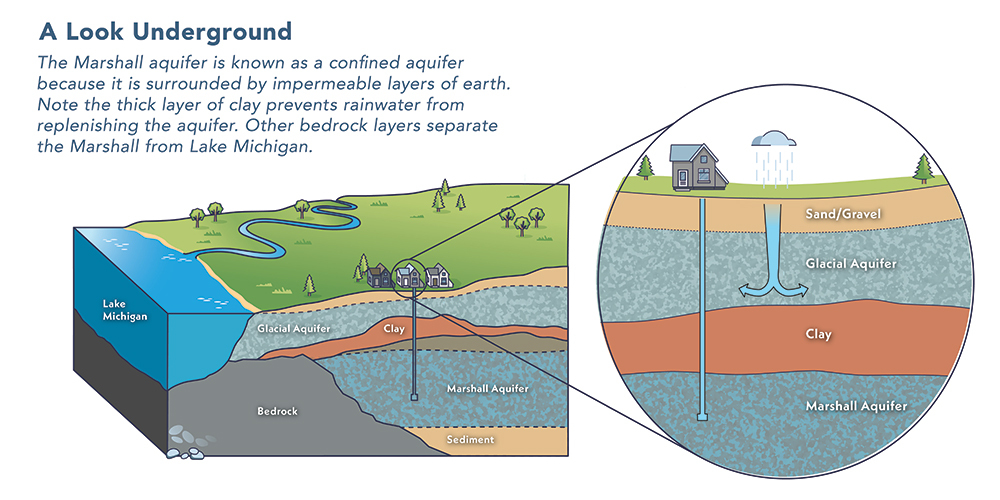
Like in much of Michigan, in Ottawa County municipal water is only available to those in or near densely populated areas. In rural areas, drinking water is sourced from aquifers - pockets of water-saturated soil or rock below ground. Locally, there are two types: glacial and bedrock. Glacial aquifers are the preferred source; however, when glacial aquifers aren’t available, bedrock aquifers are tapped. Normally, these aquifers are replenished through the water cycle. However, in Ottawa County, clay deposits block the water from refilling the bedrock system.
As rural areas have grown, more wells have been installed, and demand has increased on this limited supply. In some instances, residents' wells have run dry; in others, briny sediment has been pulled from the bottom, damaging plumbing and affecting water quality.
"It's a counterintuitive problem. After all, we're in Ottawa County. We're surrounded by water," said Land Use Coordinator Matt Chappuies, who has led the County's groundwater efforts for a number of years. "But because of our unique geology, the amount of water being withdrawn outpaces the speed at which the aquifer can naturally replenish itself."
Public Water Challenges
For those on municipal water - typically sourced from Lake Michigan in this region - the challenge isn't scarcity so much as it is production capacity. According to Eric Law, Northwest Ottawa Water System (NOWS) Water Filtration Plant Superintendent, municipal systems typically see their highest demand during the summer, when the public's attention turns outdoors to landscaping. During a recent tour of the Grand Haven Water Filtration Plant, Law showed County staff data clearly illustrating this spike.
"Looking at the data, the pattern is unmistakable," said Law. "The current capacity of the NOWS water system is 23.25 million gallons/day (MGD). Lawn irrigation having an outsized influence on water demand forces the NOWS system to produce 19.4 MGD during the morning peak - that's roughly 84% of plant capacity."
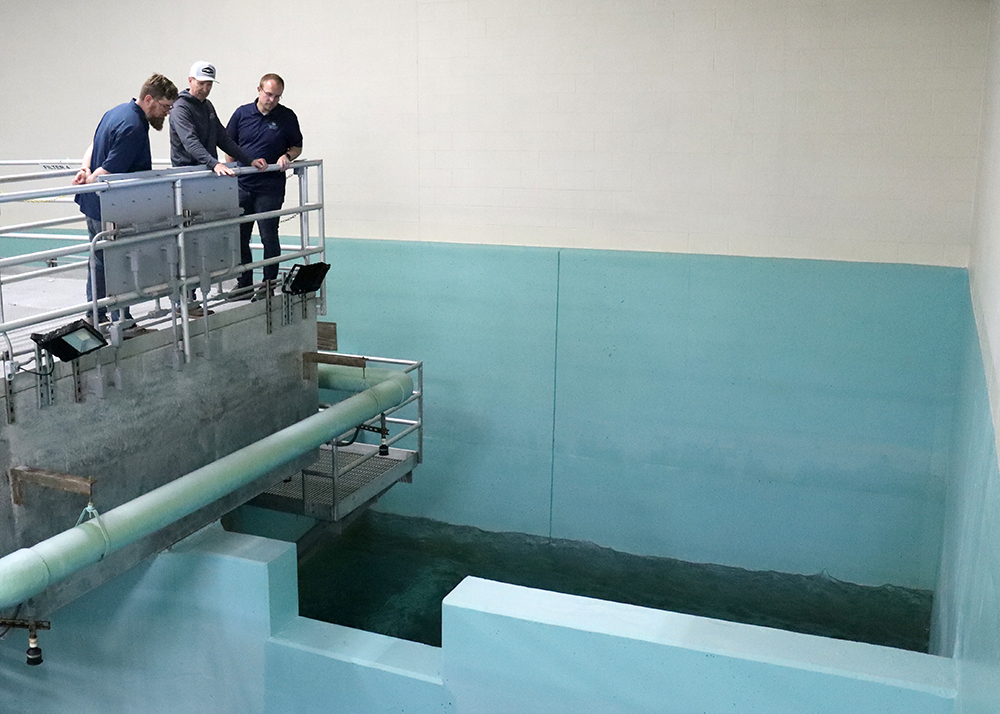 Ottawa County Land Use Coordinator Matt Chappuies (left) and Special Projects Coordinator Joe Pierce (far right) listen as NOWS Water Filtration Plant Superintendent Eric Law (center) explains the water filtration process during a tour of the plant in Grand Haven in May 2026. [Rich C. Lakeberg/Ottawa County]
Simply put, pumping and treating lake water has limits. If a water treatment system approaches its maximum capacity frequently, operators must consider use restrictions. If demand continues to increase, that could result in investing in new infrastructure. That cost must then be passed on to ratepayers. Because of this growing use, NOWS is asking customers to voluntarily avoid watering lawns between 5 a.m.-11 a.m.
NOWS isn't alone. The City of Wyoming system - which supplies water to five Ottawa County municipalities - also recently took temporary measures by instituting odd-even day outdoor watering through the end of May 2026 while it upgrades it system to manage overwhelming demand.
Save H20 by changing landscaping habits
Despite local aquifers and municipal water systems facing two very different types of problems, the fix is the same: changing our outdoor watering habits.
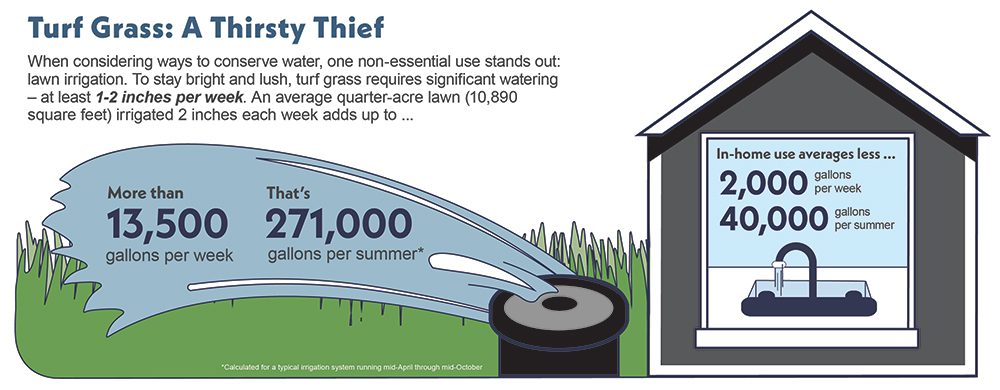
Federal data confirms 30 percent of Americans' H20 consumption is outside. For most of us, that water is going straight to our grass - one quarter-acre lawn irrigated regularly can consume more than 13,000 gallons or more per week. That is more than six times the amount of water the average family of four uses weekly for daily life - bathing, washing, drinking, etc.
Old habits can be hard to break, but there are some fairly simple steps the average homeowner can take today to significantly cut back on water use, says Chappuies.
"It takes a community," said Chappuies. "Whether it’s adding simple smart irrigation tools to reduce waste or replacing sections of turf with drought-tolerant plants, you can make a dent in water use this summer."
 Here are a few recommendations:
Smart irrigation tools: By installing smart devices like rain sensors, smart controllers or flow sensors, thousands of gallons can be saved per year.
Rain barrels: Catch rain runoff to water landscaping. The barrel can be connected directly to an irrigation system, or soaker hoses can be attached.
Let it grow: Mow strategically by cutting grass to no less than 3 inches in height, or no more than ⅓ the total. Longer grass blades provide more shade, keeping the ground moist longer.
Shrink your lawn: Turf grass covers most of the average yard. Consider planting turf only where it is needed. Low-traffic areas can be converted into gardens or buffers planted with low-maintenance natives that need little water and provide habitat.
More resources
For more details on these recommendations, general water conservation and landscape best practices, and links to partner resources, visit miottawa.org/be-water-wise
For more information, or high-resolution images from this release, contact:
Rich C. Lakeberg | Communications Specialist
rlakeberg@miottawa.org
|