|

Dear Port Sheldon Township Partners,
Welcome to The Current Connection, a customized update from the Ottawa County Water Resources Commissioner’s Office.
This edition is tailored specifically for Port Sheldon Township, highlighting projects, financial updates, and water stewardship initiatives within your community.
Our goal is to keep communication clear, timely, and meaningful — ensuring every township has the information needed to plan effectively and continue our shared commitment to responsible water management.
In this issue, you’ll find:
- Recent and upcoming drain and infrastructure project updates within your township
- Updates on county-wide initiatives that may impact your area
- Contact information for key staff and upcoming coordination opportunities
Together, we continue to protect, maintain, and improve Ottawa County’s water systems for the benefit of every community and resident we serve.
Warm regards,
Joe Bush, Ottawa County Water Resources Commissioner
Who To Contact
You may receive many questions and concerns from residents, and we want to ensure you have the support you need to serve them effectively. Joe and his knowledgeable team are valuable resources who are ready to assist. Please reach out to one of the staff members listed online for help in addressing residents’ inquiries.
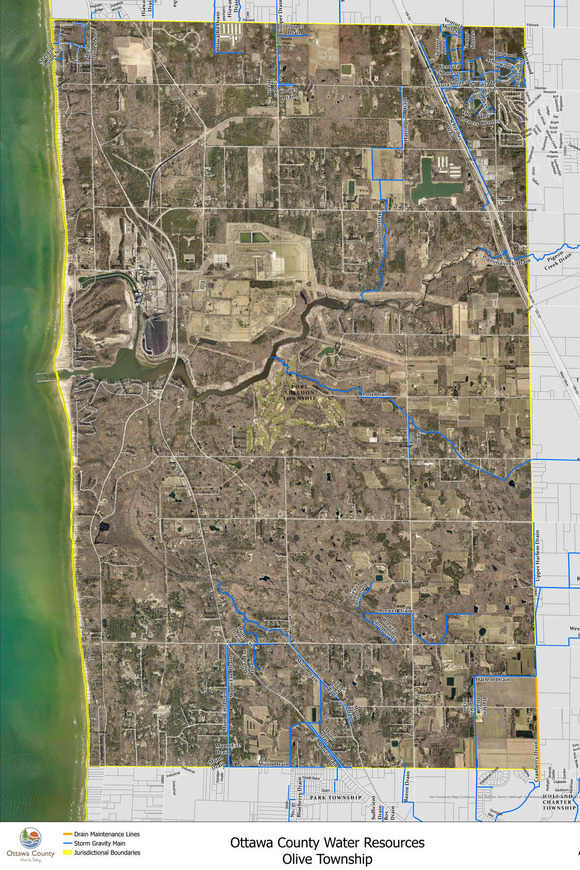
 The Ottawa County Water Resources manages over 1,000 drains countywide. We manage over 20 drains in your township alone. Below is a map that shows the drains in your township.
 Our office receives two main types of petitions under the Michigan Drain Code:
-
Chapter ¾ –Adoption of a Drain and Drainage District There are numerous stormwater infrastructure systems throughout Ottawa County that are considered orphaned—meaning no governmental entity is responsible for their maintenance. As a result, there is no designated budget for repairs or upkeep, which often leads to frustration among residents when problems arise. A Chapter 3/4 petition allows such systems to be formally adopted as public drains under a drainage district, ensuring long-term maintenance and funding.
-
Chapter 8 – Maintenance and Improvement of an Existing Drain Our office is required to follow the Michigan Drain Code, which governs all drainage work within the county. If a drainage project exceeds the legal maintenance limit of $10,000 per drainage mile, a Chapter 8 petition may be necessary to authorize the work and establish an assessment process to fund the repairs.
Each petition type has specific application requirements as outlined in the Drain Code. Once a completed petition is submitted to our office, we are legally obligated to proceed with the petition process. Petitions may be submitted by residents, a township or city, the Michigan Department of Transportation (MDOT), or the Ottawa County Road Commission—though they most commonly originate from residents or local townships.
When an application is received, a Board of Determination meeting is scheduled. The Water Resources Commissioner appoints a three-member independent board to determine whether the project is necessary. Board members must not live, own property, or work within the municipality where the project is proposed. During the meeting, an engineer provides a general overview of the drainage concerns or proposed improvements, followed by an opportunity for the public to share comments and testimony about the issues.
If the BOD determines the project is necessary, the engineering firm proceeds with project design and the acquisition of any required easements. Once design plans are finalized, the firm prepares a budget and coordinates with the Water Resources Commissioner to make any needed adjustments or cost allocations.
A Day of Review is then held for the public to review and comment on proposed assessment apportionments. All landowners within the drainage district receive notification detailing their estimated special assessment amounts. Property owners have a 10-day appeal period following the Day of Review if they wish to contest the assessments.
All petitioned projects are publicly bid, and the contract is awarded to the lowest qualified bidder. Our engineering team oversees the contractor’s work to ensure that the project is completed in accordance with the approved plans. Upon completion, costs are assessed to the benefiting parties, which may include the Road Commission, Township, County, MDOT (if applicable), and property owners within the drainage district. While the petition process is lengthy, it is ultimately rewarding, as it provides long-term drainage improvements and protection for the community.
We currently do not have any open petitions or potential upcoming petitions for your township.
Ongoing Petition Project – Fiscal Year Summary
Sheldon Dunes No. 2
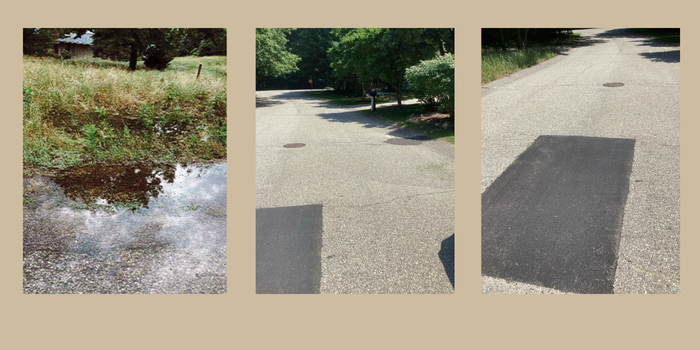
During the past fiscal year, Port Sheldon Township has continued work on the ongoing Sheldon Dunes No. 2 Petition Project, which was initiated in 2022 to address sinkhole formation and ponding along local roads.
ENG serves as the project engineer for this effort. To date, repairs to several sinkholes have been completed, with construction performed by Busscher Development. The next phase of work includes preparing a bid letting for the installation of several leach basins to improve road drainage, cleaning and restoring the detention basin, and televising and cleaning the stormwater infrastructure throughout the subdivision.
At this time, our office is not aware of any new or upcoming petition projects within this area.
Work on the ongoing Sheldon Dunes No. 2 Petition Project, which was initiated in 2022 to address sinkhole formation and ponding along local roads.
Capital Improvement Planning
Now that our assessments have been distributed, the department has begun developing the Capital Improvement Plans (CIPs) for the townships. These plans are based on historical maintenance expenditures, projected costs for known maintenance and petition projects, and a contingency allowance for unforeseen issues that may arise throughout the year.
Please note that these figures represent estimates, and the final budget may differ from our current projections as new information becomes available during the planning process. We anticipate distributing the completed CIPs before your new fiscal year begins.
 Ottawa County has hundreds of county drains that help manage stormwater and protected our homes, roads, and natural areas. Because our team is small compared to the number of drains we oversee, we often respond to issues as they arise rather than performing routine maintenance on every system.
Most of the calls we receive involve things like fallen trees, trash or sediment buildup, animal burrows, ponding or flooding, and sinkholes or catch basin problems. Sometimes, residents also contact us about drainage concerns between neighboring properties.
When maintenance is needed, we notify affected property owners and request bids from qualified contractors. Our office reviews the bids to make sure they meet all Drain Code requirements, awards the project to the lowest responsible bidder, and then monitors the work until the area is stable and ready for mowing again. Because our department is an Authorized Public Agency (APA), we can handle most drain maintenance without needing separate state permits. However, depending on the type of work, some projects may still require additional review and approval from EGLE (the Michigan Department of Environment, Great Lakes, and Energy).
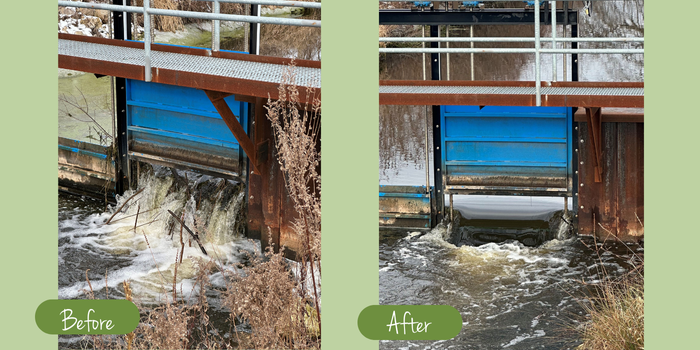
Over the past year, we received four drainage-related complaints from residents in your township related to the Harlem Drain. The Harlem Drain has three dams that impede its flow. All four complaints concerned the buildup of debris on these dams. Contractors have been dispatched to remove the debris from the dams.
Before, the Harlam Drain was filled with debris. After, the drain is cleared and flowing properly.
Fall Stormwater Maintenance Reminder
Fall is here, and with it comes the task of preparing for the winter months ahead. Just like cleaning your home’s gutters, it’s important to keep leaves and debris away from storm drains. Clear drains allow stormwater to flow properly during rain, snowmelt, and freeze thaw cycles, helping prevent flooding and icing on roads.
If your township offers leaf pickup, please remind residents to keep leaf piles away from stormwater structures when placing them curbside for collection. A little extra care now helps keep our drainage systems working efficiently all season long!
 Your township is included in our Municipal Separate Storm Sewer System (MS4) coverage, as required by the State of Michigan. Within the township, there are two distinct sewer systems:
- Sanitary sewers, which carry wastewater to a treatment plant for processing, and
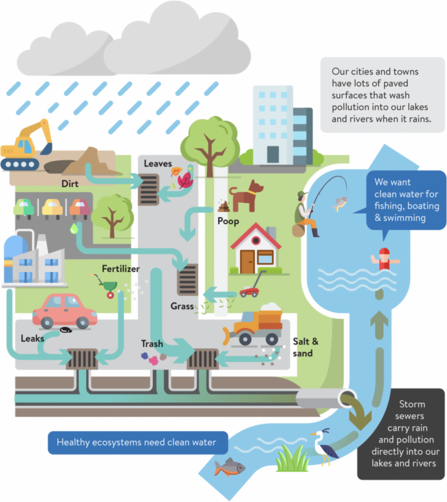
- Stormwater sewers, which collect runoff from impervious surfaces such as roads, roofs, and parking lots.
Unlike sanitary sewage, stormwater is not treated before it is discharged into the waters of the state. Our department holds an MS4 permit that authorizes this discharge and requires us to comply with the regulations set forth by the Michigan Department of Environment, Great Lakes, and Energy. The primary goal of this program is to reduce the amount of pollutants entering Michigan’s waterways.
Maintenance activities associated with these requirements include catch basin cleanings, detention pond maintenance, and other measures to improve stormwater quality.
This past fiscal year, our MS4 analyst inspected 30 catch basins within your township.
 New developments and redevelopments are required to comply with the County’s stormwater management standards to receive review and approval through the development process. This review evaluates factors such as wetland and stream buffers, floodplain limits, existing stormwater infrastructure, and potential drainage outlets associated with each project.
The purpose of this process is to ensure that stormwater runoff from new or redeveloped sites does not negatively impact nearby streams, lakes, wetlands, or adjacent properties. It helps reduce the risk of flooding, erosion, sedimentation, and pollutant transport that could occur without proper stormwater management. In addition, it ensures the County remains in compliance with MS4 permit requirements and state and federal water-quality regulations.
As one of the fastest-growing counties in Michigan, Ottawa County has experienced a significant increase in development activity. Our office has been actively engaged in numerous development reviews over the past few years—ranging from single commercial sites to large residential subdivisions. During the past fiscal year, our office reviewed over eight development projects within your township.
 Ottawa County Water Resources Commission is unique to be carrying this program in ouroffice. It is the only county in the state to have this program housed in our department. The Sediment Erosion & Sediment Control Program is housed somewhere in the county. Other counties have it housed with the Road Commission or Health Department.
The Soil Erosion & Sediment Control Program is required by the State of Michigan, under Part 91 of the Natural Resources and Environmental Protection Act (Part 91, P.A. 451 of 1994, amended). This program covers any activities related to “earth changes,” such as soil disturbances. There are requirements that determine whether or not you would need a soil erosion permit:
- Activities within 500 feet of a lake, stream, or drain
- Disturbance is one acre or more
There is a fee for the review and inspection of these activities. The fee structure is based primarily on acres disturbed, with a base fee plus an additional charge per acre. For example:
- Single-family homes (up to 1 acre): $100, additional acres $10 each.
- Large developments (subdivisions, commercial): up to 1 acre $200, each additional acre $30.
The goal of this program is to protect the waters of the state and adjacent properties from the negative effects of soil erosion and sedimentation through erosion control. Enforcing erosion controls benefits our local waterways by reducing the sediment from construction sites and disturbed land that can carry high nutrient loads. This program also ensures stabilization in areas disturbed by reducing long-term costs, maintenance burdens, liability exposure, and the risk of negative public perception.
This past fiscal year we had 27 soil erosion permits in your township.
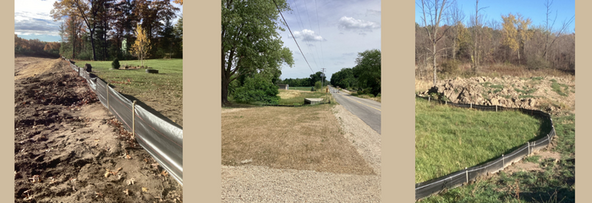
Soil erosion control measures in various settings.
|