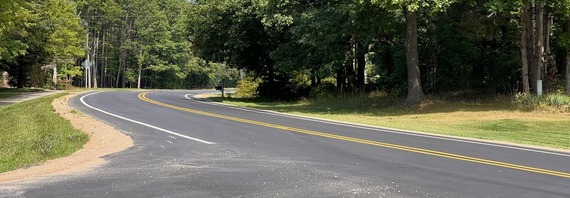
 The Ottawa County Road Commission has posted its draft 2026-2030 Strategic Improvement Plan (SIP) on its website for review.
The OCRC invites public and stakeholder input on the draft document from now until Sept. 11, 2025. Public review helps us capture insights on community experience with county roads.
Download Draft 2026-30 SIP Project Listings Document
This plan is updated annually and is based on a yearly review of county road assets in order to identify improvement needs, and determine economical methods to finance improvement and maintenance projects.
Included in the draft plan are proposed reconstruction and resurfacing work, preventative maintenance treatments, and drainage and bridge improvements.
Implementation of the projects listed in the draft SIP will be based on receipt of identified funding sources and are subject to change based on budgetary constraints or other factors.
It is important to the plan development process to gather input and comments about the proposed projects from the public and local governmental partners prior to the plan being finalized and approved by the Road Commission Board.
Comments can be submitted on our website, or sent to info@ottawacorc.com.
 What's the deal with road funding in Michigan? How are roads funded and where does the money come from?
Here's a little Q&A that answers some common questions and explains Michigan's transportation needs.
Q: Who is responsible for Michigan roads?
A: In Michigan, nearly all roads are under one of three jurisdictions:
1. State highways: Michigan Department of Transportation (MDOT) - 8% of all roads (+41% of bridges)
2. County roads: County road agencies - 75% of road miles (+52% of bridges)
3. City or village streets: Cities and villages - 17% (+7% of bridges)
Q: Why are so many Michigan roads in bad shape?
A: According to the County Road Association of Michigan, Michigan has ranked among the bottom nine states in per capita and local road spending (excluding sales tax). Freeze/thaw cycles damage road surfaces each year, and unlike most states, Michigan road agencies spend millions annually on snowplowing and salting.
Q: Where does the money come from to maintain Michigan's roads and bridges?
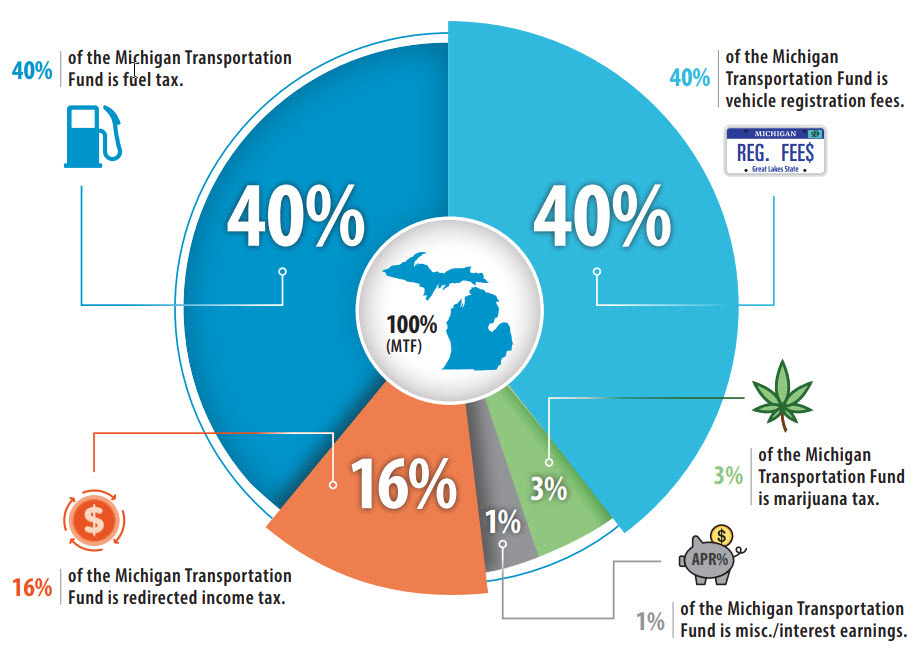
A: The largest source is state dollars through the Michigan Transportation Fund (MTF), followed by township and millage contributions, then federal funding. State funding comes mainly from the gas tax (40%) and license plate fees (40%), plus portions of income tax (16%) and marijuana tax (3%) and other miscellaneous revenues (1%).
Q: What about Michigan's sales tax on fuel?
A: Yes, it applies to gas and diesel sales - but none of that money goes to roads.
Q: How are state-collected road funds distributed?
A: Years ago, the State Legislature created the Michigan Transportation Fund (MTF). MTF has a formula – changed five times over the years: Michigan Department of Transportation (39%), county road agencies (39%), and cities/villages (22%). Funds for transit, airports and recreational vehicles are taken out before this road funding split.
Q: Does the 18.4¢ federal gas tax help?
A: Yes, but only for primary roads. Federal funds can only be spent on federal-aid eligible roads (a.k.a., primary roads), which make up about one-third of county roads. The 2021 federal transportation package (known as the Infrastructure Investment and Jobs Act or IIJA), brought only minimal increases for county road agencies.
Q: How much tax do we pay at the pump in Michigan?
A: Total fuel taxes are 70.4¢/gallon (based on $3.50 gas): Michigan gas tax - 31¢, Federal gas tax - 18.4¢, Michigan sales tax – 21¢. Only 43.4¢ per gallon goes directly to the MTF and roads.
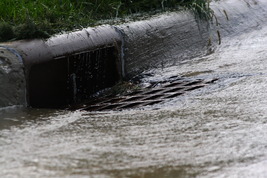
When water from rain, snow, or sleet flows over the ground, it’s called "stormwater.”
Stormwater can pick up debris, litter, fertilizer, and pesticides used for lawn care. And when that stormwater flows into street gutters, storm drains, and downstream, it can pollute rivers, lakes, and streams.
Follow these simple pollution solutions to help keep our waterways clean and healthy!
|
Don't Mow Too Low: Only remove 1/3 of the grass blade height and leave clippings on lawn to allow nutrients to return to the soil—they act as a natural fertilizer!
Careful With Chemicals: Read the label when applying pesticides and fertilizers, use them sparingly, and avoid applying them to pavement. When there is rain in the forecast, any chemicals you apply can wash downstream.
Only Rain in the Drain: Don’t rake, sweep, or hose debris down the storm drains. Leaves, yard clippings, and trash can clog storm pipes, causing floods and polluted waterways.
Curb Your Water Waste: Direct sprinklers toward the lawn and away from pavement to save water and keep chemicals and debris out of storm drains.
|