|
Summer is in full swing! Ottawa County's lakes, beaches, and pools are ready for you to enjoy and we've got lots of safety tips and information to keep you and your family safe and healthy in the water.
Never swim alone. Always swim with someone else. Watch children closely at all times.
Wear a life jacket (also called a Personal Flotation Device or PFD). This is especially important for children and people who are not strong swimmers. Learn more about Michigan life jacket rules here.
Drowning Prevention
Drowning can happen quickly and quietly. According to the CDC, drowning is the second leading cause of unintentional injury death for children ages 5-14.
- Learn to swim - take swimming lessons at any age.
- Supervise children constantly - designate a "water watcher" who isn't distracted by phones or conversations.
- Know the signs of drowning - it's often silent, not the splashing and yelling you see in movies.
- If someone is struggling in water, call 911 immediately.
Learn more about drowning here.
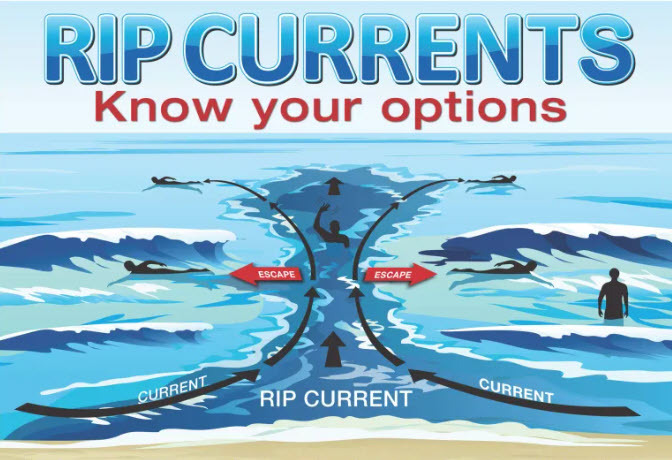
What To Do If You Get Caught in a Rip Current at the Beach
Remember: Flip, Float, Follow
-
Flip onto your back if you get caught in a current.
-
Float with the current - don't try to fight it.
-
Follow the current, then swim sideways to get out of it.
 |
How to Help Someone in Trouble in the Water
Remember: Throw, Row, or Go
-
Throw them something that floats, like a life ring or rope (this is the safest way to help).
-
Row out in a boat if you have one (second best option).
-
Go into the water yourself only if nothing else works - and bring a life jacket.
Learn more about safe swimming here.
Lake Michigan and other local lakes are not treated like a swimming pool and can have germs that can make you sick. These germs can cause:
- Skin rashes
- Infections
- Stomach problems
What Ottawa County Department of Public Health is doing:
- Testing beach water every week from June through September.
- Monitoring bacteria levels and other contaminants.
- Posting water quality results online.
- Issuing health advisories when water quality is poor.
What you can do:
- Don't drink or swallow lake or river water.
- Don't swim in murky or cloudy water.
- Don't swim right after it rains heavily.
- Take a shower after swimming.
- Take kids to the bathroom often.
- Stay home if you feel sick.
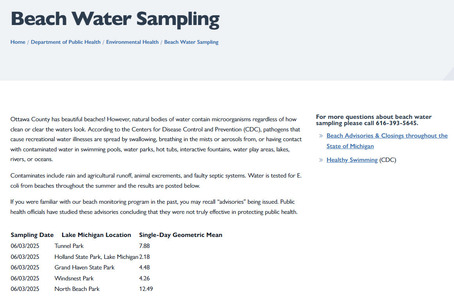
Water Testing: We test beach water every week from June through September. Check our Beach Water Testing page to see if it's safe to swim.
Find beach conditions throughout Michigan using the Department of Environment, Great Lakes, and Energy (EGLE) Beachwatch page.
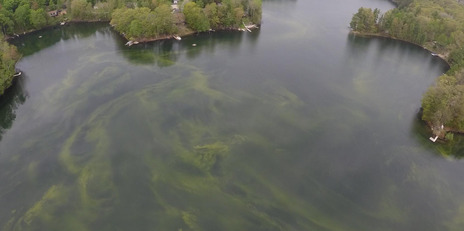
Harmful algal blooms (HABs) are caused by blue-green algae that can make people and pets very sick. Summer is peak season for these blooms in Michigan lakes and rivers. You cannot tell if an algal bloom is harmful just by looking at it, so it is best to avoid contact with any body of water that is covered with algal mats or significant rafts of algae on the surface.
What Ottawa County Department of Public Health is doing:
- Working with Michigan Department of Environment, Great Lakes, and Energy (EGLE) to monitor harmful algal blooms.
- Coordinating with state health officials when blooms are detected.
- Providing public health advisories when necessary.
- Reporting suspected blooms to state agencies.
What you can do: HABs can be many colors such as green, blue-green, blue, brown, white, purple, or red. HABs can look like scum in the water and you may see flecks, foams, globs, or mats floating in it. They may also smell earthy, pungent, or musty.
- Don't swim in water with visible algae mats, scums, or discolored areas.
- Don't let children or pets play in or drink the water.
- Unless the bloom covers a large part of the lake, you can limit your risk by using an unaffected part of the lake.
- Rinse off with clean water after any lake contact - this also includes pets.
Health effects: Skin contact may cause rashes, hives, or skin irritation. Swallowing contaminated water may cause stomach pain, vomiting, diarrhea, or weakness.
Pet safety: Dogs are at high risk because they may drink scummy water and swallow more toxins for their size. Signs of illness in pets include vomiting, diarrhea, staggered walking, and convulsions. Contact a veterinarian immediately if your pet becomes ill after contact with water.
Learn more and find an interactive Michigan map of current HABS.
Report suspicious algae to EGLE by calling 1-800-662-9278 or emailing AlgaeBloom@Michigan.gov
The Army Corps of Engineers will be dredging the Grand Haven channel this summer. You may see a large barge working in the water on calm days. We will closely watch the water quality at Grand Haven beach during this time.
What Ottawa County Department of Public Health is doing:
- Coordinating with the Army Corps of Engineers on dredging activities.
- Closely monitoring Grand Haven beach water quality throughout the summer.
- Providing updates on water quality conditions during dredging operations.
- Posting health advisories if water quality is affected.
What you can do:
- Check current water quality conditions before swimming at Grand Haven beach.
- Follow any posted health advisories.
- Report any unusual water conditions to our department.
Please follow these rules at Ottawa County beaches:
- No alcohol
- No smoking
- No glass bottles
- No littering
- No fires (unless permitted)
Swimming pools provide a refreshing escape during hot summer days, but they require proper maintenance and safety practices to protect public health. Ottawa County oversees numerous public pools throughout the county, from campgrounds to hotels. While pools are treated with chemicals to kill germs, contamination can still occur when proper protocols aren't followed. Here's what we're doing to keep public pools safe and what you can do to protect yourself and your family.
What Ottawa County Department of Public Health is doing:
- Inspecting all public pools annually to ensure safety standards.
- Reviewing monthly water quality reports from pool operators.
- Investigating complaints about pool conditions.
- Providing guidance to pool operators on best practices.
What you can do:
- Don't drink or swallow pool water.
- Shower before and after swimming.
- Make sure children use the bathroom regularly.
- Stay home when you're sick.
- Report pool safety concerns to our department.
Sunburns increase your risk of skin cancer. You can get sunburned even on cloudy or cool days. The sun's rays are strongest between 10 AM and 4 PM.
How to protect yourself:
- Put on sunscreen (SPF 30 or higher) 15 minutes before going outside.
- Cover your ears, neck, feet, and shoulders.
- Put on more sunscreen every 2 hours (more often if you're swimming).
- Find shade often.
- Consider wearing light long sleeves.
Questions? Visit us at miottawa.org/mihealth.
Have a safe and fun summer!
|