2025 Budget Details
This year's $68.1 million budget -- available to view online at ottawacorc.com -- was developed with anticipated Michigan Transportation Fund (MTF) revenues of nearly $38.8 million.
The MTF is the Road Commission's principal source of funding. It is supported by vehicle registration fees and the Michigan state gas tax. The Road Commission's MTF allocation is based on a formula which includes county population, road miles and types of certified roads, and vehicle registrations.
Other revenues projected for the FY2025 budget include the countywide road millage, federal and state funding programs, contributions from townships to local road improvement projects, permit fees, and sales of salvage equipment, materials, and other surplus assets.
These various funding sources allow the OCRC to perform myriad public infrastructure services, including summer and winter road maintenance, drainage maintenance and improvements, and other road improvement projects and maintenance.
Budgeting by the Numbers
Our major projected revenue categories for the FY2025 budget are as follows:
• MTF: $38.8 million
• Federal and State Grants: $11.3 million
• Countywide Road Millage: $7.2 million
• Township Contributions: $6 million
While the MTF is broken down into various components of our operating budget, other revenue sources go straight into road projects. These projects include preventative maintenance or road improvements.
The Board also approved the 2025-29 Strategic Improvement Plan (SIP) at its Sept. 19 meeting. Updated annually, this plan uses anticipated revenues and road condition ratings to create a roadmap for both the annual and long-term maintenance and improvement of the county road system.
The Road Commission relies on input and comments from local governments and officials, as well as the general public, to help develop this plan each year.
The final 2025-29 SIP document is currently being finalized and will be available at the "Planning & Reports" section of the Road Commission website upon its completion.
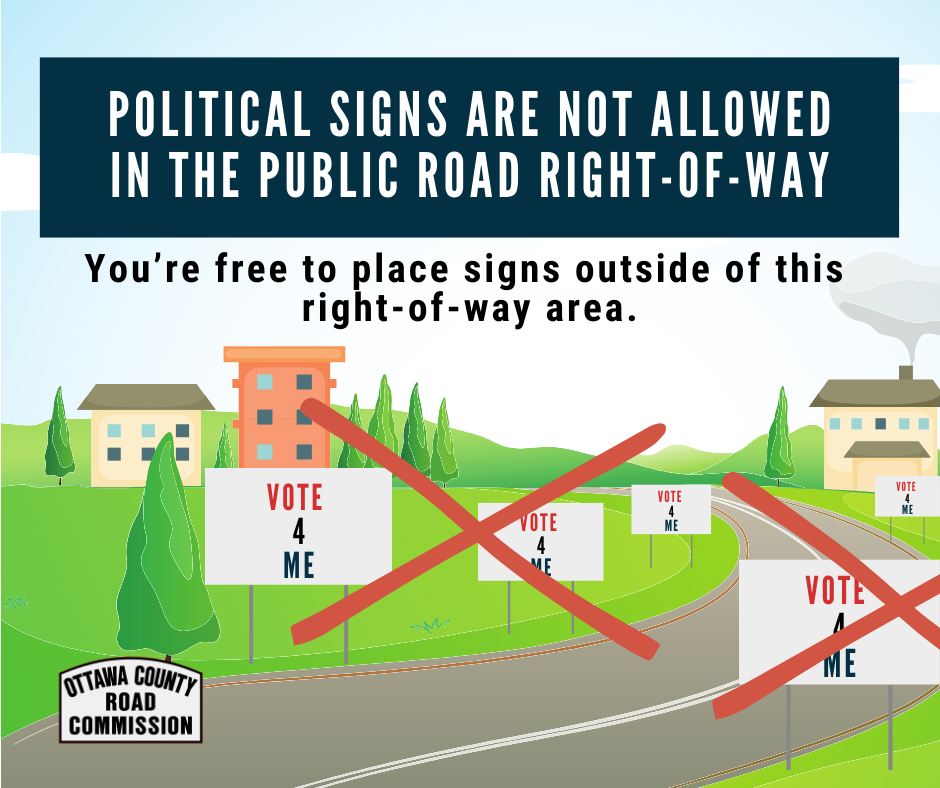 Election season means the arrival of political signs dotting the landscape across Ottawa County.
Signs of any kind should not be placed within the road right-of-way. Unauthorized signs in the road right-of-way can become safety hazards by:
- Blocking sight distance at public road intersections
- Distracting drivers from seeing important safety signs like a stop sign
- Becoming projectiles if accidentally run over by a mower or other roadside maintenance equipment
The road right-of-way width varies by road. On most two-lane county roads, the road right-of-way is approximately 66 feet wide, but the width can vary by location. When in doubt, it is a safe assumption that the road right-of-way extends at least to the far side of sidewalks, ditches or utility poles (if present).
You’re free to place signs outside of this right-of-way area, however townships and cities within Ottawa County may have more restrictive signage policies. Be sure you follow your municipality’s regulations when placing any signage.
While we do not actively go around removing signs within the road right-of-way, we will take action if there are safety concerns, such as issues related to sight distance or general distraction of many signs in one location.
The Michigan Department of Transportation (MDOT) has a separate policy governing the placement of signs on state highways (i.e. US-, I-, M-routes).
For information pertaining to MDOT’s policy, please contact MDOT’s Grand Region office at (616) 451-3091 or visit http://www.michigan.gov/mdot.
For more info about safely placing political signs, watch this video from the County Road Association of Michigan.
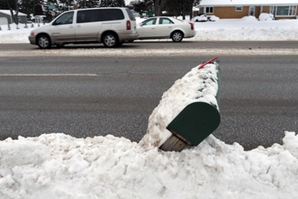
Every year in October, the Ottawa County Road Commission joins road agencies across the state in reminding residents to prepare for winter snow removal by shaking their mailboxes.
VIDEO: Make sure to shake your mailbox
The purpose of shaking your mailbox: to make sure that your mailbox is sturdy enough to handle any snow that might hit the mailbox as a result of winter snow removal operations.
Over time, mailbox posts can deteriorate or rot and become wobbly. By shaking a mailbox, residents will know if the box and post are secure or if they need to be tightened up.
Snow that comes off of the blade of a snowplow has a surprising force that can topple an unstable mailbox.
With this in mind, homeowners should prepare mailboxes for winter by tightening screws and ensuring the post and box are secure enough to endure large amounts of snow that is thrown. If the mailbox moves when shaken, or the post does not seem secure in the ground, the box and/or post may need to be repaired or replaced before winter.
More information about mailbox placement, instructions on building a temporary snow deflector and other helpful tips can be found on the "Resident Information" section of our website.
|
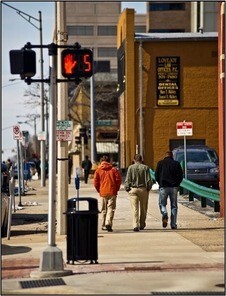
At some point in the day, everyone is a pedestrian. October is Pedestrian Safety Month — a great opportunity to include and increase pedestrian safety messaging across all platforms.
The Michigan Department of Transportation (MDOT) is reminding everyone of the critical importance of pedestrian safety.
According to recent statistics, about three out of four pedestrian fatalities occur in dark conditions and at locations other than an intersection.
People who drive should look for pedestrians crossing the road. Drivers must yield when turning at a signal.
Pedestrians are more visible to stopped vehicles when in crosswalks, but communication between pedestrians and motorists (something as simple as making eye contact) can help increase awareness.
Whether you're crossing the road on your walk to work, running an errand to the grocery store or just out for a stroll, follow these crosswalk guidelines:
- If you're at a crosswalk equipped with a pushbutton, use it. It's there to allow extra time for pedestrians to cross the roadway. Push the button to let the traffic signal know you are waiting to cross.
- Wait for your turn to cross. Waiting your turn keeps everyone safe, including you. Both vehicles and pedestrians must wait their turn to proceed.
- Once the crosswalk signal indicates that it's your turn to cross, check to make sure vehicles are stopped, make eye contact and proceed to cross the road. Watch for turning vehicles.
- Pedestrians are notified to cross by a WALK indication. A common timing provides at least seven seconds of WALK, followed by a flashing DON’T WALK message.
- Pedestrians should not attempt to cross if a flashing DON’T WALK signal has already started. The duration of that flashing message allows enough time for people already in the crosswalk to complete their crossing.
- Many intersections provide a countdown indicating how much time is left to safely cross.
Road safety is a shared responsibility. Motorized and nonmotorized users alike can find tips to make travel safer for everyone on MDOT's website.
|
|