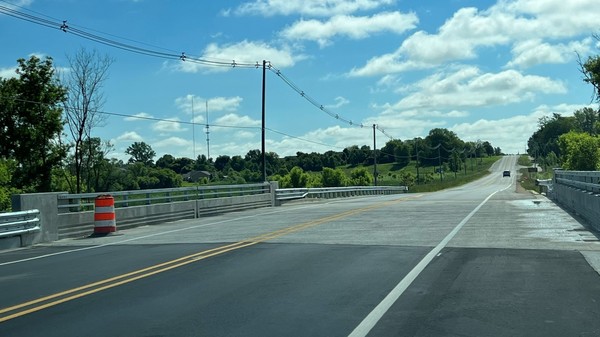
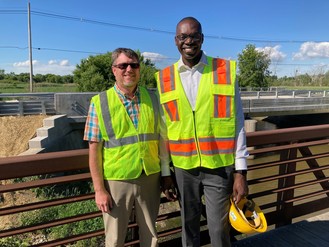
 ABOVE: Byron Rd. bridge open to traffic. BELOW: Managing Director Brett Laughlin and Michigan Lt. Gov. Garlin Gilchrist pose in front of the recently completed bridge.
The Ottawa County Road Commission is happy to announce the Byron Rd. bridge in Zeeland Township has been reopened.
The 3-month project involved replacement of the superstructure, which included full removal and replacement of the bridge deck and supporting beams, as well as bridge approach work.
The project allows legal vehicle loads to once again traverse over the structure. Prior to the improvements, the bridge had been load limited which restricted the type of traffic that could go over this critical piece of infrastructure in Ottawa County.
The Byron Rd. bridge project was made possible by the state's bridge bundling pilot project.
The pilot project is funded by Federal Highway Improvement Program (HIP) dollars. MDOT bridge staff and consultants do the preliminary design and construction administration work for the bridge bundling program.
The pilot program is only the first phase of the initiative. Roughly $196 million in federal COVID relief funds will allow the state to execute Phase II of the program beginning later this year to address 59 more bridges.
Phase II focuses on closed and load-posted bridges. Some will be permanently removed while others will be fully replaced.
The Ottawa County Road Commission will be a participant in the next round of this program.
The County Road Commission had the 32nd Avenue bridge over the North Branch of Crockery Creek in Chester Township selected for the next round of bridge bundling. The bridge is currently load restricted, and the bridge replacement project is estimated to cost $3.57 million.
The replacement project is tentatively scheduled to take place in 2023.
|
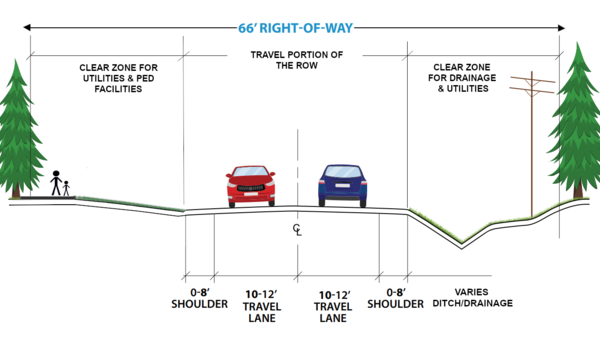 If you live on a public road, your property borders the road right-of-way, which is intended for all county road, pedestrian facility and public utility purposes.
The Ottawa County Road Commission has the responsibility and authority to regulate all activities and work in the road right-of-way to assure safe and efficient use and operation of the road system.
What are the road right-of-way limits?
Standard road right-of-way is 66 feet wide on most county roads. There are some exceptions where the right-of-way is narrower or wider, or an additional easement was granted to the Road Commission.
Avoiding right-of-way hazards
The Road Commission appreciates the public’s cooperation in keeping the road right-of-way free of all potential hazards and clear for all county road, pedestrian facility, and utility construction and maintenance.
PA 368 of 1925 prohibits the placement of any object, except authorized mailboxes, within the county road right-of-way unless permitted by the Road Commission. If someone gets injured by an unauthorized object in the right-of-way, the property owner is liable.
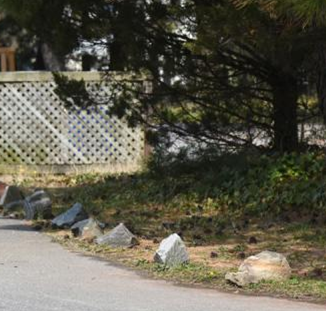
The Right-of-Way and Safety
In many instances, property owners or contractors place fences, rocks, trees/shrubs, headwalls, retaining walls or other objects within the road right-of-way as a measure for improving the landscape.
These fixed objects can become safety hazards to motorists who leave the roadway, and can also be visual obstructions for motorists at intersections and driveways.
|
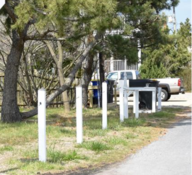
Clear & Efficient Right-of-Way Space
Items within the road right-of-way can be hindrances to road, pedestrian facility and public utility improvements.
Unapproved objects within the road right-of-way make it challenging for work crews to perform roadside maintenance, and also for utility companies to install, maintain, and replace their facilities located in the right-of-way.
|
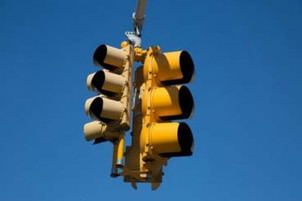
Summertime weather means there is an increased risk of thunderstorms and more chances for power outages which can cause traffic signal failures.
Michigan law requires drivers who are approaching an intersection with a traffic signal that does not clearly indicate the right of way, or is malfunctioning, to treat the intersection as a four-way stop by doing the following:
- Stop at a clearly marked stop line. If there is no clearly marked stop line, stop before entering the crosswalk on your nearest side of the intersection. If there isn't a crosswalk, safely stop before you enter the intersection.
- Yield the right of way to all vehicles in the intersection or approaching on an intersecting road, if those vehicles create an immediate hazard to you when the driver is moving across or within the intersection.
- Exercise ordinary care while proceeding through the intersection.
The “four-way stop” rules do not apply to the following scenarios:
- An intersection that is controlled by a traffic control signal that is flashing yellow unless certain events occur, including, but not limited to, activation by an emergency vehicle.
- A traffic control signal that is in a school zone and is flashing yellow only during prescribed periods of time.
|

|