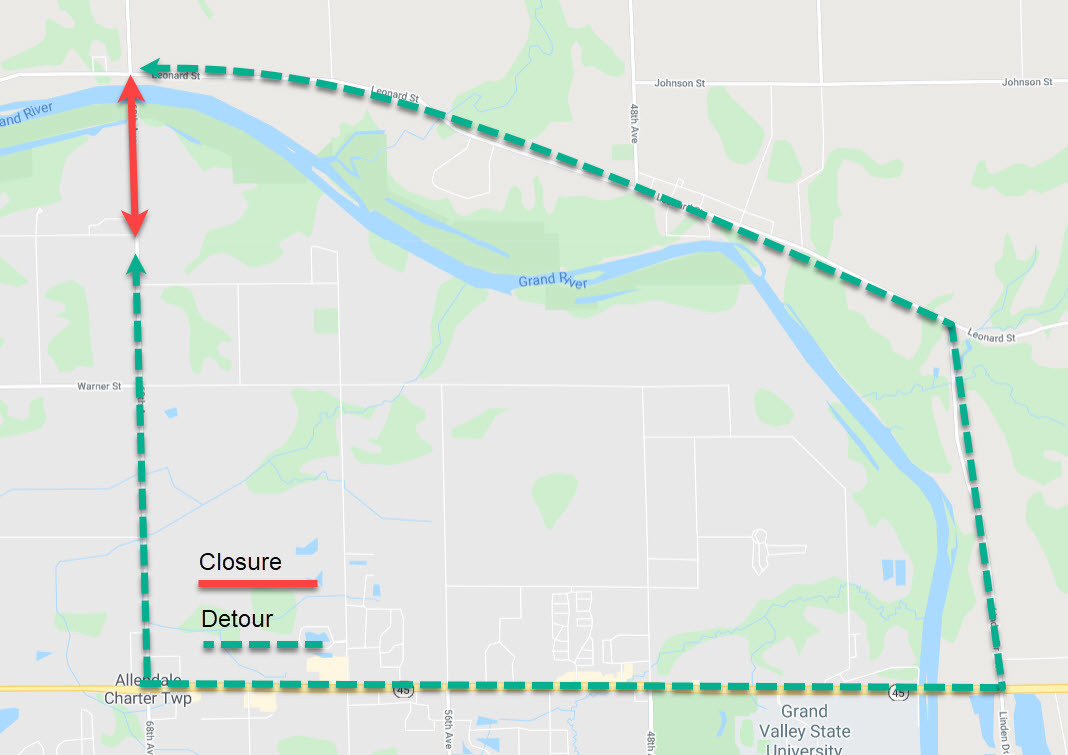
 The Ottawa County Road Commission will rehab the 68th Avenue bridge over the Grand River in Allendale/Polkton townships beginning June 8.
As part of the project, the existing bridge deck over the river will be resurfaced. There will also be approach work done as part of the project.
Both the north and southbound lanes of 68th Avenue will be closed from Osborn Street to Leonard Street during this project. The traffic detour route will consist of Leonard Street/Linden Drive/M-45/68th Avenue (see map above).
It's anticipated that this project will last 8 weeks, and the tentative completion date is July 31.
For the latest information about this project, be sure to visit our website and Facebook page, and subscribe to construction update emails.
The Ottawa County Road Commission is dedicated to providing roads and bridges that are constructed and maintained in a reasonably safe condition for public travel.
This is reflected in our policies regarding work in the road right-of-way.
The driveway surface policy for the installation of all new driveways or any work on existing driveways within the road right-of-way was developed to provide the most efficient and cost-effective process for road improvement projects.
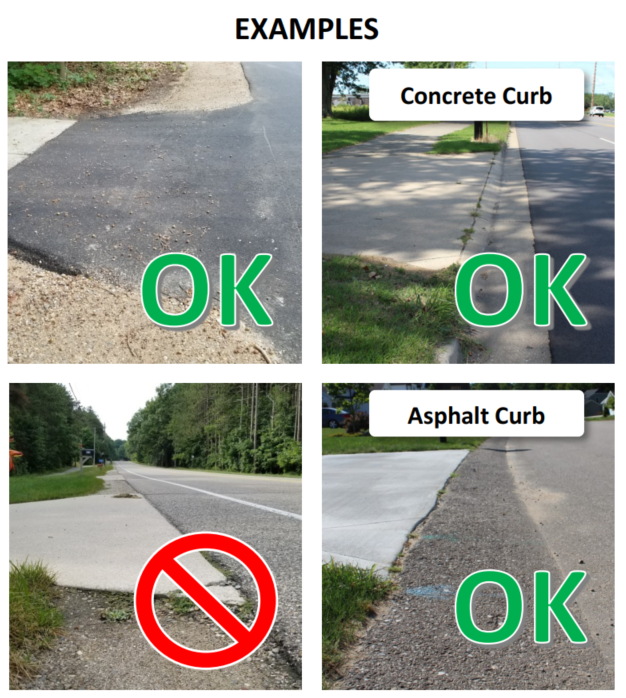
Road improvement projects that occur on roads without an asphalt or concrete curb result in the restoration of the adjacent driveways in order to match the new road elevation. Therefore, the policy does not permit the placement of a concrete driveway approach for any new or existing driveways being replaced or restored.
Roads that have an asphalt or concrete curb typically do not involve any change in elevation during road improvement projects. As a result, concrete driveways are permitted on curbed roads because restoration on adjacent driveways is not necessary.
The driveway surface policy was developed based on the following:
- The restoration of concrete driveways with concrete is not very efficient or cost-effective for the Road Commission as compared to asphalt for the following reasons:
- It takes much longer to saw cut, excavate, and remove concrete driveways that need adjusting versus the time it takes to mill an asphalt driveway.
- In order to maintain access for the property owner, concrete driveways are often required to be poured half width at a time, where asphalt can be placed the full driveway width.
- Concrete can take up to 28 days to fully cure resulting in project delays, where asphalt can be driven on the same day.
- In some cases, asphalt driveways can be placed at the same time the contractor is paving the lane of the road.
- Having rigid concrete driveways located in the shoulder of the road can pose safety risks to our maintenance staff and cause equipment damage. Our operators need to grade shoulders in the summer and plow in the winter. Flexible asphalt driveways minimize impacts to both our drivers and equipment.
A Reminder About Driveway Permits
A permit MUST be obtained from the Ottawa County Road Commission in order to construct, reconstruct, relocate, surface, or resurface a driveway or private road approach adjoining a road under the Road Commission’s jurisdiction.
Please visit the residential driveway section of our website, or contact our office at 616-842-5400 and ask to speak to the Special Services Department regarding obtaining a driveway permit. Our team will be happy to assist you in completing this task.
|
The Ottawa County Road Commission (OCRC) won the Michigan Local Technical Assistance Program (LTAP) 2019 Great Ideas Challenge, which seeks to promote and celebrate innovation in the state of Michigan by asking transportation agencies to submit unique innovations used by their agencies.
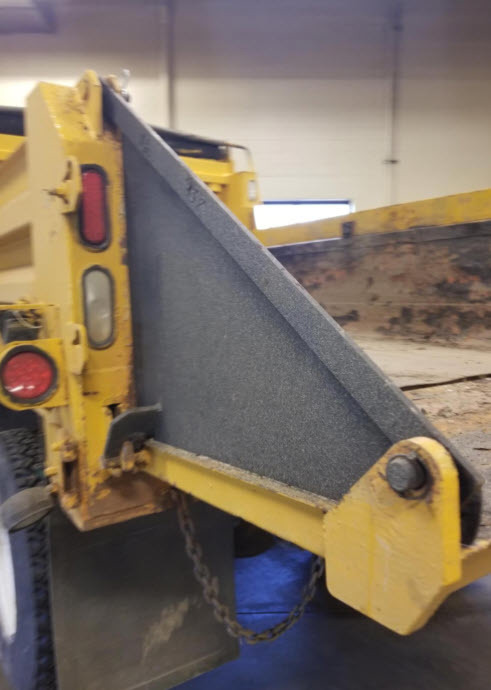
The mechanics at the OCRC designed a box tailgate extension to solve a problem frequently faced by local road agencies when using dump trucks to transport materials.
Material can often get caught in the chains of the tailgate, making unloading difficult or even causing the tailgate to fall off. The OCRC mechanics had the idea to attach a solid side plate to the tailgate pins to extend the wall of the tailgate. Therefore, the box tailgate extension has a wall that prevents material from being caught in the chains and allows the material to slide out of the truck bed smoothly. The innovation also includes a tailgate lock that keeps everything rigidly in place.
|
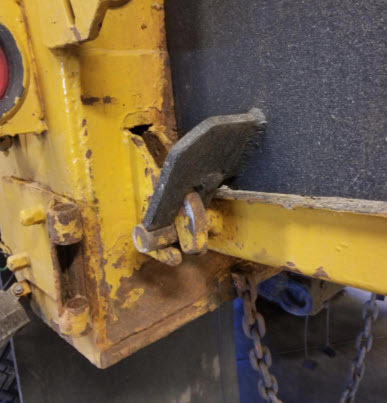
According to recently-retired Equipment Supervisor Randy Nagelkirk, a mechanic can make the box in three to four hours.
"The task involves welding, drilling holes for the tailgate pin, and cutting off bolts," he said.
The expected cost is $400.
Nagelkirk said he encourages innovations such as this one at the Road Commission because they “save time, save money for the road commission, and make life easier for the people doing the work.”
For winning the state-level Great Ideas Challenge, Nagelkirk received a monetary award for the OCRC to put toward attending employee training conferences and events. Additionally, the design was automatically submitted to the Federal Highway Administration’s LTAP Build a Better Mousetrap national competition. There, the OCRC will compete with transportation agencies from across the nation.
|
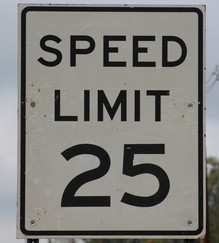
Have you ever wondered what goes into determining what speed limit should be established?
Currently, regulatory speed limits are set by state statue at a maximum 55 mph on county roads or 25 mph for business and residential districts. These speed limits are generally not posted on county roads.
The primary basis for establishing a proper, realistic speed limit is the nationally recognized method of using the 85th percentile speed. This is the speed at or below which 85% of the traffic moves. Posting unrealistically low speed limits may create a false sense of security. Studies have shown that the driver's perception of the driving environment, not the posted speed limit, is the main influence on motorists’ speeds.
Regulatory speed limits can be modified based on a unanimous recommendation from a traffic survey team consisting of representatives from the Michigan State Police, Road Commission, and local township.
The recommendation is based primarily on results of a traffic engineering study that includes the collection of speed data, review of the crash history, and roadway characteristics.
The State Police has to accept the recommendation of the survey team in order to establish a modified speed limit.
Want to learn more about traffic and safety? Be sure to download our "Understanding Road Traffic & Safety" handout to learn more.
|
|