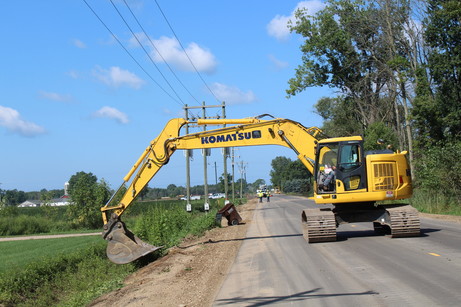
Do you know the purpose of a roadside ditch?
While some might think it’s to help property drain, roadside ditches, swales, storm sewer, culverts, or other similar drainage features are installed to convey storm water from the road surface and roadbed to an outlet such as a pond, county drain, creek, infiltration area, or other waterway.
These roadside drainage systems are typically located in the county road right-of-way and maintained by the Road Commission. In some instances, they’re maintained by the Ottawa County Water Resources Commissioner.
To reiterate, the primary role of roadside drainage is to drain the road and not adjacent private property, unless the roadside drainage system has been established as a county drain.
A proper roadside drainage system helps reduce damage to both the road surface and the underlying layers of the roadbed from water.
Flooding, washouts, and potholes coincide with poor drainage, which typically results in costly repairs.
Throughout the year, the Road Commission and Ottawa County Water Resources Commissioner are committed to maintaining their respective roadside drainage systems to improve poor drainage within and alongside roadways.
|
Typical Responsibility of Drainage Systems
Road Commission = Roadside Drainage
Drain Commissioner = Established County Drains
Property Owner = Private Property and Driveway Culverts
|
Help Maintain Roadside Drainage
Property owners need to recognize the purpose of the roadside drainage system, and the qualities of effective, environmentally friendly drainage as the first step.
Property owners adjacent to roadside drainage facilities should not do the following activities:
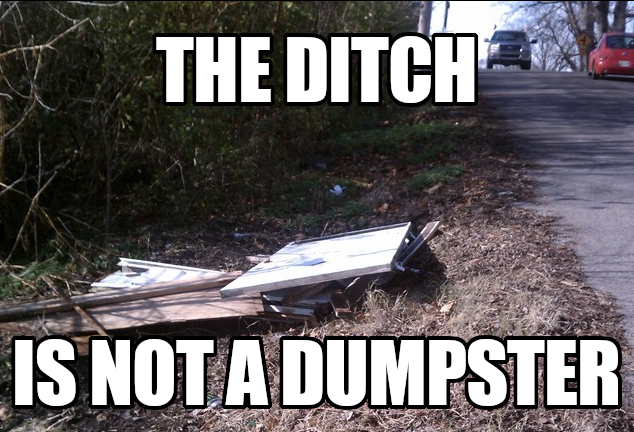
- Place any materials in or alongside the roadside ditches including: yard debris such as grass clippings or leaves (burning still contributes to the problem), landscaping such as trees or shrubs, or any other items that may impede drainage.
- Scrape, excessively mow, or expose bare soil near or within a roadside drainage system, as this can contribute to erosion and sediment pollution.
- Fertilize or apply herbicides near a roadside drainage system, as this may pollute the water.
Property owners adjacent to public roads are encouraged to proactively maintain their driveway culverts or other private drainage system to be clear of debris and obstructions. Such debris can obstruct drainage flow and contribute to flooding.
 |
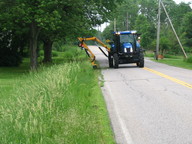
Road Commission personnel mow roadsides in order to provide clear vision at intersections and along roadways, as well as to keep vegetation from encroaching on the roadway.
The Road Commission mows all State highways, primary, secondary, and unpaved roads.
Roadside mowing is typically performed beginning in late April and ending in late October unless safety issues require more frequent attention at intersecting streets.
Individual property owners can mow their roadsides and/or drainage ditches at any time when vegetation makes sight vision difficult while exiting their driveways.
Road Commission roadside mowing priorities are as follows:
- Primary roads — Twice per year
- Local paved roads — Twice per year
- Local gravel roads — Once per year
- Clear vision areas at intersections — As needed
- State Highways — As determined by MDOT
- Subdivision Streets — NOT mowed
Crews will address areas along all roads as scheduling permits where vegetation may limit the sight distance of drivers at intersections.
Motorists are encouraged to report any roadside vegetation causing sight distance issues at intersecting streets by calling 616-842-5400.
|
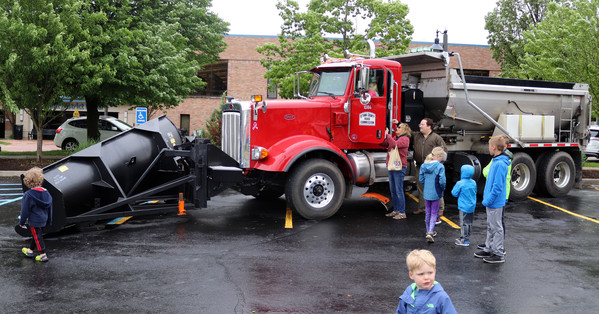 (Above photo courtesy of Krystle Wagner/Grand Haven Tribune)
The Ottawa County Road Commission was thrilled to take part in Loutit District Library's annual touch-a-truck event in Grand Haven on Monday, June 10.
The OCRC brought one of its new Peterbilt tandem-axle plow trucks to display at the event, located at the parking lot of the library. Mounted on front of the truck was the painted plow that Alward Elementary School students recently designed and painted (see photo below).
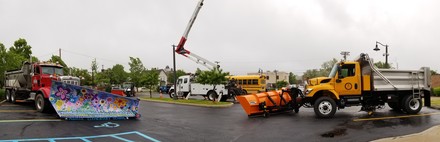
Families were able to admire the size of the plow truck, peek inside the truck's cab, and pose for photos in front of the painted plow blade.
Additionally, Communications Administrator Alex Doty was on hand to answer kids' and parents’ questions about the truck, and hand out informational pages and coloring sheets to youngsters.
The Road Commission was joined by other impressive vehicle displays from other agencies around the Grand Haven community, including the Grand Haven and Ferrysburg public works departments, the Grand Haven Board of Light & Power, the Ottawa County Sheriff's Office Marine Patrol, the Michigan Department of Natural Resources and Grand Haven State Park, Grand Haven Area Public Schools and the Grand Haven Department of Public Safety.
|
|