|
Spring is nearly here, and the arrival of a new season means the 2019 construction season isn't far behind.
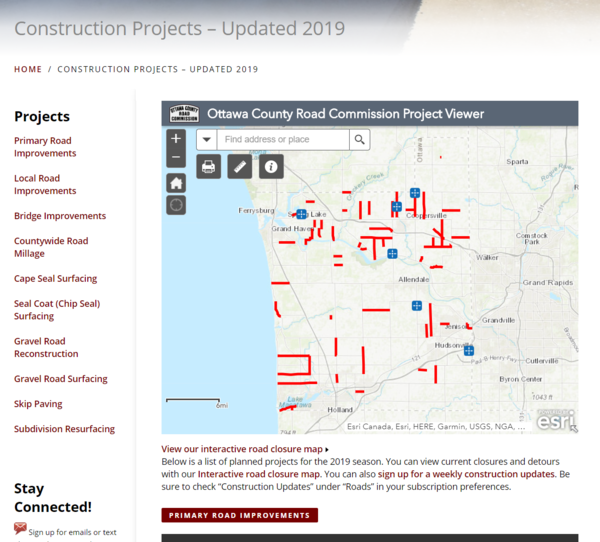
The Ottawa County Road Commission has more than 22 miles of primary road improvements planned this summer, consisting of both reconstruction (1.4 miles) and resurfacing (21.4 miles).
View an interactive map and a list of 2019 OCRC construction projects by visiting the following URL: http://www.ottawacorc.com/construction-projects/.
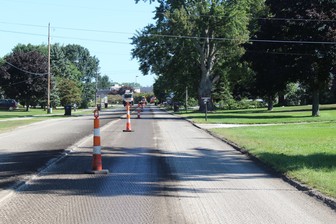
Along with resurfacing work on 12 roads across Ottawa County, work on primary roads includes the completion of the Cottonwood Drive reconstruction project in Georgetown Township, and the resurfacing of James Street from U.S. 31 to Chicago Drive in Holland Township. Both projects were 2018 jobs that were affected by the labor stoppage in the fall.
Funding for the primary road improvements comes from the Michigan Transportation Fund, federal and state grants, and the Ottawa County Road Millage.
The OCRC also has 27.6 miles of local road improvements planned, consisting of improvements such as reconstruction, resurfacing and re-graveling.
Funding for local road improvements comes from township funds (5o percent match for re-graveling, 100 percent for subdivision resurfacing and gravel reconstruction), as well as MTF and some road millage funding.
The Road Commission also intends to do more than 106 miles of preventative maintenance work. This includes 48.8 miles of seal coat “chip seal” surfacing, 17.4 miles of cape seal surfacing and an estimated 40 miles of crack seal treatment.
These preventative maintenance projects are cost-effective ways to extend the life of roads before more significant investment is needed.
Drainage improvements
The OCRC has two bridge projects on deck for 2019: Barry Street over the East Branch of Rush Creek in Georgetown Township, and 68th Avenue over the Grand River in Allendale/Polkton townships. Also planned are several large culvert replacement projects.
The OCRC maintains 1,697 miles of public roads throughout 17 townships. This diverse network includes both 427 miles of high-volume primary roads, 1,270 miles of lower-volume local roads.
Given the resources to properly maintain, the useful life of a road can last several decades.
Stay current on the upcoming construction season
View the complete list of 2019 construction projects on our website.
You can view current closures and detours with our interactive road closure map. You can also sign up for weekly construction update emails. Be sure to check “Construction Updates” under “Roads” in your subscription preferences.
|
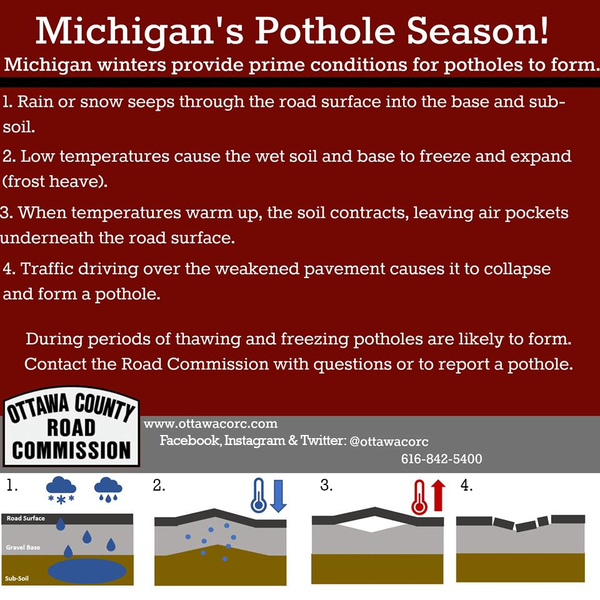 The spring thaw means the arrival of pothole season.
These pesky obstacles occur when snow and ice melt as part of Michigan's seasonal freeze-thaw cycles.
During the winter months, cold patch, also known as cold asphalt, is the most common method used to fill potholes because it can be applied right from the truck without heating.
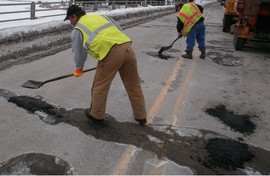
Cold patch is not dependent upon warm weather. Road crews like cold patch because it retains its pliable properties when the temperature drops, so it can be used year round.
Permanent repairs are typically made during the summer maintenance season using hot mix asphalt, once these materials are more readily available.
If you notice a pothole, please contact our office at 616-842-5400 to report the pothole location or utilize our online service request form.
|

With spring just around the corner, the increased risk of thunderstorms means there are more chances for power outages and "dark" traffic signals.
If you approach a "dark" signal intersection, do you know how to react?
As you approach a signal at an intersection that's lost power, and there are no other traffic control devices (e.g., stop sign, yield sign, temporary signal, temporary sign) or police officers present at that intersection to provide direction, the intersection should be treated as a four-way stop.
A new Michigan law requires drivers who are approaching an intersection with a traffic signal that does not clearly indicate the right of way, or is malfunctioning, to treat the intersection as a four-way stop by doing the following:
- Stop at a clearly marked stop line. If there is no clearly marked stop line, stop before entering the crosswalk on your nearest side of the intersection. If there isn't a crosswalk, safely stop before you enter the intersection.
- Yield the right of way to all vehicles in the intersection or approaching on an intersecting road, if those vehicles create an immediate hazard to you when the driver is moving across or within the intersection.
- Exercise ordinary care while proceeding through the intersection.
The “four-way stop” rules do not apply to the following scenarios:
- An intersection that is controlled by a traffic control signal that is flashing yellow unless certain events occur, including, but not limited to, activation by an emergency vehicle.
- A traffic control signal that is located in a school zone and is flashing yellow only during prescribed periods of time.
|

Michigan’s Emergency Vehicle Caution Law, known as the Move Over Law, requires drivers to slow down and move over for stationary emergency vehicles with their lights activated.
In February, the law was amended to require that when approaching a stationary emergency vehicle with its emergency lights activated, motorists must carefully slow down to at least 10 mph below the posted speed limit, and move over into an open lane, if possible.
Per the new revisions, emergency vehicles now also include road maintenance vehicles, utility service vehicles and solid waste haulers.
Penalties for violating this law
If you're caught violating the Move Over Law, you could face a civil infraction and be subject to two points on your driver’s license, along with a fine of $400.
You could face felony charges and enhanced penalties of up to 15 years in prison and/or a $7,500 fine if the violation causes death to a police officer, firefighter, or other emergency response personnel.
For injury to a police officer, firefighter or other emergency response personnel the motorist is guilty of a felony and the penalty is up to 2 years in prison and/or a $1,000 fine.
|
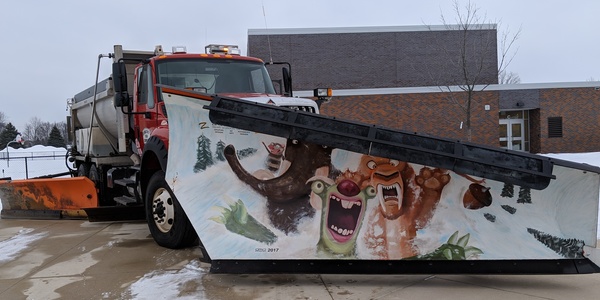 The Ottawa County Road Commission had the prvilage of participating in Hudsonville’s Alward Elementary School 2nd annual Family Genius Night.
Alex Doty and Randy Nagelkirk attended the event, which gave elementary students a sneak peak into the various careers associated with S.T.E.A.M. (Science, Technology, Engineering, Art and Math).
As part of our display we had a OCRC plow truck on display, and handed out information about plow safety and the various plow parts, as well as a plow coloring page.
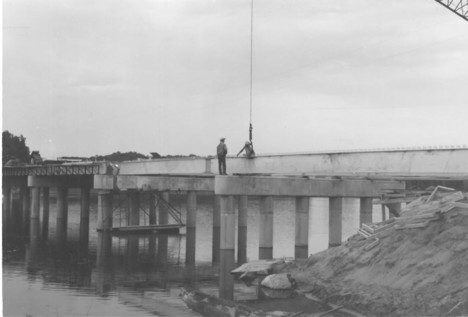
Last month, we took our social media fans on a trip down memory lane with a photo of the Stearns Bayou bridge in 1966. Don't miss our weekly "Throwback Thursday" posts on social media, which feature historic photos from the OCRC archives.
|