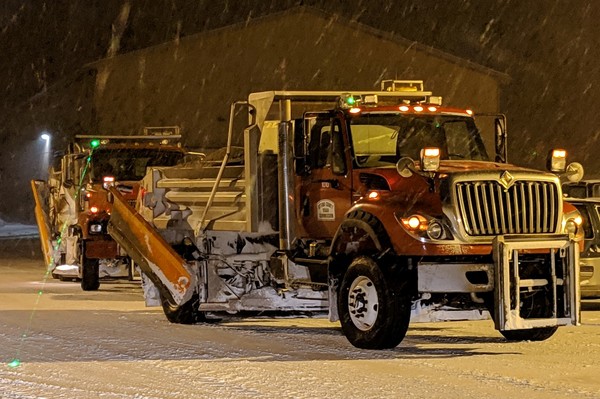
 Have you ever driven in front of an Ottawa County Road Commission plow truck and thought you have seen a green laser shining off the top of the truck?
No, you aren't seeing things. The Ottawa County Road Commission indeed utilizes lasers to help its plow operations on Ottawa County roads.
Just one piece of the Road Commission's winter fighting arsenal, the lasers use an ultra-bright green laser spot to establish an edge for the truck's wing plow blade. This allows drivers to see where the blade will align with the curb before they get there.
By seeing in advance where the blade will strike, drivers can avoid coming into contact with curbs and other objects in the road right-of-way.
The laser reference spot is on the road and in the driver’s normal field of view facilitating safer and more efficient winter control operations.
We get a lot of questions here at the Ottawa County Road Commission regarding traffic and safety on area roads.
Here are some of the more frequently asked questions that we often answer, along with an explanation from our traffic department.
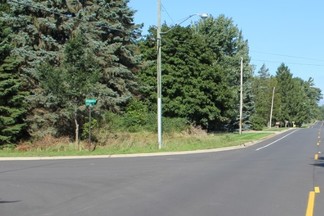
How are clear vision areas determined at an intersection?
The Road Commission attempts to keep areas near intersections clear of obstructions to provide minimum sight distance along the main street for motorists at the normal stopping point on the side street. This normal stopping position is at a point where a driver typically pulls up to view cross street traffic and is measured at 18 feet (position of driver’s eye) off the white edge line of the cross street (or the edge pavement if there is no edge line).
Please note the clear areas are provided for motorists at the normal stopping point and not at the location of the stop sign which can be further back than the normal stopping point. Be mindful to always stop at the stop sign before pulling into the clear vision area.
Also, the road right-of-way may be a limiting factor in keeping the area cleared of obstructions along the main street (this can be especially true on a main street with multiple lanes).
|
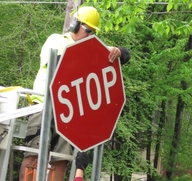
Why don't all stop signs have corresponding 'Stop Ahead' warning signs?
Many stop signs are at predictable locations and have adequate visibility, thus do not require advance warning. To provide uniformity throughout the county we use the following guidelines in establishing the need for a "Stop Ahead" warning sign:
- The view of the stop sign is limited due to a horizontal or vertical curve in the roadway.
2. There is a distance greater than or equal to 1.5 miles from the previous stop condition.
3. There is a pattern of fail-to-stop crashes at an intersection that may be corrected through the installation of a "Stop Ahead" warning sign.
|

Can I get a deer crossing sign installed on my road?
Because these signs have shown to be of little or no value in reducing motor vehicle/deer crashes and due to the scattered nature of the problem, we do not inventory or install these signs nor do we allow the installation of these signs within the public right-of-way by others.
|
Interested in reading more of our frequently asked traffic and safety questions? Visit our website, ottawacorc.com/frequently-asked-questions/faqs-traffic-safety/.
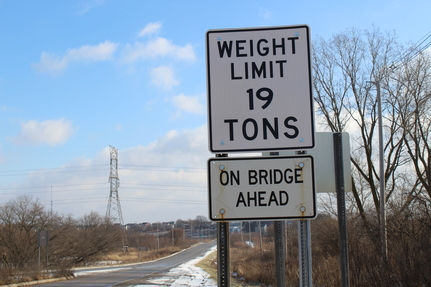
Two Zeeland Township bridges were recently posted with new weight restrictions following an engineering evaluation.
A 19-ton weight limit has been established on Byron Road over the Black River east of I-196. A 10-ton limit has been established on 96th Avenue over the Black River south of Adams Street.
Signs giving drivers advanced warning of the restrictions have been put into place. Any vehicles that exceed the respective weight limits on the two bridges must seek alternate routes.
These two new weight restrictions bring the total number of Ottawa County Road Commission restricted bridges for gross vehicle weight to four. The other two are:
- Barry Street over the east branch of Rush Creek (12 ton weight restriction) (Will be worked on this year thanks to MDOT bridge program funding)
- Squires Road over Rio Grand Creek (58 ton weight restriction)
These account for four of the 135 bridge structures maintained by the Road Commission. A bridge is defined as any structure, including culverts, having an overall span of 20 feet or more as measured along the centerline of a road.
Average Vehicle Weights
Curious about the average weight of some of the vehicles traversing our roads? Here are some common vehicles and their weights:
- Average Car -- 1.5 tons
- Delivery Truck -- 6 tons
- Loaded School Bus -- 17 tons
- Fire Truck -- 19-30 tons
- Loaded Garbage Truck -- 25 tons
- Loaded Cement Truck -- 33 tons
- Loaded Tractor-Trailer -- 40 tons
Inspecting and rating Ottawa County bridges
Our bridges are inspected bi-annually by Road Commission staff and the results submitted to the state. A Bridge Federal Sufficiency Rating (FSR) is then formulated from the inspection results by MDOT/FHWA.
|
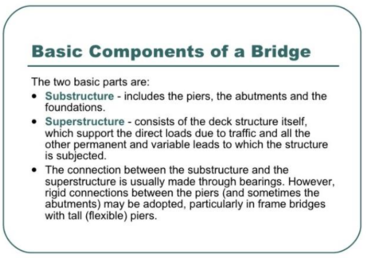
The FSR is a method of evaluating bridge data by calculating three separate factors to obtain a numeric value which is indicative of bridge sufficiency to remain in service. The result of this method is a percentage in which 100 percent would represent an entirely sufficient bridge and zero percent would represent an entirely insufficient or deficient bridge.
This rating determines the bridge structure needs and/or eligibility for funding. Based on where the rating lies, the bridge may be eligible for total reconstruction (replacement), eligible for rehabilitation or eligible for preventative maintenance.
How bridges are funded
A major source of funding for these bridge improvements is the MDOT Local Bridge Program.
Applications are submitted each year for possible funding. Funding applications are reviewed based on bridge FSR, the impacted area, detour route, and other social and economic factors.
Bridges are eligible to receive grant funding (approximately 95%) through the Michigan Department of Transportation Local Bridge Program. This state and/or federally funded program requires a 5 percent matching contribution from a local source, typically the Road Commission.
Projects selected for funding is highly competitive. More than 420 applications were submitted in 2018 for 2021 projects, with only 105 being awarded funding by the state.
The Road Commission is also responsible for all costs associated with design, construction inspection, materials testing, right-of-way acquisitions, and other preliminary engineering work. Routine maintenance and repair costs associated with bridges are typically 100% paid for by the Road Commission and/or other local sources.
|
Watch OCRC winter maintenance videos
Want to learn more about OCRC winter maintenance operations?
The Road Commission has produced several online videos that highlight winter maintenance activity.
Current videos in the Winter Maintenance 101 series include:
Plowing Priorities
How Road Salt Works
Be sure to watch these videos, subscribe to the OCRC YouTube channel, and check back often for additional video content.
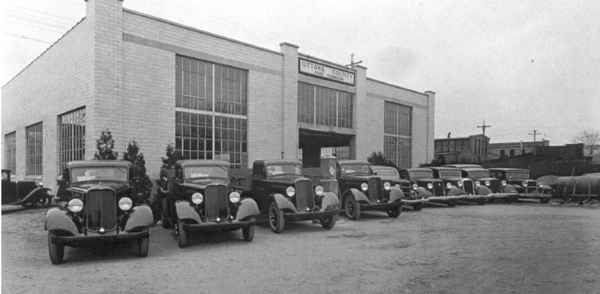
Each month, we'll take a look back at the OCRC's past with a photo from our archive.
This undated photo takes a look at our fleet of vehicles lined up outside of the old Grand Haven Ottawa County Road Commission garage in the city of Grand Haven.
Time and technology has sure changed, but our pride and dedication remain the same!
|