|
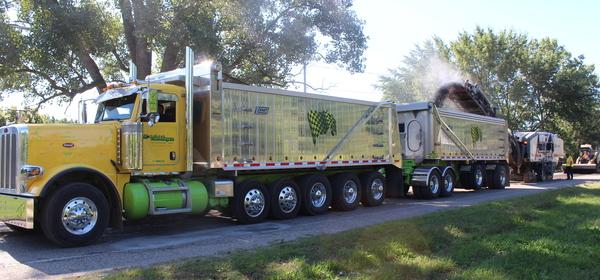
A truck collects milled asphalt as part of a street resurfacing project in 2018.
It's a new year, and as we begin to plan out our projects and improvements for 2019, we thought it would serve as a good time to teach a little bit of road maintenance lingo.
Read on to find out all about various road maintenance and improvement techniques at our disposal:
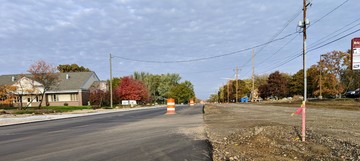 Reconstruction: Total removal of the old pavement, aggregate base and sand subbase; utility relocation; then storm drain upgrades, repairs or replacement; then placement of new sand, aggregate and pavement. This is the most aggressive and costly solution to road damage.
Cost: between $400,000 and $2 million per mile.
Resurfacing: Adding one or two layers of pavement on top of old pavement.
Cost: $100,000 to $200,000 per mile.
Graveling: Sometimes called gravel resurfacing, adding 3 to 8 inches of new gravel on top of existing gravel that has sufficient drainage and width.
Cost: $10,000 to $40,000 per mile.
|
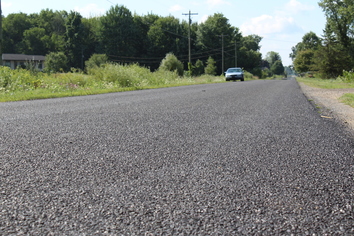 Widening: Gravel shoulder area is trenched down to the full depth of the pavement and base aggregate. New aggregate is compacted with equipment and pavement added to equal the strength of the existing road; then new aggregate shoulders are added.
This type of project might involve relocating ditches farther from the road, extending crossroad culverts, relocating driveway culverts, tree removal and re-seeding, some of which could require the road agency to purchase additional land to have adequate right-of-way.
Chip seal: Also known as seal coating or Bituminous Surface Treatment (BST), it is the application of a special protective material to an existing pavement service. A dump truck full of chips (gravel) locks onto the chip spreader and is pulled backward. A thin layer of asphalt is sprayed in front of the chip spreader. The aggregate chips drop onto the asphalt and is rolled several times by crews.
Cold-in-place recycling: Not common because of the high cost of equipment, this process involves grinding up the road’s aggregate base and existing asphalt, adding asphalt binder and some cement and then paving, rolling and compacting it to make a bound aggregate base material.
|
 It’s officially winter, and that means plenty of snow will continue to build up at the ends of our driveways.
Heavy snow accumulation, combined with icy roads and/or poor visibility during winter maintenance activities can make it difficult for snowplows to avoid garbage cans placed alongside the road. During snowstorms it may be necessary to postpone putting your trash out on pick-up days. Knowing how to make waste collection as easy as possible is important, so here are a few helpful tips that are sure to come in handy during the winter
months.
When you dig out your driveway, be sure to dig out a spot for your garbage can.
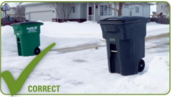
Do not place garbage cans in the street. We realize this cleared area is an enticing location to place garbage cans, but it creates a hazard as they could get hit by vehicles or taken away by snowplows. Most garbage trucks are equipped with a hydraulic extending arm that grasps garbage cans. It is recommended that garbage cans be placed at least 3 to 5 feet off the edge of pavement, into your driveway, so they are out of the way of the snowplow or snow being pushed aside while the snowplow is going down the road.
|
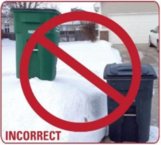 Do not place garbage cans on top of the snow piles. This placement might cause your garbage can to tip over and litter your garbage along the street, and it also makes it difficult for the garbage trucks to set the cart back down.
Timing is everything. Putting your trash out the night before collection day can make life easier, but this puts your receptacle at risk of damage during nighttime snowplowing operations. Getting up a bit early in the morning to handle this chore can avoid having garbage cans knocked over by strong winter winds or snowplows.
Retrieve your garbage cans soon after collection. Garbage cans often sit at the roadside on collection day until the evening. Empty cans are vulnerable to winds and snow removal operations and could cause a hazard if knocked into the roadway. Prompt removal of empty containers is recommended.
These tips can make garbage collection day safer and easier for snowplow and garbage truck drivers.
|
 Please welcome new Sign Shop Supervisor Eric Heyboer, who took over as the new supervisor at the end of December 2018.
Heyboer takes over for Carl Jager, who retired December 28, 2018, after 24 years of service to the Ottawa County Road Commission.
Heyboer has spent the past 21 years with the Road Commission, and started his career at the Zeeland garage. For the last 10 years, Heyboer has worked in the sign shop.
“I look forward to the opportunity,” Heyboer said of his new role.
Heyboer said he looks forward to continuing what Jager started and building on things that he’s already implemented, especially on the technology front.
This includes working with and expanding the use of the Roadsoft software program -- a roadway asset management system for collecting, storing, and analyzing data associated with transportation infrastructure.
|
 |
|
Make sure you are signed-up to receive these timely updates:
Social Media
The OCRC is on Facebook, Instagram and Twitter. Follow these pages for updates on road construction, winter maintenance and more.
OCRC Website
Check out the official OCRC website for updates on road work, FAQs and much more.
Email Distribution Lists
Sign up to receive a weekly road work report during the construction season and sign up for our monthly newsletter.
|
|