Inspired by the success of Poor Farm's 150th anniversary celebration in 2016, a documentary film on the facility was created and will premiere this spring in Holland and Grand Haven.
The Poor Farm: A Documentary, was made in association with the Ottawa County Parks Foundation and Ferris State University. Assistant Professor, Joshua Pardon and local historian, Marjie Viveen gathered additional research following the 150th anniversary celebration event in October 2016 and co-produced the film. FSU students edited the film to profile the iconic property and its amazing people.
"The words 'Poor Farm' conjure up stereotypical images and beliefs in many people," says Viveen. "'Poor folks' may not seem as smart or hardworking as we perceive ourselves, but years of researching the individual lives of Poor Farm residents has erased any ill-conceived notions I might have held. One need only ask, 'Who would I become if I were unable to live independently?'" She thinks these stories might change your mind too.
Viveen shared a story about a Holland resident, Dr. Albert Curtis, as a sneak peek of the types of stories shared in the documentary:
A native of Sincoe, Ontario, Albert Curtis trained as a butcher. This training inspired an interest in animal anatomy, leading to Ontario Veterinary College. After graduating in 1884, Dr. Curtis seized an opportunity in Holland, Michigan, establishing a practice downtown on River Avenue. Dr. Curtis boarded at Scott’s Hotel, where Carrie DeWitt was a maid. He and Carrie wed in 1891 and the couple purchased the red brick house at College and 7th.Their son Stanley was born there. By age eight, the boy’s mother was lost to tuberculosis and Dr. Curtis raised Stanley single-handedly. The two prepared breakfasts and took dinners at VanDrezer’s Restaurant for 25 cents.
Dr. Curtis' practice focused on large farm animals. He served a territory as far north as West Olive, east to Fennville, and south to Saugatuck. One of the first in the community to install a telephone, Dr. Curtis would get calls all hours of the day and night, all seasons of the year. He guided his horse and buggy in all four seasons, event the winter, with the aid of a dashboard-mounted lantern.
He specialized in equine dentistry. A horse might be skin and bones because its teeth were worn to sharp spindles, making it so the animal was unable to grind food. Dr. Curtis solved that by immobilizing the horse’s head with ropes, forcing its lips apart, clamping its mouth open, and filing its teeth flat. The procedure took about an hour and saved the horse’s life.
As motor vehicles came into wider use, Dr. Curtis grew increasingly dependent on clients driving him back and forth to treat animals. Business faded and he retired to the red brick house. Stanley, who eventually became a marine engineer and Holland City Council member, re-established residency there in 1922 in order to care for his aging father. In time, his father's care was beyond his capacity. In 1942, Dr. Curtis was admitted to the Infirmary at the Poor Farm and died there in 1943. The site of the red brick house is now the stately Curtis Office Center and Park, named for the man who once lived there.
Learn more about local history and the farm's residents by attending a movie premiere this spring!
Movie Premiere Information
There will be a special movie premiere event in both Holland and Grand Haven. At each event, guests can expect light snacks and a beer and wine cash bar. There will be a small, locally-focused silent auction, as well as live music. The documentary will be introduced by the co-producers and its run time is about a half an hour. DVDs will be available for sale.
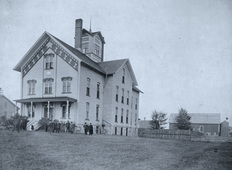
When the Ottawa County Poor Farm received its first resident in 1866, no one could have imagined the benefits it would provide over the decades. The Poor Farm was a haven for indigent people who, due to the happenstance of birth, misfortune, or poverty, were in dire straits and needed a place to call home—a sanctuary staffed with people who could nurse them to better health. Now, as Eastmanville Farm County Park, it provides hiking and equestrian trails to outdoor enthusiasts.
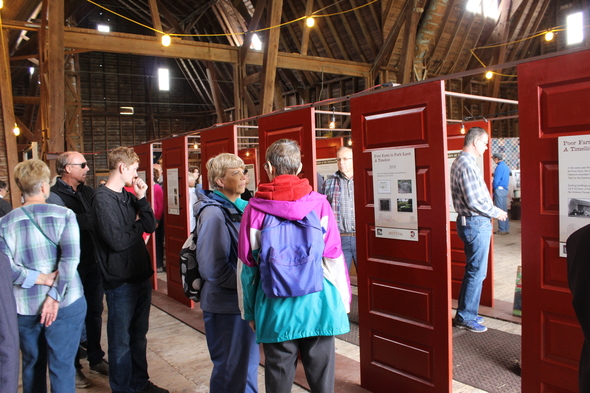
Poor Farm Sesquicentennial event attendees viewing an exhibit in the barn