|
Winter
is almost over, but as the warmer weather starts to develop, so do potholes. So what is a
pothole?
A
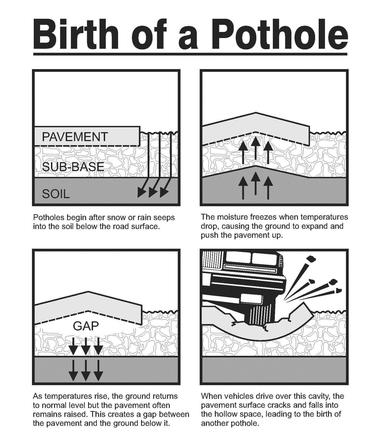
pothole is a cavity in the road formed by moisture, freeze-thaw cycles, traffic,
and time (see illustration).The number of potholes on the 1,362-plus miles of
paved county roads and 522 lane miles of state highways maintained by the Road
Commission grows larger every year.
Potholes
are a major problem in Michigan. The older, deteriorated roads can no longer
withstand the constant freeze-thaw climate. As a result, every year, road crews
hand shovel millions of pounds of cold and hot patching material into potholes.
Including labor, material, and vehicle usage, the annual cost for the Road
Commission of repairing potholes is approximately $500,000.
If you notice a
pothole, please contact our office at 616-842-5400 to report the pothole
location, or utilize our online service request form. The link to our website
is www.ottawacorc.com. Please provide the
street name, side of street, and nearest cross street for the pothole.
Springtime
weather conditions can severely impact gravel road conditions. The impact from
frost leaving the ground is compounded by large amounts of rain and/or snow
melt. The fines (silt and clay) in the gravel that are needed to bind the sand
and gravel together under normal conditions now become oversaturated and weak.
The fines also hinder the excess moisture from draining through the gravel. What
was once a frozen and solid road turns soft, unstable, and muddy. The best cure
for these “muddy” gravel roads is warm, dry temperatures, and a good wind.
Attempts
to grade and/or place gravel on top of this “muddy” condition can turn the road
into a bigger mess. There is a saying, “Adding
a bucket of gravel to a bucket of mud just gets you a bigger bucket of mud”.
There is much truth to this quip, as adding sand or gravel with heavy equipment
to a “muddy” road worsens conditions by disturbing the saturated soils even
deeper, and thus taking longer for the road to dry out and stabilize. The Road
Commission monitors the gravel roads, and once conditions warrant, we will grade
and reshape them as necessary. Until then, motorists are advised to use caution
while traversing on “muddy” gravel roads.
 A good
performing surface gravel for roads is produced with a mixture, called
gradation, of three types of material: stone, sand, and fines (silt and clay). The
stone provides the strength and load carrying ability, the sand stabilizes the
mixture by filling the voids and providing contact between particles, and the
fines provides the needed plasticity to bind these materials together to form a
hard surface. A good blend of these three material types is vital to the
long-lasting performance of gravel roads.
MDOT 22A and 23A are the most common and economical choices
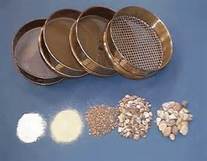
to use as surface gravel. Before any gravel is placed on a county roadway, a gradation test, also called sieve analysis, is performed to measure
the distribution of aggregate particles, by size, within a given sample. This
test determines whether the gravel is compliant with MDOT specifications. The test
utilizes various sized sieves to pass the gravel sample through to determine
the different particle size (see below). A scale is used to weigh the retained material
in each sieve. Fines are determined by washing and drying the materials that
passes through the smallest sieve to separate the sand and clay particles.
MDOT Gradation Specifications | 22A vs 23A
- Passing through a 1” Sieve | Both 100%
- Passing through a 3/4” Sieve | Both 90-100%
- Passing through a 3/8” Sieve | 65-85% vs 60-85%
- Passing through a No. 8 Sieve | 30-50% vs 25-60%
- Fines | 4-8% vs 9-16%
Gravel that is too sandy (less than 4% fines) will not be
as durable or effectively retain dust control materials. Gravel that has too
much clay (more than 16%) will be more susceptible to precipitation taking
longer to dry out. There are other higher cost options, such as limestone,
crushed concrete, or other blends, that can be considered for a gravel surface.
These may improve durability of the roadway but typically do not effectively
retain dust control materials.
|
 Get
Your Head Out of Your “Apps” and Drive to Arrive!
Road
agencies across the state are joining together to remind motorists of the
dangers of distracted driving.
Thousands
of people were killed or seriously injured on Michigan roads last year, and
most of these accidents could be avoided if drivers would eliminate
distractions. One of the biggest driver distractions is texting.
Michigan has
implemented an Anti-Texting Law
where a driver shall not "read,
manually type, or send a text message on a wireless 2-way communication device
that is located in the person's hand or in the person's lap, including a
wireless telephone used in cellular telephone service or personal communication
service, while operating a motor vehicle that is moving on a highway or street
in this state.” Under this law, it makes no difference
if you are texting while stopped at a traffic light or if you are traveling on
I-96. Both situations will land you a ticket.
Fines for
texting are $100 for a first offense and $200 for subsequent offenses.
Michigan’s texting law is considered a “primary” law. A primary law means that
an officer can pull you over for the offense without having to witness some
other violation. That is, the officer sees you texting and issues a citation.
There
are a few acceptations to the rule, meaning that there are some situations that
it is okay to drive and text.
-
Traffic
Accidents - One of the exceptions is when you
are reporting a traffic accident, serious road hazard or medical emergency.
- Believing Your
Life Is In Danger - When you believe that your life is in danger.
-
Report a
Criminal Act - If you need to report that someone
is or has committed a crime against you or someone else.
-
Law Enforcement
- A police officer, a member of a
paid or volunteer the fire department, an emergency vehicle operator or a law
enforcement official to carry out office duties.
Minimizing distracted driving is something all
of us can – and should – be doing. The Road Commission would encourage the
following actions that can help ensure the safety of yourself and those around
you:
- Set
an example for those around you, especially children and teenagers, and
model safe driving behavior by keeping your attention on the road and away
from blinking and ringing devices.
- Pull
over safely when you need to make a call or send a message.
- Educate
family members that distracted driving is extremely dangerous, just like
drunk driving or driving without a seat belt.
-
Avoid calling or texting friends, colleagues and family who
you know are driving.
|
|