|
The seal coat
treatment process, sometimes called a “Chip” Seal, is a key part of the Road
Commission’s Preventive Maintenance Program to maximize the service life of the
road network.
Today’s
technically advanced seal coats are surface treatments designed to protect and
prolong the life of pavements for up to an additional 10 years. Seal coats provide a quick and reliable
surface treatment that will seal out the damaging effects of water, help to
increase skid resistance, improve aesthetics and delineation, and provide a new
wearing surface to protect the pavement for years to come. By comparison to other road surface
treatments, seal coat surfacing is one of the most economical, and long-lasting
options available to the Road Commission.
In
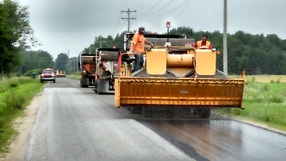
a single seal coat process, an asphalt emulsion is sprayed onto the road surface. This
layer of emulsion penetrates and seals small cracks in the existing pavement
and acts as a binder for the stone layer. The stone, also known as “chips”, is
a uniformly sized aggregate that is immediately placed on the emulsion. The new “chip” sealed surface is then
rolled to seal the aggregate to the binder and swept to remove any access
stone. A few weeks later a light application of asphalt emulsion, called a fog sealant, is applied to
the new surface to help retain the applied stones.
Over the past few years, the Road Commission has partnered with Muskegon
County Road Commission to place seal coat surfacing on several miles of county
roadways. This partnership has proven to
be both successful and more economical.
The
2016 Seal Coat program includes over 30 miles of improvements within Chester,
Jamestown, Port Sheldon, Tallmadge, and Wright Townships. Please visit our website for more
information.
|
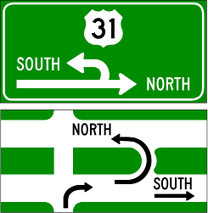 A “Michigan” left
turn is a road intersection design which replaces each left turn with a U-turn
and a right turn. The design was given the name for the frequent use along highways
in Michigan since the late 1960’s.
Michigan lefts are utilized at intersections where at least
the main road is a divided highway or boulevard. Left turns
onto (and sometimes from) the divided highway are prohibited, and traffic is
directed to a designated U-turn (or cross-over) lane in the median. When on a secondary road approaching the intersection,
motorists are directed to turn right toward the designated U-turn along the
main road.
Michigan left turn designs improve safety by providing a reduction in
left-turn collisions with the shifting of the left turn movement outside of the
intersection. In addition, traffic flow
and delay time is improved as traffic signal phasing at the intersections can
be reduced. Finally, pedestrian safety is enhanced as the design reduces
crossing conflicts to through traffic and vehicles making right turns.
The Road Commission will
be implementing the “Michigan” left design along the 48th Avenue
narrow median boulevard project from M-45 to Pierce Street that is currently
under construction.
|
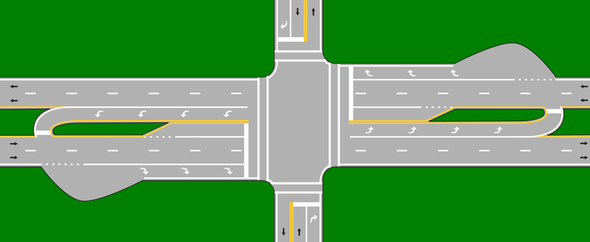 |
This drawing depicts the existing Michigan left turn on US-31 at Robbins Road in Grand Haven.
One of the drawbacks of gravel roads
is they are prone to giving off dust. Road dust is made up of fine particles
that are important to the stability of the road. As a road dries out, the fines
blow away, breaking down the gravel road. Daily traffic scatters the remaining
coarser aggregates that have become loose; causing potholes, ruts, washboard,
loss of profile, loss of ditch lines, and other problems. Keeping the road
moist helps fines adhere to each other and to aggregates, allowing for optimum
compaction.
There are several different types of
products that help control dust and retain moisture. The most commonly used
are: Calcium Chloride, a man made solution generally at 26% to 35%
concentration and Mineral Well Brine, a naturally-occurring salt water
that is pumped from the ground. When applied to gravel roads, both the chloride
and brine products draw moisture from the air and ground. This moisture binds
the materials in the road, reducing the amount of dust that becomes airborne
and providing a better driving surface.
A Township will select a contractor, purchase a dust
control material, and determine the frequency and location of applications when
requested by the Township. The Road Commission will then grade the gravel road
prior to the contractor’s placement of the dust control material. A tank truck
with a rear distribution bar is typically used by the contractor to spread the
liquid dust control evenly over the road. Please contact the local
Township office to request or
inquire about dust control applications
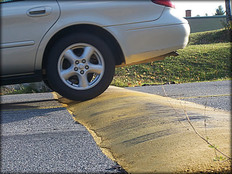 Can a speed bump be placed on your street? A speed bump is a mound of asphalt about a foot wide, 3 to 4
inches high, and placed laterally across the traveled portion of the road.
However, the speed bump poses an increased hazard to motorists, an undesirable
increase in noise, and a real problem for snow removal.
The purpose of a speed bump is to
make the ride over it uncomfortable for the driver, encouraging him/her to
reduce their speed. With the various vehicle suspensions and wheel bases, the
speed bump has shown an inability to successfully control speeds.
Speed bumps can cause maintenance problems to any vehicle
and increase response time for emergency services. Because speed bumps have
considerable potential for liability suits, Michigan has officially rejected
them as a standard traffic control device on public streets.
The control of speeding in neighborhoods is a
widespread concern which requires compliance by residents, and patience and
persistent effort by law enforcement – not speed bumps.
|
The Michigan Transportation Asset Management Council (TAMC) delivered the Michigan 2015 Roads and Bridges Annual Report to the Michigan Legislature and the State Transportation Commission in May. TAMC is required to file an annual report each year. The report summarizes road and bridge conditions throughout the State and provides condition projections into the future. The TAMC report can be found on their website at www.tamc.mcgi.state.mi.us.
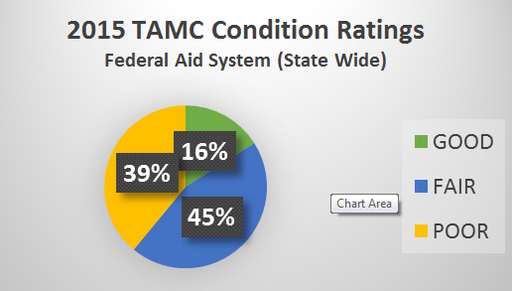
TAMC recently received 2015 pavement condition data through the cooperative efforts of various road and planning agencies in Michigan. Data was collected from 52,049 lane miles of paved federal aid eligible State Highways, City Major Streets, and County Primary Roads. In terms of physical condition, the report reveals further deterioration of these roads from the previous year with more miles being rated as “poor.” The 2015 condition data indicates 16% of these roads are in good condition, 45% are in fair condition, and 39% are in poor condition; in 2014, the breakdown was 17% good, 45% fair, and 38% poor.
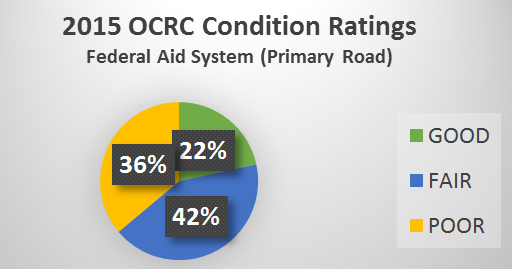
The Road Commission is pleased to report that the county primary road conditions have improved from the previous year with less miles being rated as “poor.” The 2015 condition data indicates 22% of the primary roads are in good condition, 42% are in fair condition, and 36% are in poor condition; in 2014, the breakdown for the county system was 19% good, 39% fair, and 42% poor.
|