This year’s Small Steps campaign will take effect on the first available pay period in March 2026. A March date avoids the holiday processing and makes for a smoother process for your reporting unit. The campaign includes employees in the Pension Plus, Pension Plus 2, and Defined Contribution plans, as well as those with the Personal Healthcare Fund.
A mailing will go out to applicable employees in mid-December 2025 regarding the campaign. The mailing will include their opt-out code. No additional notices will be sent to employees after this, so please advise your employees to keep the mailer. View the Small Steps campaign mailer.

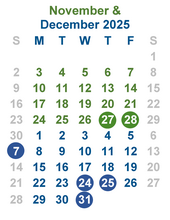
As the winter holidays approach, please bear in mind that ORS does not change payroll calendar dates when a pay period falls on a holiday or weekend.
Employees may be paid ahead of the holiday or weekend date, but for your report header, you must use the date reflected on your payroll calendar.
If you pay employees on a day other than your pay period end date, adjust your record end date accordingly, while keeping the same report end date. Be advised that records will flag because they do not match your payroll calendar.
For example: If your pay period end date falls on Jan. 1, 20xx, but you pay your employees on Dec. 30, 20xx, your report header will have a pay period end date of Jan. 1, 20xx, while records within the report will have an end date of Dec. 30, 20xx.
This is especially important for IRS limits associated with DC/PHF contributions on a DTL4 record. If the record posts incorrectly, the employee may receive inaccurate service credit. Any DTL4 records with an end date of Dec. 31, 2025, and prior will be applied to the 2025 IRS limits. The system is coded to capture record end date, not report end date.
Please refer to the Reporting Instruction Manual (RIM) section 7.00.01 Payroll calendars and due dates and our list of non-business days.
|

ORS is wrapping up its audit of weekly worker’s compensation wages (WWC) reported from fiscal years 2020–2023. This has generated questions from reporting units regarding WWC reporting rules and guidelines. The information below addresses inquiries related to current reporting rules and guidelines, which have been in place since May 26, 2022.
When reporting wages, know that all WWC wages must be reported on DTL2 records using class code 8000. This includes:
- WWC paid directly by a third party.
- WWC checks turned over to the employer.
- Differential payments tied to WWC claims.
- Hours the employee would have worked if not on WWC.
Remember, WWC wages are subject to both employer and employee retirement contributions.
If you have employees receiving WWC who also work at temporary jobs, wages and hours earned for actual work performed while receiving WWC are reportable compensation.
Self-insured vs. third-party: If your reporting unit is self-insured, WWC wages are reportable on DTL4 records. WWC wages are not reportable on DTL4 records if your reporting unit uses a third-party insurer.
Frequently asked questions will be published on the PSRU website in the near future to address recent inquiries.
For more information regarding weekly worker’s compensation, visit 4.02: Reportable compensation.
|
The State Aid Resources page is now updated for fiscal year 2026. The infographics reflect the Michigan Public School Employees’ Retirement System (MPSERS) state aid appropriations for eligible reporting units. MPSERS state aid payments will be visible on state aid reports starting this month.
For greater clarity, this year’s page has two separate infographics: one for K-12 districts, intermediate school districts, charter schools/public school academies, and libraries; and one for community colleges and universities. This information can assist in understanding the state aid payments you receive from the Michigan Department of Education.
See more information on state aid payments from our October newsletter.
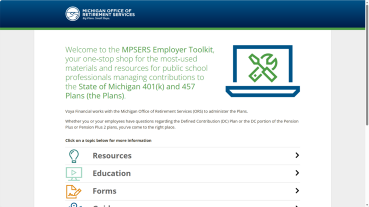

A resource for you, the MPSERS Employer Toolkit, is a one-stop shop for tools and education on the State of Michigan 401(k) and 457 Plans. This is meant to aid you in your work administering and discussing the State of Michigan 401(k) and 457 Plans with your employees, not for sharing with them.
|
|