|
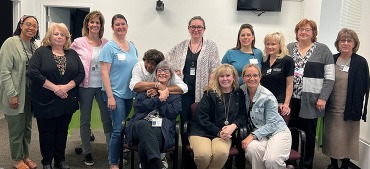 Back row: Andrea Agboka (Chief Public Health), Buff Smith (Client Representative), Lisa Bauer (Supervisor), Nicole Mato (Care Coordination Nurse), Pearlean Lewis-Jones (Client Representative), Tori Arrowsmith (Client Representative), Marsha Cresmen (Care Coordination Nurse), Beth Hella (Nurse Case Manager), Jean Wright (Nurse Case Manager) and Celeste DiParvine (Nurse Case Manager); Front row: Beth Olmsted (Nurse Case Manager), Michelle Reese (Nurse Case Manager) and Danielle White (Community Nurse); Not shown: Sasa Doll (Client Representative)
Our Oakland County CSCHS team members have years of experience in CSHCS, public health nursing, public health client representation, and caring for families. As you can see in the picture above, we are a close-knit team that are here to assist your family. Please contact us at 248-858-0056 if you have any questions about the program.
|
|

Camp Scholarship applications for 2025 through the Family Center for Children and Youth with Special Health Care Needs (Family Center) are now available here!
Updated information for 2025 includes:
- Camp scholarships have been increased to $500/per child
- Applicants can apply every year
- Multiple applications per family will be accepted; however, each camper is only eligible for funding every other year
- Children who are not enrolled in CSHCS, or do not have a CSHCS-eligible
diagnosis, are required to submit a letter from their specialty provider
verifying their diagnosis/special health care need. This includes children with developmental and/or behavioral conditions
- Applications will be accepted as long as funding is available
- Only 10 scholarships per camp will be awarded
|

Did you know that February is a time to celebrate the impact of black history, culture, and achievements?
- In 1915, historian and teacher Carter Woodson noted that African American contributions were “overlooked, ignored.”
- He founded a week of reflection and celebration for the achievements of Black people.
- In 1976, the week grew into a month and has been celebrated ever since.
As we honor Black History Month, it's a particularly meaningful time to bring attention to sickle cell disease. Research tells us that there are health care disparities for sickle cell disease, a disease which disproportionately affects Black people. About 9 in 10 people experiencing sickle cell disease are Black or non-Hispanic Black. In 2024, CSHCS expanded coverage to people over 26 years old who have sickle cell disease.
-
Adults over 26 are offered access to nurse case management and care
coordination services, and the funding of medical bills, co-pays, deductibles, etc.
- Help us get the word out about expanded coverage to friends and family!
Contact the Oakland County CSHCS office at 248-858-0056 for assistance. Learn more about sickle cell disease here.
|

Did you know lead exposure can permanently change the nervous system? The good news is that it can be prevented if someone is screened early for lead exposure.
A new Michigan law requires that primary care physicians test 1-year-olds and 2-year-olds for lead at their well visits. This will help identify children with high lead levels earlier in life.
Oakland County Health Division (OCHD) is committed to increasing childhood lead screening and education. The OCHD Childhood Lead Poisoning Prevention Program is staffed by nurses and auxiliary health workers who test children for lead exposure.
- The nursing team educates families about lead, connects them to resources, and discusses treatment.
- Our Environmental Health team works to remove lead sources and reduce re-exposure in the household.
-
Our dieticians share information with caregivers about dietary changes.
Walk-in during these times for testing:
-
North Oakland Health Center (1200 N. Telegraph Rd, Building 34E, Pontiac)
on Mondays, Wednesdays and Thursdays from 9 a.m. - 3 p.m. (one hour break for lunch)
- South Oakland Health Center (27725 Greenfield Rd, Southfield) on
Tuesdays from 9 a.m. - 3 p.m. (one hour break for lunch)
Stop at the front desk and they will direct you to testing.
Learn more about OCHD's Childhood Lead Poisoning Prevention Program here.
|
|
|

There are many types of emergencies that can occur in Michigan. Knowing how you'll respond to each type is critical for maintaining the health and safety of your family. Emergency planning for children with special needs means paying attention to extra details in order to preserve a delicate medical balance for your child.
Plan Together
Meet with your family to discuss the importance of planning for emergencies and then create a plan together allowing input from each member. Creating a plan together not only helps keep everyone safe, but also builds confidence and peace of mind.
In addition to building a standard family emergency kit (the details of which can be provided at your request), a person with special needs may require additional preparation to face challenges that arise during an emergency.
Consider these steps when planning:
- Complete an emergency information form
-
Meet with your primary care provider and specialist to develop a care plan
for emergency situations
-
Ask your pharmacist whether medications that require refrigeration can be
stored in a cooler during emergencies
-
Consider purchasing a generator or battery backup for medical equipment
that requires electricity. Check to make sure your equipment can be safely run on a generator.
-
In one place, gather a two-week supply of dietary foods, medications and medical supplies such as dressing materials, nasal cannulas, and suction catheter, etc.
-
Consider keeping a manual wheelchair available
|
The Family Center is a statewide parent directed center that serves children and youth who have or are at an increased risk for physical, developmental, behavioral, or emotional conditions regardless of CSHCS enrollment.
The Family Center offers:
|
Contact Oakland County CSHCS at 248-858-0056 for more information.
|
|
|

The Rainbow Connection is a 501(c)(3) nonprofit that grants wishes and provides support services to Michigan children diagnosed with a life-threatening illness and their families.
-
Since 1985, The Rainbow Connection
has granted over 4,300 wishes to brave
kids across the state.
- A once in a lifetime wish, such as a shopping spree, family vacation or
celebrity meet and greet, allows the whole family something to dream about and look forward to.
- The wish is an opportunity to create hope, joy and lifelong memories for the
entire family during a difficult time.
- The Rainbow Connection has no waitlist and is committed to never having
one.
To qualify for a wish, a child must:
-
Be diagnosed with a life-threatening illness by a licensed physician
-
Reside in Michigan
-
Be 18 years old or younger
- Not have received a wish from any other wish-granting organization
A child can be referred for a wish by a physician, social worker, parent, or other person familiar with the child’s condition. Make a referral or learn more about The Rainbow Connection at www.rainbowconnection.org.
Additionally, they stay connected to Wish Families before, during, and after their wish with support programs.
- Special Response Program – Provides emergency financial assistance to
wish families in the form of rent, transportation, clothing, food, utilities, gas or other needs on a case-by-case basis, contingent on program funding
- Enhancement Program – Provides year-round, free family activities like
sporting events, picnics, fairs, holiday parties, theater shows, and more
- Scholarship Program – Provides scholarships to Wish Children pursuing
post-high school education
|
|
|
|
|
|