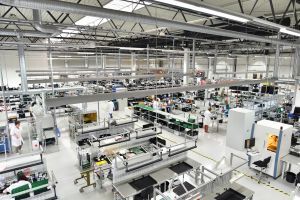
Did you know, manufacturing contributes approximately $114 billion annually to the state’s economy? Michigan is home to nearly 583,000 manufacturing workers — accounting for more than one out of every eight non-farm jobs in Michigan.
According to the Bureau of Labor Statistics, Michigan created nearly 118,000 new manufacturing jobs from 2009 to 2025 — an increase of 25% — remaining a national leader in manufacturing job creation and outpacing most other states.
LEO has several initiatives that equip workers with the skills needed to thrive in advanced manufacturing and clean energy sectors, while supporting businesses in growing their workforce.
-
LEO’s efforts to expand use of the Registered Apprenticeship training model supports programs that combine classroom learning with hands-on experience, helping students and workers gain practical skills while earning competitive wages.
-
The Going PRO Talent Fund supports short-term, employer-driven training programs ranging from classroom instruction to Registered Apprenticeships.
-
LEO’s Community and Worker Economic Transition Office plays a vital role in helping Michigan communities and workers navigate economic shifts in key industries like automotive and energy, ensuring that no one is left behind as technology and production evolve.
|
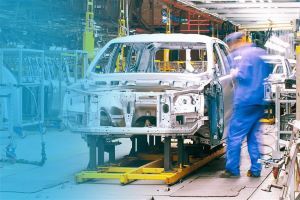
The Transition Office recently announced the award selections for 11 small- and medium-sized auto employers receiving a share of the $21 million in Michigan Supplier Conversion Grant program funding to shift from producing parts, components or materials for internal combustion engine vehicles to products needed in qualified vehicle supply chains (like hybrids) – ensuring Michigan remains a national leader in automotive manufacturing.
Eleven Michigan-based automotive companies will use funding to purchase new equipment or make upgrades, expand facilities and align workforce initiatives designed to meet evolving industry standards in battery components, electrification and advanced materials.
This grant was made possible through $22.6 million from the U.S. Department of Energy’s Domestic Automotive Manufacturing Conversion Grant program designated to award grants directly to small- and medium-sized automotive manufacturers to adapt to economic and industry changes which will increase domestic production capacity of qualified vehicles and their components.
|
General Motors contributed $1.5 million to support the MiSTEM Network to advance innovation in science, technology, engineering and mathematics (STEM) education in Michigan. The gift, bringing their total support to $2.5 million, is focused on preparing Michigan students for high-demand careers in STEAM.
This funding directly supports the state STEM strategy of place-, problem- and project-based (3P) learning aligned with Michigan’s strategic industries. The funding will be used for elementary (K-5) student programming focused on in- and out- of-school learning with students, community, businesses and families. This grant funding will also support the publication and enhancement of a publicly available Michigan STEM learning asset map.
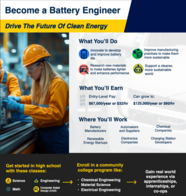
The University of Michigan Electric Vehicle Center has developed a free collection of classroom posters to help students explore careers connected to electric mobility.
The collection introduces students to four career paths—Battery Engineer, Transportation Planner, EV Technician, and CAD Designer—and provides age-appropriate information about what people in these roles do and how their work contributes to the future of transportation.
With versions created for K–2, 3–5, 6–8 and 9–12 classrooms, the posters can be incorporated into STEM lessons, career exploration activities, counseling resources and other student programs.
Questions? Contact Jessi Kittel, Workforce Development Lead at the University of Michigan Electric Vehicle Center, at jessik@umich.edu.
|
The You Drive the Future campaign offers organizations an opportunity to showcase their people and work while introducing younger audiences to mobility career pathways. MichAuto and the University of Michigan Electric Vehicle Center are seeking college students and early-career professionals who live or work in Michigan to create short “day-in-the-life” videos about careers in mobility, EVs, software, manufacturing, design, policy and related fields.
Participants film their own footage, a marketing company handles the editing, and participants are paid per video. Candidates may come from mobility firms or elsewhere in the mobility community.
View more information, including an application form, at YouDriveTheFuture.com.
The Transition Office and MiSTEM are recruiting for several positions:
If you or someone in your network would be a good fit, we encourage you to apply.

In July 2025, Congress passed H.R.1, which included sweeping reforms to the Medicaid program. One significant impact is the requirement for states to impose work requirements on Medicaid beneficiaries.
To maintain eligibility, impacted Medicaid expansion beneficiaries must complete 80 hours per month of paid or unpaid employment, volunteering or performing community service, attending a high school diploma/equivalency program, attending a college or vocational program, or participating in an internship or work program – such as those available through local Michigan Works! Agencies.
The impact of these work requirements on low-income Michiganders, as well as their communities, is significant. Of the nearly 614,000 Michiganders participating in the HMP during fiscal year 2026, more than 60% do not currently meet the work requirements that will go into effect in January 2027.
LEO is working in partnership with the Michigan Department of Health and Human Services and the state’s 16 Michigan Works! Agencies to avoid disruption of benefits for Medicaid beneficiaries while increasing access to education and training programs, family-sustaining employment and higher wages.
More information about Medicaid work search requirements is available at Michigan.gov/HMP.
|
Join the Transition Office on Tuesday, Oct. 27 at 10 a.m. for the fall advisory committee meeting. The Transition Office will provide updates on key projects currently underway, including the Transition Impact and Risk Assessment and the Layoff Aversion Assessment.
Register for the virtual meeting here.
|