We’re excited to announce that the EV Workforce Hub is now the MI Auto Workforce Hub! This new name better reflects our focus on supporting Michigan workers through all automotive industry transitions, not only electrification.
While our mission remains the same, the updated name captures the full scope of our work to support workers, employers and communities across the state. Check out our new website, which features updated information about workgroup projects and a full list of MI Auto Workforce Hub partners at Michigan.gov/AutoWorkforceHub.
We also have a new email address! If you have questions or want to connect, please reach out to the team at LEO-MI-Auto-Workforce-Hub@Michigan.gov.
|
1. Data & Coordination
At the September Data & Coordination meeting, the Upjohn Institute presented early findings in their work on the EV Labor Market Report, highlighting that auto jobs are dominated by production roles, but recent growth is concentrated in higher-skilled occupations (e.g., engineering, management). Anthropic, an AI company, also joined the meeting and shared findings from their Economic Index. The presentation highlighted how generative AI tools like Claude are being used across industries, with low current adoption in Michigan’s automotive sector. The Data & Coordination workgroup is exploring how data on AI adoption can inform workforce development and training.
2. Structural Barriers
The Structural Barriers Workgroup is finalizing Reliable Rides: Connecting Workers to Jobs, a transportation barrier removal playbook that will help employers implement practical programs that remove obstacles employees face in to getting to work. During the September meeting, partners reviewed and provided feedback on transportation models and strategies. The playbook will be online soon—stay tuned!
3. Training, Curriculum & Career Readiness
The Training, Curriculum and Career Readiness workgroup is moving into the pilot phase of its K-12 Manufacturing Curriculum Expansion Playbook. This playbook aims to be a practical guide that helps schools and employers build partnerships to implement manufacturing curriculum in high schools. The pilot will begin with statewide educator and employer roundtables, followed by local convenings to test and refine the model. September’s workgroup meeting also featured insights from Massachusetts’ MassBridge and MassMakes initiatives, which offered valuable strategies for aligning curriculum with industry needs and engaging both educators and students in advanced manufacturing pathways.
If you are interested in joining any of the workgroups referenced above, please contact LEO-MI-Auto-Workforce-Hub@Michigan.gov.
Community Growth Fellowship
The Michigan Community & Worker Economic Transition Office established a new program, the Community Growth Academy, an 18-month program that helps Michigan communities impacted by transitions in the auto and utility sectors plan for long-term economic growth and prepare for future change.
The Community Economic Development Association of Michigan is launching the Community Growth Fellowship, a key part of the Community Growth Academy.
Starting in January 2026, 10 fellows will be placed at selected host sites for 15 months to help design and implement strategies that build economic resilience, strengthen local workforces, and diversify regional economies. Fellows will work directly with local governments, nonprofits and community partners to move projects forward that support long-term growth.
Applications for the inaugural cohort of Community Growth Fellows must be submitted by 11:59 p.m. EST on Oct. 22. For more details and information on how to apply, go to cedamichigan.org/programs/community-growth-fellowship.
Michigan Supplier Conversion Grant Program
The Community and Worker Economic Transition Office is now accepting Notices of Intent to apply for the Michigan Supplier Conversion Grant Program. The program has allocated $31.8 million to help manufacturers currently producing parts for internal combustion vehicles retool their facilities and retrain their workforce to enter electric vehicle supply chains. By submitting a Notice of Intent, companies with strong submissions will receive technical assistance to develop competitive project applications.
-
Deadline: Monday, Nov. 10, 2025 at 11:59 p.m. EST.
-
Eligibility: Applicants must be domestic entities located in Michigan that are currently manufacturing products, components or materials for internal combustion engine vehicles. Companies must either have fewer than 1,500 employees or be operating a facility with 500 or fewer employees on the site where the retooling project will take place
-
Who Should Apply: Manufacturers looking to offset costs associated with fixed assets, machinery and equipment, technology and training to support the production of electric vehicles or components.
View the Michigan Supplier Conversion Grant Program webpage for more information.
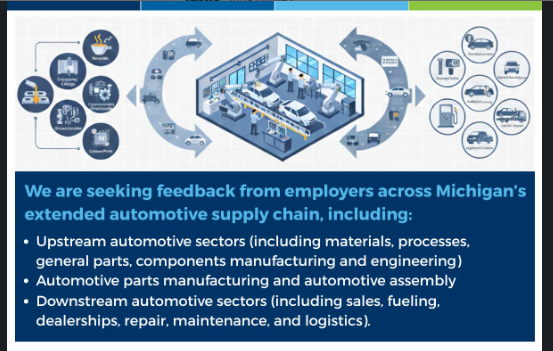
The Center for Automotive Research is conducting a statewide assessment of workforce needs in Michigan’s automotive industry on behalf of the MI Auto Workforce Hub.
Please spread the word by inviting employers across Michigan’s extended automotive supply chain to provide feedback about changing jobs, skills and hiring demand in relation to new vehicle propulsion systems (e.g., electric vehicles) and industry shifts.
Complete the survey for confidential interviews with the Center for Automotive Research by Friday, October 10.
-
MI Auto Workforce Hub Structural Barriers Workgroup meeting: Oct. 9, 2025, at 3:30 p.m.
-
MI Auto Workforce Hub Data & Coordination Workgroup meeting: Oct. 22, 2025, at 11 a.m.
-
MI Auto Workforce Hub Training, Curriculum & Career Readiness Workgroup meeting: Oct. 23, 2025, at 2:30 p.m.
|