Friday, October 9, 2026
Table of Contents
- Child Care Center Rule Book Correction
- Get the Facts About CDC Absence Billing
- New MiLEAP Videos Highlight Child Care Resources for Businesses
- New Report Shows How MiLEAP Builds Bright Futures for Children and Families
- Social Emotional Consultation Available to Providers at No Cost
- 400 Voices and Counting - Add Yours to Michigan's Early Childhood Survey!
- MiLEAP Awarded Nearly $5 Million Federal Grant to Advance Student Basic Needs Work
- CPSC Recalls and Safety Warnings
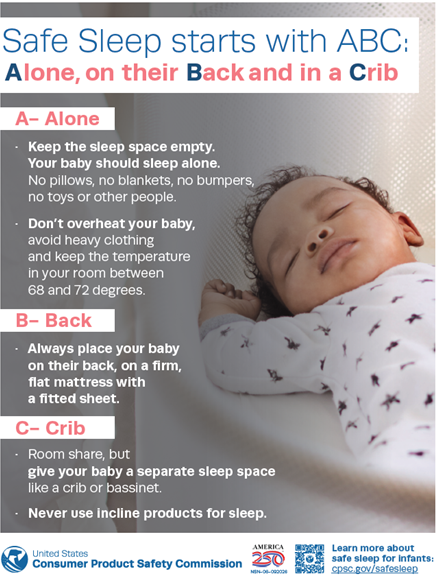
- CPSC Safety Education: Safe Sleep ABCs
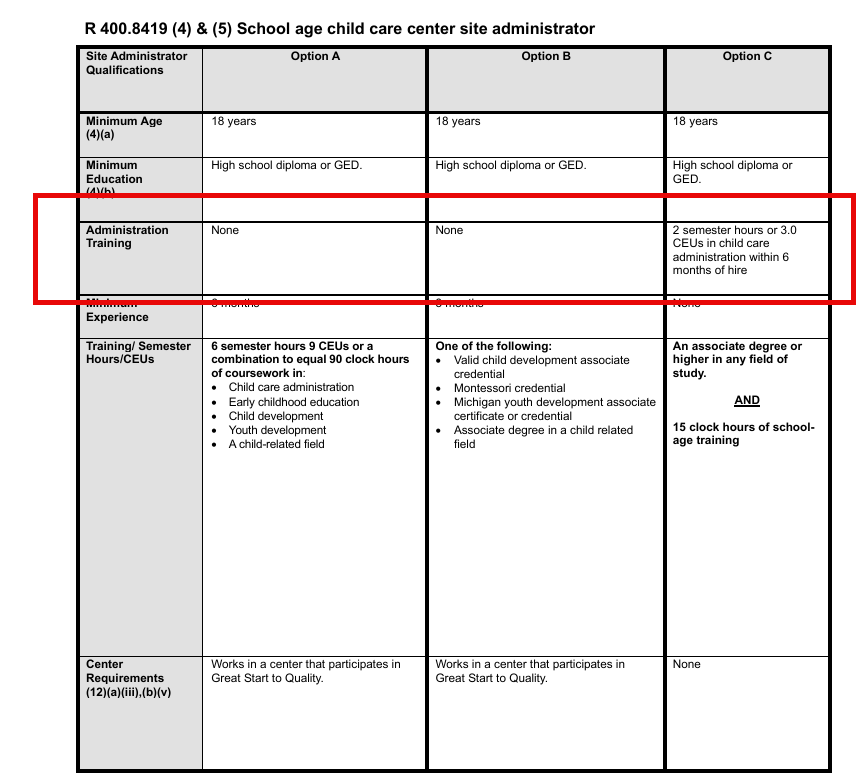
There is a typo in Appendix G of the Center Rule book. In the table for R400.8419(4)&(5), the row “Administration Training” should read “None” all the way across the row, replacing the language in the last box.
Please see the area marked in red on the chart below. The correction will be reflected in the Center Technical Assistance and Consultation Manual.
Please reach out to your licensing consultant with any questions.
New requirements for how licensed providers bill the CDC Scholarship for absence hours took effect on October 1, 2026. Learn more information on the facts vs. the myths around these changes below.
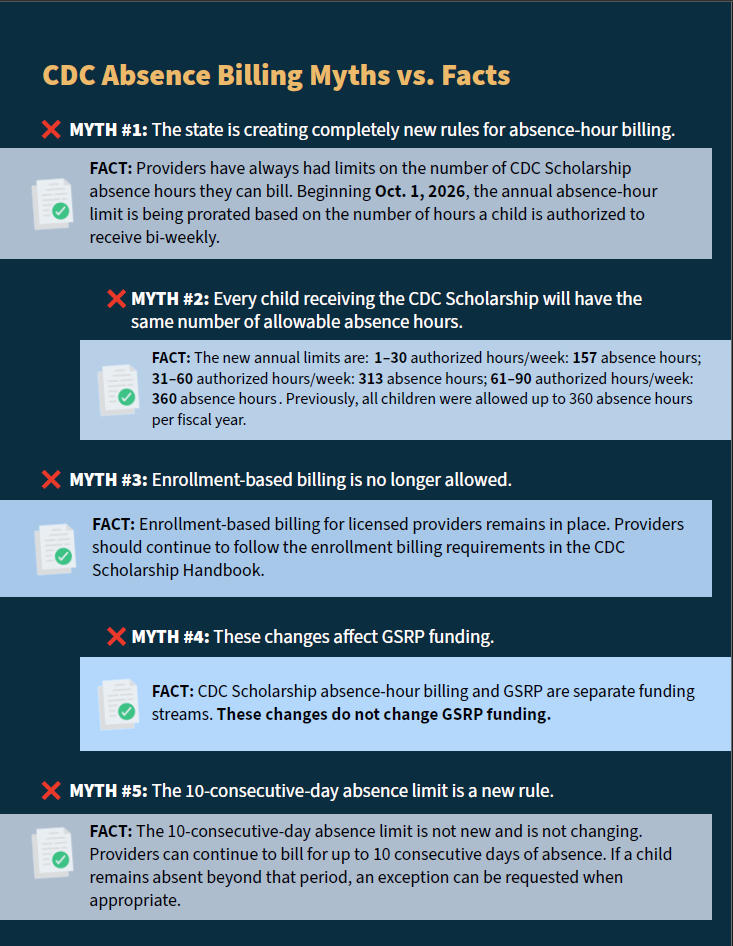 Why are the absence-hour limits and billing guidance changing?
The changes are required under Michigan’s FY27 budget legislation and are intended to strengthen program integrity and establish clearer limits around absence billing. The new allowable absence hours apply by fiscal year and reset with each new fiscal year. The current changes take effect Oct. 1, 2026, for the fiscal year ending Sept. 30, 2027.
I still have questions...
For more questions that aren't addressed in the above resources, contact: MiLEAP-CDC-Admin@michigan.gov
MiLEAP has launched a series of short videos highlighting how affordable, high-quality child care supports Michigan families, businesses, and communities. The videos highlight resources including PreK for All, the Child Care Scholarship, and MI Tri-Share, and how businesses can help support their workforce
View and share these new resources by clicking the button below.
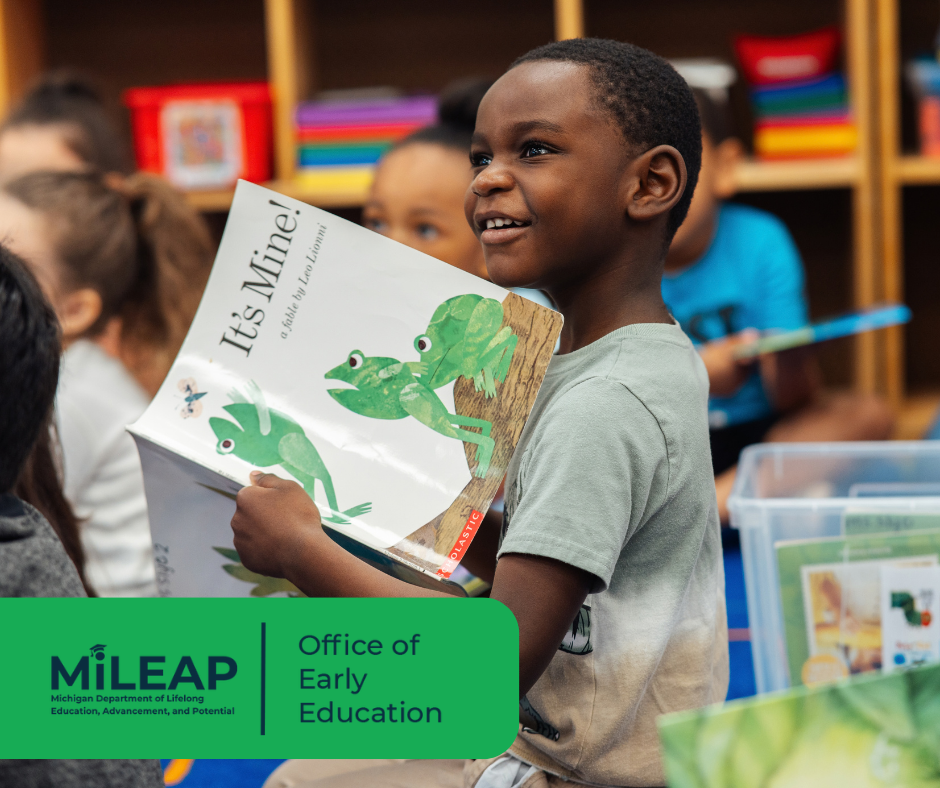
Over the past several years, Michigan has made historic investments in early childhood education that are expanding opportunities for children and families across the state. Today, more than 66,000 four-year-olds are receiving high-quality preschool through PreK for All, and more than 50,000 children and families access low- or no-cost care through the Child Development and Care program.
These investments and accomplishments are highlighted in the new Vision & Impact Report from the Michigan Department of Lifelong Education, Advancement, and Potential’s Office of Early Childhood Education. Read the report online to learn more about the programs that expand access, strengthen quality, and help ensure children have the tools and skills they need to succeed in school and beyond.
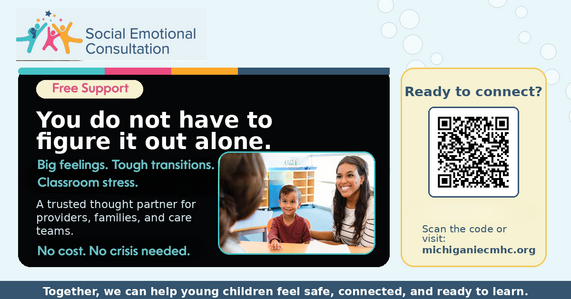
Free support for big feelings, tough transitions, and classroom stress.
Michigan Social Emotional Consultation helps child care providers, GSRP programs, families, and care teams build practical strategies that support children at home, in child care, and in early learning settings.
No cost. No crisis needed. No licensing impact.
Visit Social Emotional Consultation for Early Care and Education to learn more.
Hello Michigan 0-5 Early Childhood Providers and Partners,
What’s helping you support young children’s social-emotional well-being—and what would make that work easier? We want to hear from you!
Deadline extended to Friday, October 30, 2026
Nearly 400 people across Michigan have shared their perspectives. Thank you! We’re extending the deadline to October 30 to make room for more voices, including yours.
Your experience will help shape recommendations for strengthening support for young children and the adults who care for them. The survey takes about 10–15 minutes, and you’ll only see questions relevant to your role.
As a thank-you, participants may enter a raffle for a chance to win one of ten $15 Biggby Coffee gift cards.
Share your perspective and take the survey by clicking the button below, or go to michiganiecmhc.org/surveys

October 9, 2026
Michigan receives largest of three competitive Basic Need grants under FIPSE to support implementation of recommendations from MiLEAP College Student Basic Needs Task Force
LANSING, Mich. — The Michigan Department of Lifelong Education, Advancement, and Potential (MiLEAP) has been awarded nearly $5 million through the U.S. Department of Education’s Basic Needs for Postsecondary Students Program to advance efforts to address basic needs barriers facing Michigan students.
“Every Michigan student deserves the chance to build a bright future,” said Gov. Gretchen Whitmer. “Today’s announcement continues our work to lower the cost of higher education and make it easier for students to pursue a postsecondary degree. This investment prepares Michiganders for thriving careers and gets us closer to our state’s Sixty by 30 goal. Let’s keep working together to help every student succeed.”
Michigan’s award was the largest of just three grants selected in Fiscal Year 2026 through a highly competitive national process, under the $9.9 million Basic Needs for Postsecondary Students Program, which is part of the federal government’s Fund for the Improvement of Postsecondary Education (FIPSE).
The four-year grant will support implementation of recommendations from Michigan’s College Student Basic Needs Task Force, with a focus on helping students connect with existing resources and strengthening the capacity of institutions to identify and respond to basic needs.
“When students are struggling to meet their basic needs, it can be difficult to stay focused on completing a degree or credential,” said Dr. Beverly Walker-Griffea, executive director of MiLEAP. “This investment gives Michigan an important opportunity to move from recommendations to implementation. We’re proud to bring resources to Michigan that will help create conditions that allow more students to succeed and reach their educational goals.”
The Basic Needs Task Force was launched in 2024 to identify ways to reduce basic needs insecurity as a barrier to postsecondary success. With support from The Hope Center for Student Basic Needs, the Task Force developed its 2025 report, which included recommendations for addressing these barriers and an analysis of the challenges facing Michigan students.
Among other data, the report found that 20% of Michigan undergraduates experienced low or very low food security, while 44% of Michigan community college students surveyed reported experiencing housing insecurity during the previous 12 months.
A survey of 9,420 Michigan Reconnect applicants found that 31% reported housing insecurity, 31% reported food insecurity, 32% reported caring for children and 40% reported mental or physical health challenges.
“Michigan’s students are the future of our state’s workforce and economy, and we must make sure they have the support they need to complete their education and build successful careers,” said Sen. Gary Peters (D-MI). “This federal investment will help more students succeed, strengthen Michigan’s workforce, and create more opportunities for good-paying jobs here at home.”
Research cited by the Task Force also found that, among students experiencing basic needs insecurity who did not access campus resources, 74% said they did not know the resources existed, whether they were eligible, or how to access them.
These findings point to an opportunity for institutions to strengthen how they identify students who may need support and connect them with resources already available on campus and in their communities.
“We’ve heard from colleges and universities across Michigan that strengthening how they support students’ basic needs is a priority,” said Sarah Szurpicki, deputy director overseeing MiLEAP’s Office of Higher Education “This investment creates an opportunity to bring that work together across the state, coordinate efforts, share resources and strategies, and build on what’s already working.”
To advance these efforts, the federal grant will support three primary areas:
-
Campus navigation and basic-needs hubs: Supporting participating institutions in proactive outreach, individualized navigation, resource connections, application and renewal assistance, and follow-up.
-
State benefit pathways: Strengthening processes and partnerships that can help eligible students access and maintain benefits, including Medicaid and SNAP.
-
Professional development and institutional capacity: Providing training, coaching and other support to help institutions strengthen basic-needs practices and build connections across campus and community partners.
The project will also establish shared data, reporting, and evaluation practices to help MiLEAP and participating institutions better understand student needs, assess implementation and identify practices that can be sustained and expanded.
“We commend Michigan for listening to students, bringing together key constituents, prioritizing research and data, and taking demonstrable action that will improve basic needs security and lead to more degrees for Michiganders,” said Dr. Sara Abelson, assistant professor and senior director of education and training at The Hope Center for Student Basic Needs.
The grant builds on Michigan’s continued efforts to increase postsecondary attainment and advance the state’s Sixty by 30 goal of having 60% of working-age adults earn a skill certificate or degree by 2030.
Learn more about Michigan’s basic needs work and access resources by visiting MiLEAP’s Basic Needs Resource Hub.
Please review the following recalls and safety warnings. For a full list of recalls and product safety warnings visit Recalls & Product Safety Warnings | CPSC.gov
You can also watch the CPSC Recall Roundups on YouTube by clicking the button below.
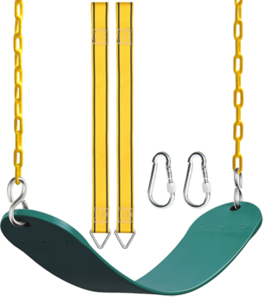
Pacearth Direct Recalls PACEARTH Swing Seats Due to Risk of Serious Injury from Fall Hazard | CPSC.gov
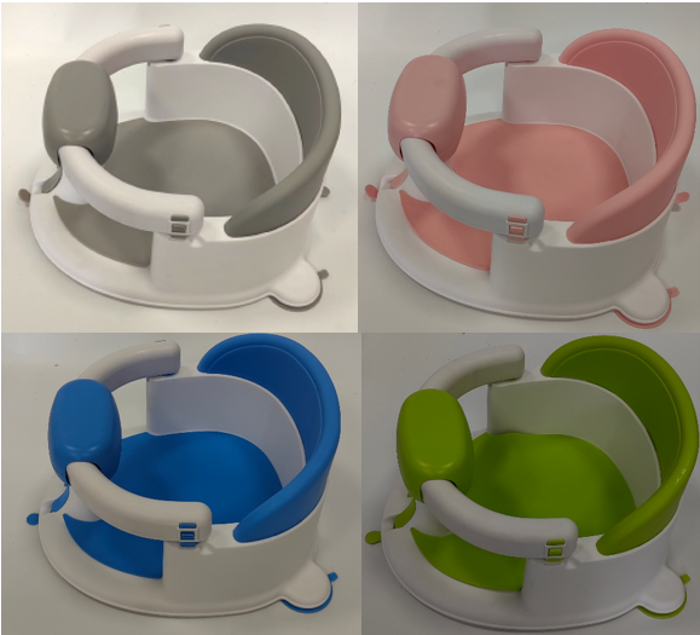
ONTHEWEI Recalls Baby Bath Seats Due to Risk of Serious Injury or Death to Children from Drowning; Violate Mandatory Standard for Infant Bath Seats | CPSC.gov
The Conqueror Recalls Avengers Medals Due to Risk of Serious Injury or Death from Magnet Ingestion; Violate Mandatory Standard for Magnets | CPSC.gov
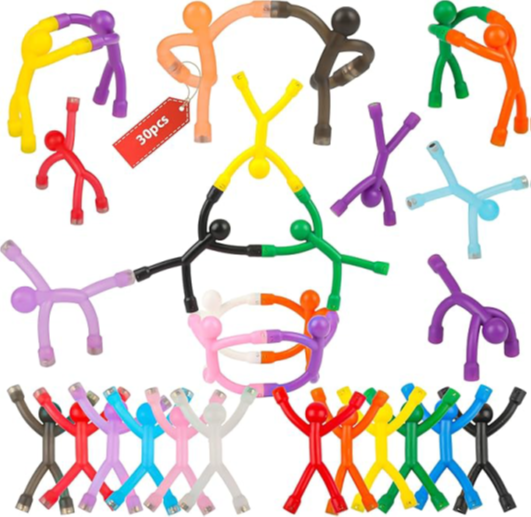
GBYMIUY Recalls Magnetic Stick Figure Toy Sets Due to Risk of Serious Injury or Death from Magnet Ingestion; Violate Mandatory Standard for Toys | CPSC.gov
LLK Trading Recalls Mochi Malrang Mystery Dumpling Toys Due to Risk of Serious Injury or Death from Water Bead Ingestion; Violate Mandatory Standard for Toys | CPSC.gov
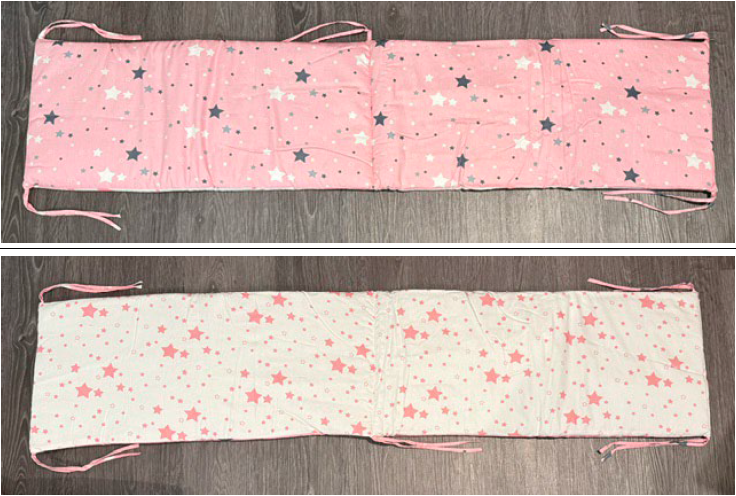
CPSC Warns Consumers to Stop Using Mbabyjon Crib Bumpers Immediately Due to Risk of Serious Injury or Death from Suffocation Hazard; Violate Federal Ban on Crib Bumpers | CPSC.gov
|