Friday, July 31, 2026
Table of Contents
- New Child Care Home Rules Training Updates and Reminders
- August Child Care Licensing Regional Office Hours
- BFS Plan Review Office Hours
- CCLB Forms Update Project
- Michigan Care Improvement Registry (MCIR) Updates and Reminders
- July Nurturing Note
- Upcoming Webinar: Using a Framework of Administrative Burden to Understand Child Care Provider Engagement in the Child Care Development Fund (CCDF) in Three States
- PRESS RELEASE: New Training Will Help Early Childhood Educators Recognize Early Signs of Dyslexia and Strengthen Literacy Foundations
- PRESS RELEASE: $135 Million Available to Expand Before-School, After-School, and Summer Learning Across Michigan
Our training sessions for the New Child Care Rules for Group and Family Homes are continuing throughout the month of August. You can find the remainder of our in-person and virtual trainings on our Licensed Child Care Provider Training page.
Additionally, our self-paced training course is accessible through the Michigan Association for the Education of Young Children's (MiAEYC) Knowledge Center. To register for this training and access it, please log in to your existing MiAEYC account, or create a user account in the MiAEYC Knowledge Center. This is a free account that allows you to access training and resources from the MiAEYC Knowledge Center. New Home Rules Self-Paced Training
The following upcoming sessions currently have low enrollment. If a session is still not full two days before the training, it will be cancelled and any registered participants will be notified.
| In-person Sessions with Low Enrollment |
|
Region
|
Location
|
Date and Time
|
Registration Link
|
|
Northeast and UP
|
Pregnancy Services of Delta County
2501 1st Ave N, Escanaba, MI 49829
|
8/8/26
10 am-12 pm
|
Register Here
|
|
Pontiac
|
United Community Family Services CALA Building
2033 Austin Dr., Troy, MI 48083
|
08/12/26
6:00 – 8:00 pm
|
*Includes Arabic Interpretation
Register Here
|
|
Southcentral
|
Caterpillar Corner
2168 Cedar St, Holt, MI 48842
|
8/6/26
6:30-8:30 pm
|
Register Here
|
|
Wayne
|
Wayne RESA
33500 Van Born Rd, Wayne, MI 48184
|
8/5/26
6-8 pm
|
Register Here
|
Have Questions? Need Answers? Don't Miss Our Office Hours!
Please join us for the CCLB Regional Office Hours hosted by the CCLB area managers! This is an opportunity to stay informed, connected, and engaged within your child care licensing region. Whether you're a seasoned provider or just starting out, these sessions are a great opportunity for conversation and connection.
Please see the coverage map below to ensure you attend the correct office hours for your county.
Child Care Coverage Map
Don't miss out on this opportunity to connect, learn, and thrive within your child care community. We look forward to seeing you there!
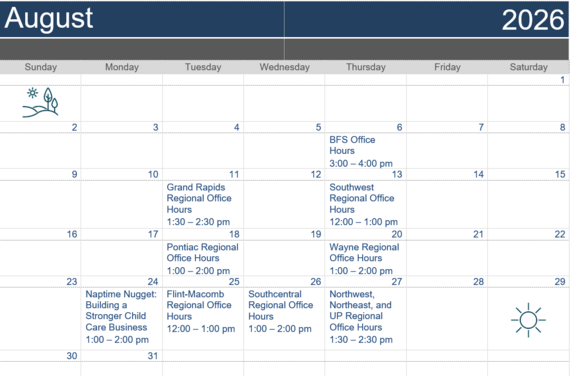
Upcoming Office Hours:
Grand Rapids Region with Katrice Sweet
Tuesday, August 11th, 1:30 p.m. to 2:30 p.m.
Zoom Registration Link - Grand Rapids Region
Southwest Region with Charnell Lennox
Thursday, August 13th, 12:00 p.m. to 1:00 p.m.
Zoom Registration Link - Southwest Region
Pontiac Region with Jackie Sharkey
Tuesday, August 18th, 1:00 p.m. to 2:00 p.m.
Zoom Registration Link - Pontiac Region
Wayne Region with Paris Howard
Thursday, August 20th, 1:00 p.m. to 2:00 p.m.
Zoom Registration Link - Wayne Region
Flint-Macomb Region with Crecendra Boone
Tuesday, August 25th, 12:00 p.m. to 1:00 p.m.
Zoom Registration Link - Flint-Macomb Region
Southcentral Region with Darlese McConnell
Wednesday, August 26th, 1:00 p.m. to 2:00 p.m.
Zoom Registration Link - Southcentral Region
Northwest & Northeast and UP Regions with Candice Case-French & Erin Kidd
Thursday, August 27th, 1:30 p.m. to 2:30 p.m.
Zoom Registration Link - Northwest and Northeast Regions
Child Care Licensing has partnered with the Licensing and Regulatory Affairs Bureau of Fire Services plan review division to offer monthly office hours. This is an opportunity to stay informed, connected, and ask questions surrounding plan reviews.
Office Hours with BFS and CCLB
Click here to register or join the below office hours.
Thursday, August 6, 2026, 3-4pm
Thursday, September 3, 2026, 3-4pm
Thursday, October 1, 2026, 3-4pm
The Child Care Licensing Bureau (CCLB) is updating forms to align with Michigan's new child care licensing rules for child care homes and centers. Updated forms will be released on an ongoing basis and posted to the CCLB Forms webpage as they become available.
In addition to incorporating the new licensing rules, all CCLB forms are being updated to improve accessibility for individuals with disabilities. These updates are designed to meet the State of Michigan's digital accessibility requirements, which are based on the Americans with Disabilities Act (ADA) and the Web Content Accessibility Guidelines (WCAG). Accessible forms help ensure that all individuals have equal access to CCLB information and services.
What's Changing?
When a form is revised, the bottom of the form will indicate whether previous versions may continue to be used or if they have become obsolete.
-
Obsolete forms: If a form is marked obsolete, you must replace it with the current version within one year of the latest revision date.
-
Previous versions allowed: If a form indicates that previous versions may continue to be used, you may continue using existing printed copies. However, CCLB strongly encourages providers to transition to the newest version to ensure they are using the most accessible and up-to-date forms.
Learn More
Visit the CCLB Forms webpage regularly to access the latest forms and updates.
For more information about digital accessibility, visit:
-
ADA.gov –
-
Web Content Accessibility Guidelines (WCAG) –
Thank you for partnering with CCLB to ensure child care licensing forms remain current, accessible, and easy for everyone to use.
The transition to MCIR powered by STC|ONE will occur on August 10, 2026. To prepare, school and child care users may begin self-registering for the Learning Management System (LMS) and accessing required training as of July 27, 2026.
This is a reminder that the Michigan Department of Health and Human Services (MDHHS) Division of Immunization has moved to a paperless process and nonmedical immunization exemptions are now housed in the Michigan Care Improvement Registry (MCIR).
-
Electronic Submission: Parents no longer need to submit a paper copy of the nonmedical immunization exemption to the child care center as they are recorded electronically.
-
Access via MCIR: If the child care center is attached to the child’s record in MCIR, center staff can click on “status” and see that there is a PDF (electronic copy) of the exemption.
-
No Printing or Signing Required: The exemption in MCIR does not need to be printed off or signed. The exemption recorded and stored in MCIR is complete and meets compliance.
-
Paper Submissions: Remember that during operational hours, staff need to be able to access the records in MCIR onsite. If staff do not have access to MCIR onsite, a printed copy should be saved in the child’s file.
For Child Care Centers without Computer Access to MCIR:
If a child care center does not have access to a computer and is not associated to MCIR, it will be the parent’s responsibility to obtain a paper copy of the nonmedical immunization exemption from the local health department issuing the waiver and deliver it to the child care provider. If you are a site that does not have computer access to MCIR, please be sure to talk to your parents about this.
This applies only to nonmedical immunization exemptions. The Medical Exemption Form is still available only in paper format.
Summer is Here! Let's Head Outside!
Michigan summers offer more than just sunshine. Summer also provides opportunities for young children to learn, grow, and support healthy development through outdoor play. Whether it's digging in the dirt, blowing bubbles, or collecting rocks, time outside supports children's social-emotional development in meaningful ways.
Outdoor play helps young children:
- Build confidence by trying new challenges.
- Practice problem-solving, creativity, and flexible thinking.
- Develop self-regulation through movement and sensory experiences.
- Strengthen friendships through cooperative play.
- Reduce stress and improve mood by connecting with nature.
You don't need elaborate equipment or planned activities to make a difference. Sometimes the best learning happens when young children are given the time, space, and freedom to explore.
Here are a few resources to spark ideas for outdoor play:
Rocking and Rolling. Fresh Air, Fun, and Exploration: Why Outdoor Play Is Essential For Healthy Development
Outdoor Play and Safety for Children in ECE
Some of the best learning happens outside. Giving young children time to explore nature, move their bodies, and follow their curiosity helps support healthy development while making summer memories.
Ashley McCormick, LMSW, IECMH-E®
Infant and Early Childhood Mental Health Consultant
To learn more about Infant and Early Childhood Mental Health Consultation and resources for Child Care Providers, click HERE

On August 18, from 11:00 a.m. to 12:30 p.m. Eastern Time, research teams from Yale University, Public Policy Associates, and the University of Chicago will host a free webinar entitled, Using a Framework of Administrative Burden to Understand Child Care Provider Engagement in the Child Care Development Fund (CCDF) in Three States. Nathan Burroughs (American Institutes for Research) will provide overarching commentary before moderating a group discussion.
At the webinar, the panelists will discuss findings from their studies of child care assistance programs in Connecticut, Michigan, and Illinois. They will share insights into child care providers’ experiences of administrative burden, including how administrative burden affects program participation and how policy changes affect administrative burden.
-
Provider Experiences of Administrative Burden: Learning from Connecticut Family Child Care and Center-Based Care Providers (Presenter: Joanna Meyer, Yale University)
-
Understanding Provider Burden: How Policy Changes Affect Learning, Compliance, and Psychological Costs (Presenter: Rebecca Frausel, Public Policy Associates)
-
Administrative Burden as a Predictor of Future Engagement with State Programs: Lessons from Illinois’s Workforce Grant (Presenter: Rose Geoghegan, The University of Chicago)
These studies are funded by the Administration for Children and Families, Office of Planning, Research, and Evaluation.
To register, please click this link or visit this web page: https://us02web.zoom.us/webinar/register/WN_PUbbtfkARkOoapkpfoku-g#/registration.
LANSING, Mich. – A new two-day professional development training is being offered in Michigan to equip early childhood educators with practical, research-based strategies to identify early warning signs of dyslexia and support the development of the foundational language and literacy skills children need to become successful readers.
The Michigan Department of Lifelong Education, Advancement, and Potential (MiLEAP) and the Michigan Dyslexia Institute (MDI) are partnering to offer the training, Dyslexia Starts Early: Building Strong Language and Literacy Foundations for Future Readers; A Michigan Dyslexia Institute/Orton-Gillingham Approach, across three locations this summer. The training supports Governor Gretchen Whitmer's Every Child Reads initiative by strengthening educator knowledge of the Science of Reading, increasing awareness of dyslexia, and providing research-based instructional practices that benefit all learners before they enter kindergarten.
"Many of the early signs of dyslexia appear before children begin formal reading instruction. That’s why it’s so important that educators have the knowledge and tools to recognize those indicators and support children who may be at risk for reading difficulties," said Dr. Beverly Walker-Griffea, executive director of MiLEAP. "Strengthening our early childhood workforce is one of the most meaningful ways we can improve early literacy across Michigan. This training is another step in advancing Governor Whitmer's Every Child Reads initiative and ensuring more children develop a strong foundation in language and literacy that prepares them for success in kindergarten and beyond.”
The training is grounded in the Science of Reading and incorporates research-based Orton-Gillingham (OG) principles, providing early childhood educators with practical classroom strategies to strengthen oral language, phonological awareness, executive functioning and emergent literacy while helping them recognize characteristics associated with dyslexia. Participants will also learn how to use assessment information to inform instruction and communicate with families about children's language and literacy development.
An estimated one in five people has dyslexia, making it one of the most common causes of reading difficulties. Dyslexia accounts for approximately 80% to 90% of learning disabilities related to reading. Research shows that children who demonstrate multiple early risk indicators in early childhood and the early elementary years are significantly more likely to experience later reading difficulties, underscoring the importance of early awareness and intervention.
"At Michigan Dyslexia Institute, we believe one of the most powerful ways to support children with dyslexia is to start before they fail," said Marsha Chance, executive director and CEO of the Michigan Dyslexia Institute. "Early childhood educators play a critical role in building the language and literacy foundations that all children need while recognizing early signs that a child may be at risk. When educators have the knowledge and tools to provide intentional, research-based instruction and respond to concerns early, they have the opportunity to strengthen literacy outcomes for all children and change the trajectory for those at risk of reading difficulties."
"Strong literacy starts with strong early learning experiences," said Emily Laidlaw, MiLEAP deputy director overseeing the Office of Early Education. "When early childhood educators understand how language and early literacy skills develop, they are better equipped to recognize when a child may need additional support and to provide instruction that helps every child build the foundation for future reading success. This training reflects MiLEAP's commitment to ensuring educators have access to high-quality professional learning that benefits children across Michigan."
The training is the first professional development opportunity offered by MDI specifically for early childhood educators and is designed to complement, not replace, existing classroom practices.
"Educators should expect an engaging, hands-on experience with activities they can immediately incorporate into their classrooms," said Sue Angell, OG implementation coordinator, and instructor with the Michigan Dyslexia Institute who will be co-leading the training. "The training isn't about adding more to teachers' plates. It's about strengthening the excellent work they already do by providing practical tools that support language development and early literacy for all children."
"We're not teaching educators to diagnose dyslexia," said Marlene Tebben, OG instruction advisor and instructor for the Michigan Dyslexia Institute who will be co-leading the training. "We're helping them recognize early indicators, understand how children learn to read and adjust instruction using research-based practices, so every child has the strongest possible foundation for future reading success."
The two-day training will be offered at the following dates and locations:
- Aug. 11-12 at Genesee Intermediate School District (ISD)
- Aug. 25-26 at Oakland Schools
- Sept. 1-2 at Bay-Arenac ISD
Each session will serve up to 30 early childhood educators and is funded through Michigan's Preschool Development Grant Birth-Five (PDG B-5) Renewal, awarded by the U.S. Department of Health and Human Services, Administration for Children and Families. Because space is limited and participation criteria apply, host ISDs are conducting targeted outreach to eligible early childhood educators.
To learn more about MiLEAP's efforts to strengthen early learning and support Governor Whitmer's Every Child Reads initiative, including resources for early childhood educators and families, visit Michigan.gov/MiLEAP.
Eligible organizations encouraged to attend statewide information sessions before applying for the 2026-27 Out-of-School Time Grant Program
On July 21, 2026, Michigan Public Act (P.A.) 25 of 2026, Section 32n was signed into law with $135 million budgeted to provide in-person before-school, after-school, before-and-after-school, or during the summer programming to children in grades K-12. The new legislation defines the eligible applicants, the type of programming, and the priorities that the Michigan Department of Lifelong Education, Advancement, and Potential (MiLEAP) must use in a competitive grant process to award the funds across the state.
Learn more by reading the full announcement below.
Learn more detailed information about the 2026-2027 Out-of-School Time Grant below.
Find more information about eligibility, submitting an intent to apply, and how to register for a webinar or attend an information session on the Out-of-School Time Grants webpage.
Questions regarding this grant announcement may be emailed to MiLEAP-OST@Michigan.gov.
|