PlanetM Mobility Report

  Having trouble viewing this email? View it as a Web page.

Planet M Header

PlanetM Announces Round Three Mobility Grant Recipients

Gov. Gretchen Whitmer

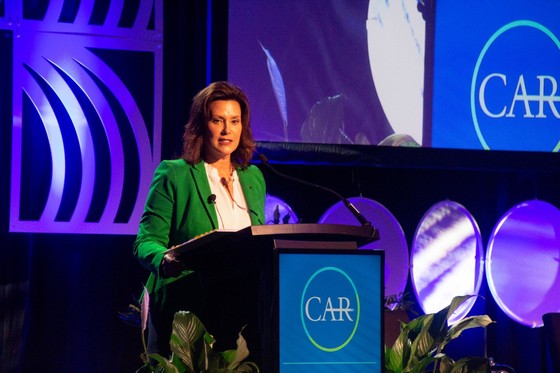
Gov. Gretchen Whitmer at the CAR Management Briefing Seminars in Traverse City.

Governor Gretchen Whitmer announced the latest recipients of the PlanetM Mobility Grants during her remarks at the Center for Automotive Research’s Management Briefing Seminars in Traverse City Wednesday.

The latest recipients – Aerotronic, Aktv8, Aveopt, GoKid, Intvo and Propelmee – will deploy pilot projects throughout Michigan that address some of today’s toughest mobility challenges, including traffic congestion as well as pedestrian and roadway safety.

Also announced – the mobility industry now gains access to airspace at the Smithers Winter Test Center and Proving Grounds in Michigan’s Upper Peninsula through PlanetM’s newest testing partner – the Michigan Unmanned Aerial Systems Consortium (MUASC). The addition of this facility expands testing opportunities from roadways to airspace, opening the door for possibilities including the development of a new class of emerging technologies and advancements.

The next pilot grant application deadline is October 1, 2019.To apply or learn more, visit planet.com/grants.

City of Detroit and GM Partner to Launch CAR4YOU Pilot in Detroit Neighborhood

Project Kinetic launched its first of several mobility pilots this week. Led by the City of Detroit, General Motors and Matrix, Car4You is a revolutionary car-sharing program that provides low-cost vehicles accessible by the hour in Detroit’s Osborne neighborhood.

Project Kinetic


Project Kinetic is a collaboration, formed in January 2018 between the city, private, and philanthropic sectors. Representatives from each of the partnering organizations worked together for 12 weeks to brainstorm more than 120 innovative solutions to tackle some of the most pressing mobility challenges facing Detroit.

May Mobility Brings Autonomous Shuttles to Consumers on the Streets of Grand Rapids

AVGR May Mobility Shuttle


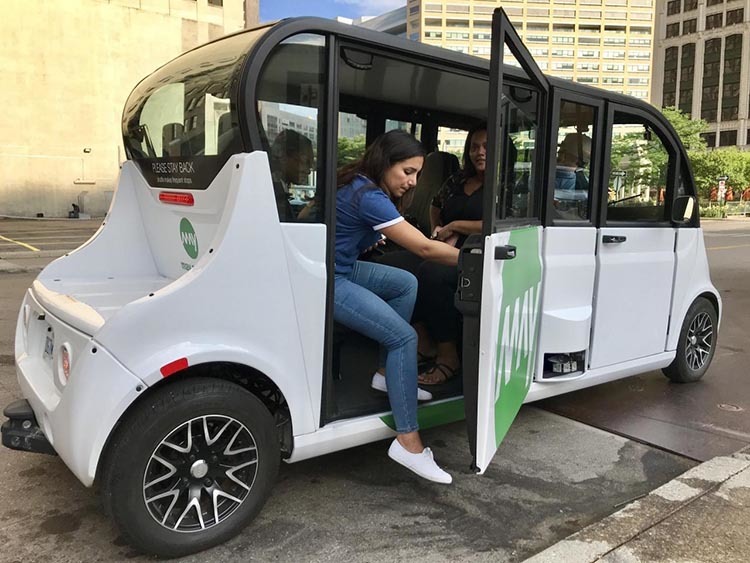
Nine Michigan companies, as well as the city of Grand Rapids and the state of Michigan, formed a unique coalition, the Grand Rapids Autonomous Vehicle Initiative placing four May Mobility electric, autonomous vehicle shuttles on city streets for a year-long pilot project to prove civic infrastructure and operational capabilities of the rapidly growing AV market.

May Mobility’s Grand Rapids fleet, the largest of its kind, is open to the public through July 2020 at no cost, and runs on a 3.2-mile Downtown Area Shuttle (DASH) West bus route which consists of 22 stops, 30 traffic lights and 12 turns.  

“Ensuring that inclusive and accessible transportation operations exist for people in communities, including Grand Rapids, remains a vital priority for PlanetM, and it starts with identifying solutions to today’s most crucial mobility challenges,” said Trevor Pawl, Senior Vice President of Business Innovation at the Michigan Economic Development Corporation (MEDC). “Through this exciting collaboration with May Mobility, AVGR combines Michigan’s opportunistic approach to the advancement of new mobility technology with our commitment to improving the quality of life for individuals, by directly engaging with those most impacted in the community.”

PlanetM Landing Zone Member Spotlight: Airspace Experience Technologies

ASX logo

Dr. Anita Sengupta, co-founder and chief product officer at Detroit’s Airspace Experience Technologies (ASX) recently attended Uber’s Elevate summit in Washington, D.C., touting the company’s unique approach to making electric vertical take-off and landing (VTOL) craft a working, commercially viable reality while highlighting the transformative mobility work taking place here in Michigan.

Dr. Sengupta showcased ASX’s eVTOL tilt-wing design with benefits like speed to market and compatibility with existing regulatory and pilot licensing frameworks. This design could lead to ASX providing cargo transport service relatively quickly for paying customers, with passenger travel to follow once regulators and the public get comfortable with the concept.


Welcome Ibeo!

Ibeo Automotive Systems, a LiDAR sensor specialist from Hamburg, Germany, recently became the newest member of the PlanetM Landing Zone in Detroit.

This new location allows Ibeo to cater to the growing demand for LiDAR technology in the U.S. and expand its business segment into one of the most important markets for autonomous driving.


Collaboration is Key in the New Age of Mobility

The Detroit Moves panel in July focused on designing mobility for urban transit, and served as a preview to what the event will look like when part of the North American International Auto Show beginning in 2020. The diverse panel of public, private and academics included: Kevin Mull, director of connected mobility solutions at Bosch Global, Jessica Robinson, executive director of the Michigan Mobility Institute, Scott Benson, Detroit city councilman for the 3rd district, and Maria LaLonde, senior program offer of the New Economy Initiative. The group was able to tackle mobility from their respective industries, and discuss how they will collaborate as the mobility realm shifts and develops.

Detroit Moves Panel


Michigan also welcomed Australian delegates to the state in July for an inside scoop on the mobility scene in metro Detroit and Ann Arbor. A tour of the PlanetM landing zone, NAVYA, Project Kinetic, Mcity, ACM and more, was a result of an MOU signed between Michigan and Australia last year and allowed for the key decision makers in the group to see Michigan’s mobility ecosystem first hand. The tour also highlighted opportunities for collaboration with regards to technology, infrastructure and regulatory policies on a global scale.  

You're Invited: Mobility and the New Urban Ecosystem

Join us August 21 for a series of Automotive News Shift panel discussions at the Industry Innovation Center at Wayne State University. 

Shift-logo-350


The industry’s top mobility executives will address topics such as the importance of public-private partnerships; talent and resources necessary to define, develop, research, plan and build tomorrow’s smart and socially-equitable cities; and the challenges every major city will face in embracing the future of mobility.his placeholder text.

To request a seat at this free event, register here.


Heading to AutoMobility LA?

AutoMobility LA

Organizers of the LA Auto Show® and AutoMobility LA™ recently announced MEDC’s PlanetM will be a presenter of its 2019 Top Ten Automotive Startup Competition. The competition recognizes technologies with the most potential to positively impact society and change how mobility is perceived and experienced.

The newly-formed sponsorship between AutoMobility LA™ and PlanetM reflects the strong cross-country collaboration between California and Michigan’s technology and automotive hubs, an important connection in today’s growing mobility realm.

Startups focused on automation, connectivity, mobility as a service, clean/sustainable mobility, advanced material and manufacturing are encouraged to apply by September 27.

Upcoming Events

In the News

A new kind of mobility startup: the talent agency

Read the latest from Trevor Pawl, Senior Vice President, Business Innovation at MEDC.

U.S. Congress seeks to jump start stalled self-driving car bill

Two key committees in the U.S. Congress said they will revive efforts to pass long-stalled legislation to speed the adoption of self-driving cars. The House Energy and Commerce Committee and Senate Commerce Committee sent automakers, safety groups and others interested in the bill a request for input and said they were working on a “bipartisan and bicameral basis to develop a self-driving car bill.”

How Lightweight Robots Can Help Solve The Autonomous Last-Mile Delivery Service Problem Solving the last-mile delivery problem is essential for the growth of on-demand services. In an interview, Matthew Johnson-Roberson, CEO and co-founder of Refraction, shared how low-cost and lightweight robots can help. Refraction creates robotic platforms that focus on last-mile goods delivery in urban areas. Its REV-1 is a lightweight and low-power autonomous delivery robot that meets e-bike regulations. The robot can use bike lanes, but it is still fast and nimble enough to operate in traditional car lanes and move through the world without impeding traffic.

Lyft opens to the public autonomous driving data set from its Level 5 self-driving fleet

Lyft is offering the public a set of autonomous driving data that it calls the “largest public data set of its kind,” containing over 55,000 3D frames of captured footage hand-labeled by human reviewers, data collected by seven cameras and as many as three lidars depending on the car used, plus a drivable surface map and HD spatial semantic data that corresponds to the captured info to provide context to researchers.

BMW and Tencent will launch a computing center to support autonomous vehicle development

BMW and Chinese tech giant Tencent will launch a computing center to support autonomous vehicle (AV) development in China by the end of the year, according to Reuters. The data center will store and process data from semi-autonomous and autonomous driving simulations and road tests in the country.

Toyota to invest $600 million in China’s Didi and a new joint venture

Toyota Motor said it will invest $600 million in Chinese ride-hailing giant Didi Chuxing and a new joint venture to expand collaboration with the firm in China. The move accelerates a trend in China which has seen automakers launch their ride-hailing services, and ride-hailing firms such as Didi team with automakers to develop purpose-built cars for their services.

Consumer Confidence In Self-Driving And Electric Vehicles Needs Some Work

A new survey by J.D. Power and SurveyMonkey found that consumer confidence in both electronic vehicles (EVs) and autonomous vehicles (AVs) is not where proponents would like it to be. Specifically, the general population has a "low level of confidence" for AVs and a "neutral level of confidence" for EVs, according to the survey results.

The results come from the inaugural J.D. Power 2019 Mobility Confidence Index Study, which the company plans to conduct every quarter moving forward as a way gauge mainstream consumer interest in AV and EV technologies over time.

Waymo uses evolutionary competition to improve its self-driving cars

Waymo has partnered with DeepMind on a "Population Based Training" method for pedestrian detection that has the best neural networks advance much like lifeforms do in natural selection, saving time and effort. The approach regularly has the networks compete against each other, with weaker examples being replaced by stronger "progeny" that are copies of the better-performing networks with slightly tweaked parameters. This automatically gets rid of the poorer-performing networks while saving Waymo from having to retrain networks from scratch.

Ford bought a robotics company to boost its self-driving cars Back in April, Ford chief Jim Hackett admitted that the company overestimated the arrival of self-driving cars. He added that the applications of Ford's first autonomous fleet will likely be narrow, "because the problem is so complex." Now, the automaker has acquired a Michigan-based company called Quantum Signal to help it solve those problems and advance its goal of launching a self-driving vehicle business. Quantum Signal may not be a household name, but it played an important role in helping the US military develop software that can control its robotics vehicles from thousands of miles away.


Reach out to our PlanetM team at PlanetM.com to connect to the people, places and resources dedicated to the evolution of transportation mobility.

planetm-footer