 |
Michigan DOT Toward Zero Deaths (TZD) February 5, 2019
Michigan DOT sent this bulletin at 02/06/2019 09:39 AM EST
|
Having trouble viewing this email? View it as a Web page.
|

February 5, 2019 – 14 people died on Michigan roadways since last week making a total of 80 this year. In addition, 82 more were seriously injured for a statewide total of 321 to date.
Compared to last year at this time there are 14 more fatalities and 16 fewer serious injuries.
Safety Focus Area: Roadway Departure Crashes
Contact: Tara McLoughlin at: tara.mcloughlin@dot.gov U.S. Federal Highway Administration
February 1, 2019
EDC5 AIMS TO BAT ONE OUT OF THE PARK WITH FOCUS ON RURAL ROAD SAFETY
By: Cate Satterfield, FHWA Office of Safety, Co-Lead for EDC-5 Reducing Rural Roadway Departures
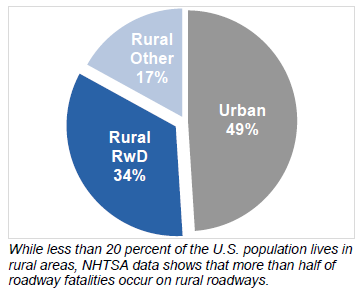
While less than 20 percent of the U.S. population lives in rural areas, NHTSA data shows that more than half of roadway fatalities occur on rural roads.1 Further, fully two-thirds of these rural fatalities involved a roadway departure (RwD), where a vehicle crosses a center line, an edge line, or otherwise leaves its travel lane. This means that not only are deaths on rural roadways severely overrepresented, so are fatalities and serious injuries related to RwD crashes—quite a curveball!
To address this considerable safety issue on the Nation’s rural road systems, FHWA has selected “Reducing Rural Roadway Departures” as 1 of the 10 innovations that are the focus of round 5 (20192020) of the Every Day Counts (EDC-5) initiative.
“We want States, locals, Tribes, and Federal agencies to consider that they can do more, and we want to show them how a data-driven systemic approach can help them proactively reduce the risk of future crashes,” said Karen Scurry, FHWA Office of Safety HSIP Program Manager and a core member of the team for this EDC effort.
“When a batter comes up to the plate, he puts on a batter’s helmet,” said Dick Albin, the FHWA Resource Center Co-Leader for the EDC effort, who turned to a baseball analogy to emphasize the importance of factoring the element of risk when addressing safety. “That batter may have never been hit with a pitch, but he knows this is a high-risk location—he’s facing a baseball traveling nearly 100 mph—and there is potential for life changing consequences, so he takes this precaution of wearing a helmet. Similarly, the systemic approach to safety looks for high-risk locations where countermeasures can be applied to reduce the potential risk of a crash.”
The Systemic Approach to Roadway Departures
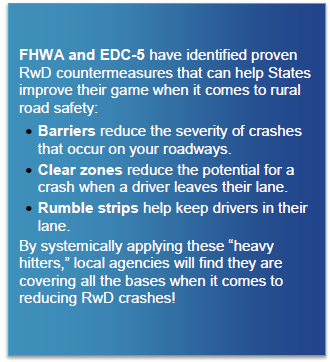
Agencies can use a variety of tools to analyze and prioritize the locations and countermeasures that will be most effective in keeping vehicles in their travel lanes, reducing the potential for crashes when vehicles do leave the roadway, and minimizing the severity of those crashes that do occur. The systemic or risk-based approach identifies treatment locations based on a set of common risk factors rather than solely based on crash data. This is an important consideration since many rural roadways have lower average daily traffic rates than urban areas do, and crash data do not always indicate concentrations of RwD crashes. Further, agencies can develop safety action plans for addressing high-risk locations systemically even if they have limited data. By addressing locations with high risk rather than all roads, the limited funds available can be used most effectively.
From October-November 2018, FHWA conducted a series of five regional EDC summits where innovation champions from around the country came to learn about deploying innovations; exchange ideas with their State, local, and industry counterparts; and provide feedback to FHWA on the support and resources needed to adopt the innovations.
Beginning in 2019, FHWA will begin working to provide training, technical assistance, and resources to assist agencies with their rural roadway departure strategies. In many cases that will probably begin with developing Rural Road Safety Action Plans that are in sync with the State’s Strategic Highway Safety Plan (SHSP). Many Tribes and some counties already have plans in place and are reaping the safety benefits as a result. These plans often provide the justification that makes it easier to access available funding. For instance, Highway Safety Improvement Program (HSIP) funds are available for use on all public roads. Minnesota and Washington are two States that have set the bar high, proportionally allocating HSIP funds to the types of agencies that are facing high rates of severe crashes, rather than using them exclusively on the State system. Training will also be available on how to conduct a systemic safety analysis using the data and information that agencies have available, even if it is limited. Other outreach efforts will focus on the correct installation of low-cost countermeasures such as chevrons on curves. Train-the-trainer courses and resource packages will focus on ways to involve champions with better connections to these agencies, such as Local and Tribal Technical Assistance Programs (LTAP/TTAP).
“Our goal is for agencies to make informed decisions about when and where to apply countermeasures, sort of like lining up the right pinch hitter,” Satterfield joked. “But in all seriousness, our goal is to help agencies reduce roadway departure fatalities and injuries on rural roads. The NHTSA’s Fatal Analysis Reporting System (FARS) indicates that nearly 12,000 people annually drive onto a rural roadway but don’t make it home because they are killed in a roadway departure crash. Everybody can do more, and sometimes the way we can do that is by making more effective use of the data and resources we’ve got.”
Interested in learning more or getting started using the EDC5 “Reducing Rural Roadway Departures” innovation? Please contact your FHWA Division Office Safety Specialist today!
1 NHTSA, “Traffic Safety Facts – 2016 Data – Rural/Urban Comparison of Traffic Fatalities.” DOT HS 812 521, April 2016. Available at: https://crashstats.nhtsa.dot.gov/Api/Public/ViewPublication/812 521