Civil War exhibit 'Conceived in Liberty' opens Oct. 11 at Michigan Historical Museum
Michigan Department of Natural Resources sent this bulletin at 10/07/2014 12:03 PM EDTExhibit draws its themes from President Lincoln's Gettysburg Address.
Having trouble viewing this email? View it as a Web page.

FOR IMMEDIATE RELEASE
Oct. 7, 2014
Contact: Sandra Clark, 517-373-6362 or Ed Golder, 517-284-5815
Special exhibit about end of Civil War and Reconstruction, ‘Conceived in Liberty’
opens Oct. 11 at Michigan Historical Museum
A special exhibit that focuses on the end of the U.S. Civil War and Michigan in the 20 years after the war opens Saturday, Oct. 11, at the Michigan Historical Museum in downtown Lansing. The museum will be open from 9 a.m. to 4 p.m. and there will be no admission charge on opening day, courtesy of the Michigan History Foundation.
The “Conceived in Liberty” exhibit takes its themes from President Abraham Lincoln’s Gettysburg Address. It opens with that battle and follows Michigan soldiers through the end of the war. There are stories of cavalrymen in battle, engineers and mechanics building bridges, Native Americans serving in Company K of the 1st Michigan Sharpshooters and soldiers defending supply lines, including Michigan’s 102nd U.S. Colored Troops.
The exhibit then turns to the war’s end and the following two decades. It includes artifacts associated with Lincoln’s assassination, stories of Michigan’s economic expansion and diversity, and illustrations of equality and inequality following the war. The final segment, which includes the Civil War flag exhibit area, focuses on how we have remembered the war.
Some of the special artifacts included in the exhibit are:
-
A saddle used by Brevet Brig. Gen. James H. Kidd. Kidd, a native of Ionia, served in the 6th Michigan Calvary under Gen. George Armstrong Custer.
-
An 1863 newspaper from Vicksburg, Mississippi, printed on the back of wallpaper because there was no newsprint available due to the Union siege.
-
Items from the 1st Regiment Michigan Volunteer Engineers and Mechanics, who helped win the war by building or rebuilding bridges, railroads and blockhouses.
-
An invitation received by U.S. Sen. Zachariah Chandler of Michigan to attend President Abraham Lincoln’s funeral services at the White House April 19, 1865. The card is on loan from the Library of Congress.
-
A rosette from the casket of Abraham Lincoln. Dell Root Howard, who graduated from Coldwater High School in 1876, donated the rosette to the Coldwater Chapter of the Daughters of the American Revolution, which in turn donated it to the Michigan Historical Museum in 1941. It is unknown how Howard came to possess the rosette. She would have been 8 years old the year Lincoln was assassinated.
-
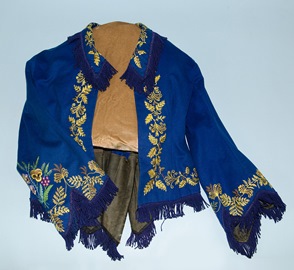 A lady’s jacket said to be worn by a Michigan resident who was at Ford’s Theatre the night President Lincoln was shot there.
 -
A tobacco pouch carried by abolitionist and women’s rights advocate Sojourner Truth, who lived in Battle Creek after the war. She traveled to Kansas in 1879 in support of the “Exodusters,” blacks who fled the South after federal troops were withdrawn at the end of Reconstruction.

To celebrate the opening of the exhibit, special activities are planned Oct. 11 at the museum. They include re-enactors and a participatory demonstration of cricket, a popular game with Civil War soldiers.
Family programming related to the exhibit will start in November and continue through next summer. For more information on the popular “Second Saturdays” program, go to www.michigan.gov/museum.
The museum and visitor parking are on the north side of Kalamazoo Street, two blocks east of M. L. King Jr. Boulevard. Weekend parking is free. General admission fees for the Michigan Historical Museum are $6 for adults 18-64, children through age 5 are free, youth ages 6-17 are $2, and seniors 65 and up are $4. Annual passes are available, and there is no admission charge on Sundays.
The Michigan Historical Center is part of the Michigan Department of Natural Resources. Its museum and archival programs help people discover, enjoy and find inspiration in their heritage. It includes the Michigan Historical Museum, 10 regional museums, Thunder Bay National Marine Sanctuary and Underwater Preserve, and the Archives of Michigan. Learn more at www.michigan.gov/michiganhistory.
The Michigan Department of Natural Resources is committed to the conservation, protection, management, use and enjoyment of the state’s natural and cultural resources for current and future generations. For more information, go to www.michigan.gov/dnr.
###
/Note to editors: Accompanying photos are available below for download. (All photos courtesy Michigan DNR.) Captions follow.
Lincoln Jacket.jpg – This jacket is said to have been worn by a Michigan woman who was in the audience for the play "Our American Cousin" at Ford’s Theatre when President Abraham Lincoln was assassinated. The jacket was worn once – that evening – and never worn again.
Sojourner Truth Pouch.jpg – This colorful tobacco pouch was carried by abolitionist and women's rights advocate Sojourner Truth, who lived in Battle Creek, Michigan, after the war. She traveled to Kansas in 1879 in support of the "Exodusters," blacks who fled the south after federal troops were withdrawn at the end of Reconstruction.
Lincoln Rosette.jpg – This rosette is said to have come from the casket that carried President Abraham Lincoln. It was donated to the Michigan Historical Museum in 1941 by the Coldwater Chapter of the Daughters of the American Revolution. The DAR chapter had received it as a donation from Dell Root Howard, a Coldwater, Michigan, native who was 8 years old when Lincoln was assassinated. It is unknown how the rosette came into her possession.
Indian School.jpg – This sign and window are from the Holy Childhood Indian School in Harbor Springs, Michigan. While Company K of the Michigan Sharpshooters, a company comprised of Native Americans, fought valiantly in the U.S. Civil War, they faced harsh treatment at home. Native American children were separated from their families and made to attend schools like this one, where they were forced to assimilate to white culture./

|
Questions? Contact Us |
| STAY CONNECTED: | ||||
 |
 |
 |
||
SUBSCRIBER SERVICES:
Manage Subscriptions | Unsubscribe All | Help