Wetlands Month featured creature: the Blanding’s turtle
Michigan Department of Natural Resources sent this bulletin at 05/30/2014 10:38 AM EDT|
Find one of Michigan's terrific turtles by exploring our Wetland Wonders. |

 |
 |
 |
 |
 |
Wildlife Viewing
Wetlands Month featured creature: the Blanding’s turtle
May 30, 2014
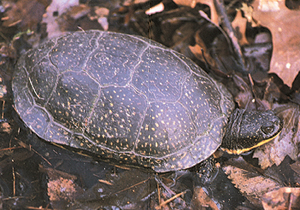 May is American Wetlands Month, a month to appreciate and enjoy the wonders of wetlands! Take some time to experience this amazing native ecosystem by visiting one of Michigan’s Wetland Wonders. There you may find one of Michigan’s terrific turtles – the Blanding’s turtle.
The Blanding’s turtle is mostly yellow and black. The carapace, or upper shell, of the turtle is domed and dark brown or black with some light yellow spots. The plastron, or lower shell, is yellow with dark blotches on the outer edges. The Blanding’s turtle has a large, dark head with a yellow chin and an impressively long neck, which it uses to reach out and catch prey.
Blanding’s turtles may be found throughout the state, except for the extreme eastern and western Upper Peninsula. A turtle of quiet water, Blanding’s turtles prefer ponds, small lakes, wetlands and slow-moving rivers. They feed on crayfish, snails, insects, frogs, fish, worms and plants. This turtle can feed on land or water, unlike most other Michigan turtles that feed in the water only.
A long-lived turtle, the Blanding’s turtle can live to be more than 50 years old. This turtle lays up to 20 eggs in June. The female sometimes travels up to a mile from water to find a sandy site in which to lay her eggs. The young hatch in August or September and must travel to a nearby water source, dodging predators like raccoons, herons and egrets on the way.
Blanding’s turtles are considered a species of special concern in the state, meaning that this turtle is becoming increasingly rare. This is mostly due to habitat loss and road mortality, as the turtle often crosses roadways to get to nesting and feeding sites.
If you come across a Blanding’s turtle in the wild, please leave the turtle where it is. Do not attempt to collect it as a pet, and please do not move the turtle. Appreciate it with a photo or a long look and then let it be, as it is a protected species in Michigan.
The Blanding’s turtle can be found at many of Michigan’s state game and wildlife areas, including Fish Point, Maple River, Allegan and Shiawassee River.
Michigan’s state game and wildlife areas are free to wildlife watchers. Hunting license fees pay for habitat management at these areas. Even if you are not a hunter in the traditional sense, consider purchasing an $11 dollar base license to help the creatures you "hunt" with binoculars, cameras and spotting scopes.
Also consider joining the Michigan Waterfowl Legacy (MWL). MWL is a 10-year, cooperative partnership to restore, conserve and celebrate Michigan's waterfowl, wetland and waterfowl hunting community. The initiative is a "call to action" to honor yesterday, engage today and build for tomorrow. To learn more about the MWL visit www.michigan.gov/wetlandwonders or look for MWL on Facebook.