Showcasing the DNR: Looking for right strain of brown trout
Michigan Department of Natural Resources sent this bulletin at 11/14/2013 02:35 PM EST


Showcasing the DNR
Showcasing the DNR was originally designed for weekly news publications, but we see benefit in sharing it more broadly. You’re invited to share these stories with friends, family and anyone you believe finds value in learning about the DNR’s efforts to better connect people of all ages to Michigan’s great outdoors and cultural heritage.
Media organizations are welcome to cut and paste these stories for use with their own readers and website visitors. Use the Internet link (at the end of this email) to access camera-ready photos (in color and/or grayscale) to supplement the story.
Thank you for your interest in Showcasing the DNR. If you would like to see past Showcasing stories, visit www.michigan.gov/dnr-stories. Questions or comments? Please contact DNR public information officer Ed Golder at (517) 335-3014 or goldere@michigan.gov.
Thursday, Nov. 14, 2013
906 words
Photos available: Yes
Looking for the right strain of brown trout
Is it possible that no one strain of brown trout is best for Michigan’s state fish hatchery system? State fisheries biologists are beginning to wonder.
A four-year research project that compares two strains of brown trout that have been stocked in a pair of rivers, a handful of inland lakes and four Lake Michigan ports, is heading into the homestretch and is preliminarily showing that neither strain is best in all situations, according to Department of Natural Resources (DNR) research biologist Todd Wills.
The DNR Fisheries Division has long used Wild Rose-strain brown trout for stocking across the state. Fisheries officials have become concerned about diminishing returns from the stockings of the Wild Rose strain, which has been in the system for many years.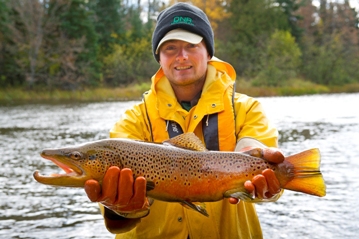 So the DNR launched an experiment in which similar numbers of Sturgeon River-strain browns, taken from wild broodstock, were stocked in various bodies of water. The fish were fin-clipped (right ventral fin clip for Wild Rose strain, left ventral fin clip for Sturgeon River browns) for easy identification. The rivers (both tailwater fisheries, the Au Sable River below Mio Dam and the Manistee River below Hodenpyl Dam) have been subject to mark-and-recapture, electro-fishing surveys – running a current through the water that stuns the fish and causes them to temporarily float to the surface – for the last four years.
“In the two tailwaters, the Sturgeon River strain is far outperforming the Wild Rose strain,” Wills said. “We’re getting better survival with the Sturgeon River fish and good growth.”
The Sturgeon River strain fish go into the river a little bit smaller than the Wild Rose strain, which has been in the hatchery system for many years and seem to grow more quickly than the Sturgeon River fish while in the system. But the Sturgeon River fish are nearly as long as the Wild Rose fish after a year in the river, showing the kind of vigor biologists like to see.
Results from the five inland lakes, however, where both species have been stocked (Bear Lake and Starvation Lake in Kalkaska County, Lake 15 and McCormick Lake in Montmorency County and Bridge Lake in Otsego County) are just the opposite.
"In the inland lakes, the Wild Rose strain fish are doing better,” Wills said.
Added DNR fisheries biologist Tim Cwalinski: ““Anglers report catching more Wild Roses than Sturgeon Rivers. That backs up what we’re seeing when we shock the lakes.”
Returns of the fish from stocking at the four Lake Michigan ports (Frankfort, Ludington, Cedar River and Menominee) have been disappointing.
“In three years we’ve only seen four fin-clipped fish,” explained Wills. “With that amount of data we really can’t say much of anything other than we’re not seeing a lot of returns to the creel. I don’t think that’s much of a surprise; brown trout have not done well in the Great Lakes in recent years. And that’s doesn’t seem to be a strain thing; it’s more likely a changing-ecosystem issue.
“We spend a lot of time and money raising fish in the hatchery and we want to know that what we’re stocking is surviving well enough and living long enough to be worth the effort,” Wills said. “The project will be finished within the next 18 months and fisheries managers should have a better idea of what they want to stock to benefit their anglers.”
In mark-and-recapture studies, DNR fisheries crews work the stream with electro-fishing boats. The fish are netted and the crew collects length and weight data, as well as noting fin clips. They take scale samples for age studies in the laboratory. Before the fish are released back into the river, fisheries workers cut off the tip of the upper edge of the fish’s tail fin.
The next day, the crew surveys the same stretch of river, noting the percentage of fish that are marked versus those that aren’t. The resulting ratio gives fisheries biologists a tool with which to estimate the population of trout in the river.
Although the data haven’t been completely worked up yet, fish with left ventral fin clips (Sturgeon River strain) far outnumbered fish with right ventral clips (Wild Rose strain) during the recent survey below the dam at Mio. And unclipped fish outnumbered clipped ones. That adds some information that the DNR never really had before.
“If you get an 18-inch brown trout with no fin clips, that could be a fish that’s from before the study started,” Cwalinski said. “But we were getting quite a few 5-inch fish that were not clipped – those are wild fish. So fish are reproducing in there. There’s probably a lot of spawning, but there’s also a lot of mortality due to high summer water temperatures. Still, some of those fish make it.”
Fisheries biologists always assumed there was little natural reproduction below the dam at Mio, where water temperatures can get quite high some summers.
“Until we started clipping fish, we didn’t see it,” Cwalinski said. “So we can finally go in there and say, ‘There’s more wild production in here than we knew.’ That’s not a bad thing. We are stocking to supplement a wild population that could probably swing up and down pretty heavily in any given year.”
The final report will not be completed until sometime in 2014. When it’s finished, you’ll be able to find it at www.michigan.gov/fishresearch. To learn more about Michigan’s fish production system and individual hatchery work, visit www.michigan.gov/hatcheries.
###
Editor’s note: Photos to accompany this story are available for download at www.michigandnr.com/ftp/OutReach/ in the folder marked "Brown trout strain study."
**Credit photo: Michigan DNR
Captions:
DSK 485 10.jpg: DNR fisheries biologist Todd Wills (left) and technician Ed Melling collect trout from the Au Sable River below Mio.
DSK 485 28.jpg: DNR electro-fishing crews turned up some large brown trout, such as the one in the net on the right, in the Au Sable River below Mio.
DSK 485 48.jpg: DNR fisheries biologists hope to find a strain of brown trout that will thrive in both lakes and streams.
DSK 485 69.jpg: DNR fisheries managers are optimistic that if they can identify the right strain of brown trout, they’ll be able to grow more big fish like this male held by fisheries technician James Zellinger.