A Lesson in Respect: Bald-faced Hornets
Michigan Department of Natural Resources sent this bulletin at 09/30/2013 11:00 AM EDT


Wildlife Viewing
Michigan wildlife viewers and enthusiasts,
Following is another in our series of stories about Michigan’s unique and wonderful wildlife species. Enjoy!
A Lesson in Respect: Bald-faced Hornets
by Doug Reeves, assistant chief, DNR Wildlife Division
I don’t believe I have ever seen a Norman Rockwell painting that includes boys standing on a gravel road with stones in hand looking up at a bald-faced hornet nest, but such a scene is about as classic “Americana” as you can get. Rockwell should have painted that scene – I doubt that there are many children who grew up on a farm or in a rural area who have not been part of one like it. Oh the lessons that are learned outdoors!
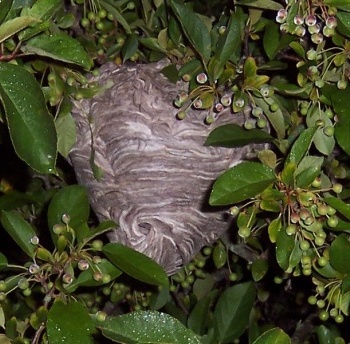 When I think of bald-faced hornets the first word that comes to mind is “respect,” and I do mean RESPECT – as in, “to avoid violation of or interference with” (American Heritage Dictionary, Second College Edition). For some people, the thought of bald-faced hornets conjures up fear. For those who have hyper-allergic reactions to stings, that fear is justified. For the rest of us, a healthy dose of respect is all that is required to live around these creatures. They don’t seek us out looking for ways to scare us or make us miserable. In fact, they kill and eat a lot of insects that we find annoying. These are not pollinating bees; they are predators!
Scientific literature indicates that bald-faced hornets aren’t really hornets – they are the largest members of the yellow jacket family. As important as those things may be in some circles, I think the things most people need to know about bald-faced hornets are that they are important to the function of ecological systems, they are insectivorous, they build “paper” nests that hang in trees and shrubs (and sometimes manmade structures), they will defend their nest by stinging an offender who disturbs it, and those stings can pack a wallop! There is no ambiguity in a bald-faced hornet sting.
Each year during my outdoor excursions, I come across several bald-faced hornet nests. Some are way up in the tree canopy, while others are only a few feet off the ground. Last week I discovered one in a small Sargent’s crabapple shrub about 5 feet off the ground, located within about 8 feet of a trail that I mow and walk frequently. I don’t expect that walking past it at that distance will elicit a defensive response on the part of the insects, so I will continue to walk by it, but I do have some concern that going by with my mower might get their attention, especially if the clippings blow in the direction of the nest. Since I have already been stung once this year while mowing in another location, I think I will just let the vegetation on that trail grow for the rest of the year, at least for 20 feet or so on either side of that nest. I do have respect for those insects.
I am not saying that every bald-faced hornet nest should be left alone. Some are in unacceptable locations, where normal human traffic will cause a defensive response by the hornets sooner or later. Because some people do have very serious allergic reactions to stings, those nests need to be removed. But I do advocate leaving them alone if they are in an area where trouble is unlikely.
There is a lot more for me to learn about bald-faced hornets. I have seen them catching other flying insects around a hummingbird feeder and wondered how they processed those insects so they could feed the larvae back in the nest. I have seen them at the base of swamp white oak trees in my woods many times, and although I have theories about what goes on there, I have so far been unable to really decipher what they are doing. I have watched bald-faced hornets work at making the “paper” covering for their nest but really don’t know where they got the material for it. I have also marveled at the interior of their nests when birds or small mammals have torn into them in the late fall. By the way, if you want to bring a bald-faced hornet nest indoors, my advice is to wait until there have been multiple killing frosts. Experience has taught me that collecting one on a frosty morning and taking it into a warm room can produce surprises when the very much alive insects get warmed up and start to explore their new surroundings!
The outdoor world is full of things to observe and contemplate. Take a walk in the forest, at a park or a state game area and observe all of the life around you. I bet you will be amazed!
How can you help wildlife and their habitats in Michigan? There are several easy ways you can help conserve Michigan's wildlife and their habitats:
- Buy a wildlife habitat license plate.
- Buy a Living Resources wildlife patch.
- Simply make a tax-deductible donation.
- Learn about creating wildlife habitat on your property.
With increased funding to the Nongame Wildlife Fund, we can boost our efforts to conserve and manage Michigan’s wildlife. Join us in protecting the natural, wild and wonderful things that make MiNature.